Showing posts sorted by relevance for query Aragon. Sort by date Show all posts

Thursday, 11 February 2016

THE TUDOR DYNASTY & THE MUSIC OF THE CHAPEL ROYAL IN 16th CENTURY ENGLAND

The exquisite vaulted ceiling and one of the many frescoes of the Chapel Royal at Hampton Court Palace


In a followup to Tuesday's post on the historic Latin Vespers Service at the Chapel Royal at Hampton Court Palace, this post will discuss what the press who reported on the monumental occasion missed.

If you found yourself clicking on the external links provided, or simply perused other news articles in print or on the web, you may have noticed an not-altogether insignificant discrepancy in the dates provided in regards to the beginning of the reformation under Henry VIII (which, as stated in Tuesday's post here on unravelingmusicalmyths.blogspot.ca began in 1534) and the last Latin Service performed at the Palace's Chapel Royal,  documented by the press as "450 years ago... in the 1550's": 

 in regards to the Latin Mass ultimus, the reference is made to the King Henry VIII and the "mid-16th century"- but the reality is, the patriarch Tudor was already dead by 1547! According to the given timeframe of "450 years ago" (from today), the 'last Latin Service' would have been employed in the year 1566 - making Henry almost a full two decades into his grave - and three successive monarchs Tudor in.

So what exactly happened to music at the Chapel Royal, and to Cathedrals and Churches across England in the 32 year time span since Henry VIII initiated reformation proceedings with the issue of Act of Supremacy in November of 1534?

Read below to find out!


The boy-king Edward VI, the only
legitimate son of
Henry VIII and his third wife, Queen
Jane Seymour, who died in less than two weeks of
Edward's birth due to post-natal complications.
Half-brother to Mary I and Elizabeth I.
KING EDWARD VI (Reigned: 28 January 1547 – 6 July 1553):

Six months into the reign of the nine-year old newly crowned King of England, the incorrigible Edward VI, under the influence of Lord Edward Seymour, 1st Duke of Somerset and the Archbishop Thomas Cranmer (the same Archbishop who aided Henry VIII in his annulment from his Queen, Catherine of Aragon and his subsequent break from Rome), both Protestants like the boy-king, would orchestrate a series of ‘royal visitations’ at the countries’ major Cathedrals (including Winchester, York, Canterbury, and Windsor) with the explicit intent to ensure ‘Popish Rituals’ were abolished. Although the minutiae of details regarding who would be made allowed to participate in the act of singing the mass and by what frequency it would be permitted varied according to church, an edict issued by the Archbishop Cranmer at Lincoln Cathedral in 1548 made the changes to both language employed and the use of ornate polyphony within the music itself unmistakably transparent. In the demand, Cranmer (and effectively, the Monarch) decreed that “the choir shall henceforth sing or say no anthems of our Lady or other saints, but only of our Lord, and them not in Latin; but choosing out the best and most sounding to Christian Religion they shall turn the same into English, setting thereunto a plain and distinct note, for every syllable one: they shall sing them and none other.”

The Chapel Royal, the reigning Monarch’s personal Church (and establishment of musicians) at court, had already introduced the first English form of the compline (the evening service) three months prior. This is of interest to note, as it was one of the first precursors of what was to become of liturgical services across the nation. The Chapel Royal, under it’s Sovereign held the distinction of immunity from the actions of reformists. Nonetheless, the conversion from Latin to English at the Chapel set a precedent for the Church of England and all major Cathedrals across the nation.[1] Within five months of the first compline at the Chapel Royal in May of 1547, the Mass Ordinary was sung entirely in English at Westminster Abbey in London.

Two years later, the Act of Uniformity would declare the English-language “Book of Common Prayer” as the ‘dictation of God’ to be used in the Church in replacement of the Latin Service books. By the time the second edition was issued, revised under the hand of the Archbishop Cranmer, music itself in regard to liturgical services was reduced to a diminutive role, considered by the ‘church’ as an unnecessary distraction, and as a result, received scant mention. As the new King, the Archbishop and members of Edward's Regency Council began whitewashing Cathedrals, stripping them of ‘Popish iconography’ - including the organs used for music - so suffered the choirs, and their choir books, which were systematically sold, destroyed and burnt.


Queen Mary I, daughter of Henry VIII & the
annulled ex-Queen Catherine of Aragon; half-sister to
Edward VI & Elizabeth I.
QUEEN MARY I: “BLOODY MARY” (Reigned: July 1553 –17 November 1558)

Edward's whitewashing and dissolution of Services according to the Latin Rite would briefly change under his successor and half sister Mary I, whose stalwart dedication to Catholicism and her invasive measures to restore it as the religion of England and it's peoples earned her the moniker “Bloody Mary” as she systematically rooted out present and ex-conspirators, enemies of Catholicism, potential threats to the throne (this period included the sad tale of Lady Jane Grey, the sixteen year-old "Nine Day Queen” – a sobriquet earned upon her execution at the command of Mary in 1554) and protestants alike for public burnings-at-the-stake. Portions of the Acts of Uniformity were overturned, organs were restored to their Cathedrals and icons returned - and by 1557, around 13 Latin Service books, hoarded in secret by citizens during the Protestant reign of Edward VI - suddenly came to light under the ‘protection’ of the Catholic Queen Mary. 

For roughly five years, Latin Order was restored, and composers were encouraged to revert to the old style of elaborate and ornate polyphony. Such works of note to come from this period were indeed composed by - and for - members of the Chapel Royal, including "Videte Miraculum"[2] and "Gaude Gloriosa"[3] by Thomas Tallis (a staple at the Tudor court, and ‘non reformed Catholic’, who would serve four Tudor Monarchs – Henry VIII, Edward VI, Mary I and Elizabeth I, respectively) and the "Cantate Mass"[4] by composer John Sheppard.

In fact, it has been written that immediately upon a thrice-echoed proclamation of “God Save the Queen!” (shouted in earnest by awaiting crowds after the announcement of Mary’s ascension to the English throne was made - at Cheapside Cross by the Lord Pembroke in July of 1553) overjoyed civilians celebrated with a ringing of bells and festivities that lasted through the evening and into the following day. They also celebrated in song: as Pembroke and various Lords of the Council walked in state to St. Paul’s Cathedral, the building’s choir was already preparing to sing a Te Deum Laudamus in honor of the Queen. Formerly stowed organs were dusted off and rolled out to accompany the music: England had not heard it’s like for nearly six whitewashed years of Edward’s reign and imposed reformations.

Such (Latin) musical festivities appear to have been celebrated nation-wide: there are multiple documented accounts of public organ playing, bell ringing and singing well up until Mary’s procession. There is even evidence English composer William Mundy’s six voice Vox patris caelestis was penned for the Queen’s pre-coronation procession, or perhaps even for the coronation itself.

Learn about Mundy’s possible connection with Queen Mary at Oxford Academic.


Queen Elizabeth I, daughter of Henry VIII &
executed ex-Queen Anne Boleyn; half-sister to
Edward VI & Mary I.
QUEEN ELIZABETH I: “GLORIANA; THE VIRGIN QUEEN” (Reigned: 17 November 1558 – 24 March 1603)

The great neutralist Elizabeth I, half-sister to Edward VI and Mary I and daughter of Henry VIII and his second wife, ex-Queen Anne Boleyn (the seductive spark that fueled the reformation’s fire under the King) herself employed Latin Services at the Chapel Royal and in her own private Services at the beginning of her reign. Under the new Acts of Uniformity, issued by Elizabeth in 1559, reformist theology and tradition would also be included into the doctrine: lessons and readings from the gospel were to be in English, and some of the Latin Rites would be suppressed - including the Elevation of the Host - in an attempt to placate Protestant zealots. This combination of half-measures, of course, did not sit well with extremists: in Easter of 1559, reformist John Jewel, who had witnessed  Elizabeth attending a Latin Mass at the Chapel Royal rebuked the Queen, declaring the “masses and all the follies and abominations of Popery [were] everywhere sanctioned by the authority of the laws.”

Elizabeth’s seemingly relaxed and neutral stance on religion was not to be taken at face value. The so-called "Virgin Queen" was notorious for her fickle indecisiveness and famously maddening ability to ride the fence on almost all major decisions affecting the State. She would, over the course of her 45 year reign on the throne of England, execute more Catholics than the Protestants killed by her late half-sister Bloody Mary and the victims of the Spanish inquisition combined. 


Footnotes:
[1]This transition, however, did not happen overnight, but rather gradually. There is some evidence that suggests the composition of additional church music in the Latin tongue during this period, including the works of composer Christopher Tye (the Quaesumus Omnipotens and Domine Deus Coelestis, among others).

In fact, for the two year span between Edward’s coronation and the indoctrination of the first edition of the English Prayer Book in 1549, it is believed most of the attendees to church would have experienced worship according to the Latin rite, using recycled music as compositions in the official Roman tongue began to phase out.

It was, naturally, at the Chapel Royal under King Edward VI that experimentation with English liturgy first occurred, eventually branching out across English churches and cathedrals at St. Paul's and Westminster Abbey, both of which performed the mass ordinary entirely in the native English tongue in suit of the Kings establishment at the Chapel Royal.

A deeper look into the minutiae of the Act of Uniformity issued in 1549 reflects a gradual transition from Latin liturgy into English:

“it shall be lawful to any man that understandeth the Greek, Latin and Hebrew tongue, or other strange tongue, to say and have the said prayers heretofore specified, of Matins and Evensong in Latin, or any other such tongue, saying the same privately, as they do understand…though it be appointed in the afore-written preface that all things shall be read and sung in church in the English tongue…yet it is not meant but when men say Matins and Evensong privately, they may say the same in any language that they themselves do understand…”

MUSIC IN THE REIGN OF MARY I:

Latin works from the Composers Thomas Tallis: Videte Miraculum[2] & Gaude Gloriosa;[3] and John Sheppard: Missa Cantate[4]

 
         Thomas Tallis, Videte Miraculum             Thomas Tallis, Gaude Gloriosa                 John Sheppard, Missa Cantate

-Rose.

Wednesday, 26 April 2017

MAYHEM BEHIND THE MUSIC X: TRIVIA & HUMOR - (LITERALLY) 'DECONSTRUCTING' MOZART & OTHER SALACIOUS SCANDALS feat. Did You Know?

It’s time for another installment of TRIVIA & HUMOR!


Today’s much overdue feature combines a veritable cornucopia of mystery, scandal and intrigue as Unraveling Musical Myths meanders through the murky mire of the macabre, resting every now and then to regale the reader with tales of mercurial madness – a frequently occurring trait we have come to know and love in our beloved maestros of yore.


“LOWLY” MUSICIAN STATUS SAVES COMPOSER’S NECK


Alleged likeness of Taverner
We begin in the mid-16th century in Tudor England, just prior to the Reformation with the composer and organist John Taverner. Considered to be one of the most important musical figures of his era, Taverner would be appointed First Organist and Master of the Choristers at Cardinal College* (named after it’s ecclesiastical founder and then-Lord Chancellor to Henry VIII, Cardinal Thomas Wolsey).

Taverner, like many an Englishman living under the notoriously volatile monarch’s reign, would find himself in a heap of trouble for allegedly possessing ‘heretical’ manuscripts – books by German theologian Martin Luther - on his person (and possibly stashed in the ‘song school,’ with the intent of teaching them to his pupils in the choir) for which the musician was promptly holed up in the college’s fish cellar (which then served as a makeshift prison until which time further punishment would be executed – pun intended). The word “allegedly” is important here – this was, after all, the most tumultuous period of Henry’s reign, during which time the King sought to have his marriage to his first wife, the Spanish Katherine of Aragon annulled in order to place future consort Queen Anne Boleyn in her stead – a notoriously rocky road for the monarch that saw a highly contested battle of power between the determined English king and Pope Clement VII, and, failing permission by the Holy See to divorce, an eventual break with Rome.

Cardinal Wolsey being counseled by King Henry VIII
Alongside his abrupt shift in power over religious matters of the State, the autocratic ruler installed himself as the Supreme Head of the Church of England, setting forth a tidal wave of reformist activity across the nation.

Accusations of heresy ran wild – whether the party was in fact guilty or an innocent offender (labeling another as a heretic was a quick and convenient way to rid oneself of their enemies in an age where one was considered guilty until proven.. well, guilty).

As it turns out, Taverner himself was a
noted reformist. Perhaps armed with this knowledge, or simply having been all-too-aware of the further punishment that his appointee would have undoubtedly suffered if left to rot in the fish cellar, Wolsey neither confirmed nor denied the accusation lobbed on the imprisoned musician, and instead, appealed quite convincingly, to the jailors’ egos by diminishing Taverner’s influence over even the meekest of students, calling him “but a musician” (then equivalent to a servant). 

Apparently, it worked. Taverner would be promptly pardoned by the Cardinal.

Listen below to a gorgeous rendition of Taverner's Dum Tansisset Sabbatum (And When The Sabbath Was Past), Performed by Alamire choir under David Skinner:


*Note: now Christ Church College at Oxford


GUNPOWDER, FIRE…ATTEMPTED MURDER?


Talk about a premiere from hell: from the blazing inferno ravaging a large portion of a specially constructed structure funded out-of-pocket by the reigning British King (some £8000 - worth about 1 million in today’s money) and which claimed two lives, to the attempted murder of the Duke of Montagu by an enraged architect (and the latter’s unsurprising - yet highly mortifying - imprisonment), Composer of the Chapel Royal George Frederic Handel’s debut performance of his suite “Music for the Royal Fireworks” would go off with anything but a hitch. 

Sunday, 7 January 2018

PARISIAN GOBBLEDYGOOK TURNS POULENC’S FIRST PUBLIC PREMIERE INTO A SUCCÈS DE SCANDALE, PAVES WAY FOR COMPOSER’S FUTURE IN MUSIC


Today, we celebrate the birth of French composer and pianist, Francis Poulenc, born 119 years ago today, the heir-assumptive to his family’s lucrative privately owned pharmaceutical company.

Poulenc, who would later become an avid soldier during the culmination of WWI (and a short stint in WWII) however, had other things in mind for his future than joining the family business.

From a very tender age, he would marvel at his mother, an amateur pianist, set atmosphere to the family lodgings with a delightful hodgepodge of both classical and simple, frolicky works - the latter, to amuse her young (and, as time would see, quite impressionable) son, of course.

Although strictly verboten by the master of the household, his father, Émile, from pursuing a life in music, young Francis would begin lessons on the piano by the age of five. Through his pre-pubescent and teenage years, young Poulenc would familiarize himself with the music of French composer Claude Debussy, the Austrian master of the lied, composer Franz Schubert (in particular his famous Winterrise cycle), and, chiefly, the scandalous (yet utterly delicious) cacophony of Russian-born, Parisian legend Igor Stravinsky’s The Rite of Spring, which Poulenc would later claim as his single greatest influence in pursuing a life in the arts – his fathers’ wishes be damned.

Spanish virtuoso pianist Ricardo Viñes
was instrumental in helping Poulenc
reach the stars.
Three years after Stravinsky and Vaslav Nijinsky caused an uproar in Paris’ Théâtre des Champs-Elysées with their deeply polarizing performance, a then 17-year old Francis delved deep into the world of music – mingling with the avant-garde poets of the day, Guillaume Apollinaire, Max Jacob, Paul Éluard and Louis Aragon - setting, in private, their texts to music. Many of these ‘practice’ pieces are said to have been later destroyed by Poulenc himself, after having been so fortunate as to being taken under the wing and tutelage of Spanish virtuoso pianist and teacher Ricardo Viñes, in whom Poulenc once revealed that he “owed everything” to the tutorship of this fine Spanish maestro. There lay some doubt as to when exactly the duo began practicing together. However it is believed Francis met with, and began his tutorship as early as 1914 – officially becoming Viñes pupil by 1916.*

The pairing of these two musicians could not have been more fruitful for young Poulenc. The virtuoso Viñes -a graduate of the Paris Conservatoire, no less - was so sought after, he was selected to premiere some of the works of leading French musical icons of the day, including works of Maurice Ravel, Claude Debussy and the ever-eccentric composer Erik Satie. Young Francis did not take his sessions with his professor lightly, and, according to the composer himself, neither did Viñes: Poulenc would later claim his esteemed teacher would was known to occasionally “rap at [his] shins” with heavily “buttoned boots” until Poulenc was able to correct his pedaling technique on the piano.

"Le Nègre au turban" by Delacroix.
Apparently, a good kick to the shin was exactly what the doctor ordered for young Francis. After just three years* under Viñes tutelage, a confident Poulenc decided he was ready or the public stage – quite literally. Unlike the riot that ensued in Paris with Stravinsky’s Rite, which drew boos, hisses, a little bit of cheering and a whole lot of drunken pummeling of thy neighbor, Poulenc’s premiere performance of Rapsodie left the audience aghast, not only by the composer’s drôle sense of humor, nor alone by the tenor who "threw in the towel" at the tail-end of the performance, refusing to sing what were known to be entirely inane, ludicrous lyrics – but also by the composer’s gall: Poulenc’s’ Rapsodie nègre, a 5-movement vocal and orchestral work for flute, clarinet, string quartet, piano and baritone, was scored by the composer during France’s love affair with “Art nègre” (African art – in particular sculpture) which began at the dawn of the twentieth century, attracting such artists from the French School as Henri Matisse, Eugene Delacroix and Pablo Picasso to

“[blend] the highly stylized treatment of the human figure in African sculptures with painting styles derived from the post-Impressionist works of Cézanne and Gauguin."[1 - see: African Influence in Modern Art - MET].


The issue with Paris’ newfound love affair with African art was a lack of knowledge of African nations, customs - and most importantly, it's vast array of languages. There was, however, at least one person who didn’t lack at least some knowledge of the many languages of the giant continent: Poulenc himself - who, like many a Parisian, browsed through the local book shops for traditional African verse that he could later set to music. He espied a book of published verses edited by Marcel Prouille and Charles Moulié: “Les Poésies de Makoko Kangourou,” allegedly written in the language of Liberian but soon discovered to be a total hoax, penned by some pranksters, and stuffed to the brim with a litany of nonsensical words, and the occasional bawdy Parisian slang!

Neverthemind, Poulenc decided – and charged full speed ahead at setting the poem to lyrical verse, deciding its either now or never – for it was during this season of the budding composers’ life, surrounded by the likes of Ravel, Satie and co, encouraged by his muse Igor Stravinsky and praised by his renowned tutor Viñes, that he had better set this new work of his to stage before he lost his nerve (remember, this would be the first public perfomance of any of Poulenc's works - as formentioned, he had destroyed all previous attempts at composition prior to meeting Viñes). Rapsodie would be the very first time anyone outside of his practice sessions would hear the music – and come to know it's creator: Francis Poulenc - le nouvel homme sur la scène.

The highly anticipated premiere would be held Dec 11 1917 at Paris' Théâtre du Vieux-Colombier. Poulenc and all who surrounded and supported him through his musical journey expected the performance to go off without a hitch – but, alack! A hitch there were a many.

The baritone assigned the vocal parts during the third and final movement was not impressed. Sure, the music was beautiful indeed, but the inane gibberish of a writer taking the mickey, soured the singers ego:

During the third movement, the baritone began to sing the malarkious ode:

"Honoloulou, pota lama!
Honoloulou, Honoloulou,
Kati moko, mosi bolou
Ratakou sira, polama!

Wata Kovsi mo ta ma sou
Etcha pango, Etche panga
tota nou nou, nou nou ranga
lo lo lulu ma ta ma sou.

Pata ta bo banana lou
mandes Golas Glebes ikrous
Banana lou ito kous kous
pota la ma Honoloulou..."

So, what exactly do those trite lyrics mean? Your guess is as good as mine.

By the fifth movement, the interlude (vocal section) was to be repeated. The boastful baritone, feeling his manlihood slip away at the beginning of each verse, suddenly “threw in the towel.” According to Poulenc himself,

“[the singer said] it was too stupid and that he didn't want to be taken for a fool. Quite unexpectedly, masked by a big music stand, I had to sing that interlude myself. Since I was already in uniform, (remember Poulenc doubled as a soldier for the French Army during this period) you can imagine the unusual effect produced by a soldier bawling out songs in pseudo-Malagasy!" [2: language of Madagascar].

Surprisingly, the audience found the whole debacle hilarious (and the gorgeous music certainly went a long way to help matters), and was declared an immediate success!


If not already queued, skip ahead in the video below to the 3:11 mark to hear the first solo - which the baritone meandered his way through, and then 8:20 to hear it repeated - this is where the singer "threw in the towel," and Poulenc himself, not exactly known nor praised for his singing abilities, ran onto the stage, still dressed in his military garb, and began to belt out the nonsensical lyrics - much to the amusement of the audience:


During his tenure as estudiante to Viñes, Francis would balance his highly prized sessions with a role in the French army during the culmination of WWI, first serving as a conscript from 1918-1921, and remaining during the immediate post war period. (He would later take up orders again as a soldier during the Second World War; serving in June 1940 in an anti-aircraft unit at Bordeaux. After France surrendered to Germany, Poulenc was demobilized from the army July 18th of that year).

During this period, the then 18 year old served a stint on the Franco-German front (during July and October 1918). Shortly following his success on the frontlines, Poulenc was assigned a series of auxiliary posts, ending as a typist at the Ministry of Aviation. These less intense duties allowed time for Francis to work on his compositions.

Ironically, Poulenc would share the same bittersweet critiques by the public and press as he had once shared privately about his mother whilst sitting cross legged on the carpet as a child, enraptured at one moment by the seriousness of her classical household performances on the piano, and gideously giggling at the more frolicky and lighter fare she would often perform - much to her son’s amusement. Rapsodie and its minor scandal so amused it’s dedicatée, Erik Satie, and fellow composers Ravel and Stravinsky, that the latter used his influence to connect the rising star with a publisher, in whom Francis would secure a contract - a gift of such great generosity - bestowed upon Francis by his musical idol nonetheless - was a treasure never forgotten by Poulenc.

As 'a whole,' the daring soldier-cum-composer Poulenc was neither loved nor hated by the press - he had a particular panache that was perhaps welcoming to the public during the hardships of war.

First impressions, however, are made to last: Rapsodie’s impromptu solo vocal by a frazzled Poulenc during the work’s finale – all whilst dressed in military garb – combined with the known fact that he had managed to make such beautiful music out of utter gobbledygook – the composer became known by the colloquial tongue-in-cheek “Leg Poulenc,” a petit maître (dandy – but yet a talented one at that) – with even the snobbiest of the snobby critics noting that that it was the composer's "good luck that the public mood was turning against late-romantic lushness in favor of the freshness and insouciant charm of his works, technically unsophisticated though they were."

The composer's fresh, "technically unsophisticated" works, and the praise lauded upon him, slightly back-handed though they may have been, soon spread across Europe. In Britain, one critic Ernest Newman  wrote of the new man about town:

 "I keep my eye on Francis Poulenc, a young man who has only just arrived at his twenties. He ought to develop into a farceur of the first order."

Indeed.


-Rose.

N.B.: I am currently busy with studies - as time permits I will re-visit this post to add all hyperlinks for easier access to related articles here at Unraveling Musical Myths.

Friday, 22 January 2016

TODAY IN MUSIC: January 22, 1575 - TALLIS & BYRD GRANTED ONE OF ENGLAND’S PREMIER PRINTING & PUBLISHING PATENTS & A 21 YEAR MONOPOLY ON POLYPHONIC MUSIC

Thomas Tallis was a member of The Chapel Royal and would serve the Tudor
Dynasty as Organist and Composer over the course of four reigning Monarchs.
January 22 is a most significant day in music for England. It was on this day in 1575 that composers and organists to the court of Queen Elizabeth I, Thomas Tallis (a long-time musician to the court of England, having served three Tudor monarchs before Elizabeth: Henry VIII, his protestant son, King Edward VI, and half-sister to Elizabeth and Edward - Queen Mary I, respectively), and Tallis’ most beloved pupil, one William Byrd, would make English history with the exclusive rights to not only print and publish the polyphonic music of which they had just been granted a 21 year monopoly, but also the right to enforce the strict prohibition of sales of any “songs made and printed in any foreen countrie(s)” in a game-changing attempt at introducing to the world - and seeking dominance in it - the English repertoire among the masses, taking full advantage of the newly improved printing press.

Tallis and Byrd, both favorites of the Queen would be made able, thanks to the patent granted them by Elizabeth, to compose and print music to be used in the church in many of the popular tongues of the period, including English, Latin, French and Italian. Even further. the musical duo were the only composers permitted to use the paper on which music was printed!

William Byrd was once a star pupil of Tallis.
These grants came at an interesting time in British History. By the time Tallis and Byrd had received oligopoly over polyphonic music in 1575, England was already well into the throes of Religious Reform. Elizabeth had already sat some 17 years on a throne which had seen varied states of religious upheavals, revolts and reversals in her predecessors Tudor. Her notoriously fickle father Henry VIII had been the major catalyst behind the secular divide of Catholics and Protestants when he, following his infamous break from the church of Rome some two decades prior in order to legally divorce his wife and reigning Queen Catherine of Aragon and marry protestant Anne Boleyn in her stead), chose to set into motion the Act of Supremacy in 1534 in which he declared himself to be the ‘Supreme Head on earth of the Church of England’. With the advent of Martin Luther and his translated biblical texts into English, Europe - already on the brink of a series of religious civil wars across the continent - armed with this new, powerful public backing from an otherwise formerly neutral world leader, would find it’s citizens re-ignited by the already flickering spark of revolutionary spirit.
 
Protestants and Catholics alike would endure extremely violent, dogmatic reigns under the Tudor dynasty, reigns that would include instated Queen’s heads rolling off the chopping block, to executed ministers, archbishops and common reformists alike. Catholic churches would see themselves whitewashed and stripped of ornamentations in both ‘décor’ (icons) and in liturgical service (music; the ‘making of the cross’ on one’s chest) and replaced with the relatively conservative services of the Protestants, only to be violently undone and to have all ornamentations restored under the conditions of Catholicism during the reign of Mary I just prior to Elizabeth’s accession to the throne.

Music went through much change as the denominations of Christianity rapidly fluctuated, and, under Elizabeth, Tallis - who had been a constant at the Tudor court over the course of three monarchs and now on his fourth - would adjust the music of the Chapel Royal accordingly:

during the periods of Catholic flourishment, the highly ornamental and embellished polyphonic music consisted of rich and elaborate harmonies sung by multiple voices reminiscent of the music of the Renaissance era, while during the Protestant rise and wane, the rich and elaborate would be replaced by the softer, muter, more simple practices of singing with only ‘one syllable per note’ (as envisioned by one archbishop Cranmer), with emphasis placed less on aesthetic structure and more on the transparency of the texts that accompanied the compositions themselves (elaborate ornamentations being considered too 'Popish' for Protestant ears).

Elizabeth I as she would have appeared
in 1575, pictured here in the so-called
"Pelican Portrait" by painter
Nicholas Hilliard.
Elizabeth, having previously bore witness to the divide amongst the subjects of both herself and her predecessors, sought a more neutral approach in religion and it’s use of music, seeking to placate zealots on both sides of the religious divide by instituting her own Act of Uniformity in 1559, which included the 'Ornaments Rubric' clause: the ultimate royal show of religious compromise which would allow the Queen to retain for the Church of England traditional Catholic ceremonies, such as the ‘making of the cross’ at baptisms, and the adornment of the surplice and the cope amongst the clergy, while the doctrine of the Church itself would remain Protestant in nature. Accordingly, she would adjust, through her grant bestowed upon Tallis and Byrd in 1575, the rich polyphonic music of the old (Catholic) church with the new, more simple sound of the protestant choir, creating a uniquely English hybrid of vocal repertoire that, while initially facing public scorn via the religious fanatics of the ever-tumultuous period, would introduce into Europe a ‘Golden Age’ of Elizabethan music – one that continues to astound and astonish audiences around the globe to this day.

Listen below to two of the thirty-four motets composed by Thomas Tallis and William Byrd from the Cantiones quae ab argumento sacrae vocantur – a collection of compositions dedicated to Elizabeth's 17th year on the throne of England (accordingly, each composer contributed 17 pieces each to the mammoth work to represent each year of their beloved Queen's Reign), and in thanks for granting them the Printing Patent in 1575. This collection was the collective composer’s first work under the Monopoly.

#26, In Jejunio Et Fletu (in Fasting and Weeping) by Thomas Tallis:


#12, O Lux, Beata Trinitas (O Trinity of Blessed Light) by William Byrd:


- Rose.


Friday, 24 March 2017

A MOST ROYAL COLLABORATION: 6TH WIFE OF KING HENRY VIII CATHERINE PARR NAMED LYRICIST FOR TALLIS’ ‘BATTLE PRAYER,’ SET TO DEBUT IN LONDON, IN ENGLISH, UNDER ORIGINAL AUTHORSHIP (LAST PERFORMED IN THE CITY MORE THAN 470 YEARS AGO) feat. Did You Know?

Tudor fans in London will be treated this Easter season with a historic performance in English of 16th century composer and Gentleman of the Chapel Royal Thomas Tallis’ “Gaude Gloriosa Dei Mater,” a so-called “prayer for battle” penned by the composer sometime after 1544 whilst in the service of King Henry VIII.

The English-language version of the nearly 5 century’s old composition was first brought to the attention of both musical and monarchial spheres in 1978, when the manuscript was discovered tucked inside of a cavity behind the plastered walls of Oxford’s Corpus Christi College. It has since undergone much scrutiny by scholars in regards to the date the music was written and for which English Monarch – King Henry VIII, or his daughter by Katherine of Aragon, Queen Mary Tudor. Researchers in favor of Mary cite the prevalence of like-Marian votive antiphons made popular during the Queen’s reign (a much frequented source of propaganda for the Monarch which conveniently contrasted both Mary’s - the Blessed Virgin Mary, and the exalted Queen Mary on earth – in the minds of loyal subjects; and a musical format of which composers living in Mary's time would often use to their advantage). Researchers in favor of Henry VIII note the unusual presence of an English text for the music – a practice most uncommon for such a composition – likening it to the newly protestant services mandated by the King’s son and future monarch, Edward VI. Supporters of this theory date the music to the late term of Henry VIII, and believe the work’s lyrics to have been translated from their original Latin into English just prior to the ascension of the royal heir.

Such has been the lyrical controversy for the past four decades – that is until very recently, when one eagle-eyed Cambridge scholar noticed a direct match between the text of Gaude Gloriosa Dei Mater and a particular psalm authored by English Queen Catherine Parr sometime in 1544. Parr’s ninth psalm “Agaynst enemies” was part of a larger work penned by the former Monarch during her marriage to King Henry VIII – a book of "Psalms or Prayers" which the Queen had published (as an English translation of a Latin devotional text penned by Catholic Saint John Fisher) in support of her royal husband’s highly contested campaign against the French.

Henry VIII's sixth (and final) wife, consort Queen of
England and Ireland Catherine Parr.
According to David Skinner, the director of music at Cambridge’s Sidney Sussex College (and the scholar who made the recent royal attribution), the King sought to rally English support and instill zeal, telling reporters

 “Henry wanted the people to rise up and ‘pray’ him into battle, as later that July he was to lead his armies at the Siege of Boulogne…”

But in order to accomplish such a feat, Henry would have to replace the use of traditional Latin litany and prayer – incomprehensible to most outside of the clergy – into a language that could be understood even by the “common man.” For this, it seems Henry would turn to his then-wife – ardent supporter of the King and skilled linguist Catherine Parr. The Queen certainly delivered – Parr’s translation of Fisher’s text is aptly described by Skinner as both “searing and wrathful… very much at odds with the original devotional nature of the Latin.”

He cites an example of Parr’s text:
“[C]ast them down hedlonge, for they are treatours & raybels agaynst me … let the wicked sinners returne in to hell”
Further lending support to Skinner’s conclusion of Royal authorship lay in the books’ penultimate and final prayers, entitled “A prayer for the King” and “A prayer for men to say going into battle,” both of which give credence to the notion that Gaude Gloriosa Dei Mater was indeed composed much prior to Mary's ascension to the throne in 1553 - likely during the latter half of King Henry VIII's reign, when England was embroiled in a bitter war with both Scotland and France.

Indeed, it is easy to imagine the gusto that must have been felt by English troops as they rushed into battle, armed with this fully comprehensible, and supremely aggressive anthem freshly ingrained in their minds.

The Gaude Gloriosa Dei Mater is set to premiere in London, both under its correct authorship, and in the English tongue for next month’s Holy Week (from Palm Sunday on the 9th to Holy Saturday on the 15th). The Alamire choir (of which Skinner is director) is slated to perform.  Click here for more details.

Listen below to Tallis' Gaude Gloriosa Dei Mater, in it's original Latin form:


Did You Know?

No one really knows with any certainty what Thomas Tallis looked like - the famous engraving of the composer (left) dates from the mid-18th century, and is nothing more than the product of one artists' perception (i.e. imagination). There are no official portraits of the composer that survive.

 
Learn more: 
  • article (with images of manuscript) at the Telegraph 
  • David Skinner's published findings, Aug 2016 at Oxford Academic (*membership/purchase)

-Rose.

Friday, 19 May 2017

PAST MEETS PRESENT: 16TH CENTURY QUEEN ANNE BOLEYN BEHEADED ON THIS DAY AT TOWER GREEN; LONG FORGOTTEN ROYAL MUSIC BOOK UNEARTHED AND RECORDED TO THE DELIGHT OF 21ST CENTURY TUDOR ENTHUSIASTS

An assumed portrait of Anne Boleyn. The
so-called "Nidd Hall portrait," currently held
by the Bradford Art Galleries and Museums,
was linked to the former English monarch in
2015 after undergoing facial recognition by
state-of the-art equipment at the University
of California in Riverside. Portraits featuring
the likeness of the Queen were famously
rounded up and destroyed after her execution
in 1536 in a concerted effort to erase the
Queen from present and future history books.
To date, the only confirmed likeness of Boleyn
exists on the "Moost Happi" medal, pictured here.
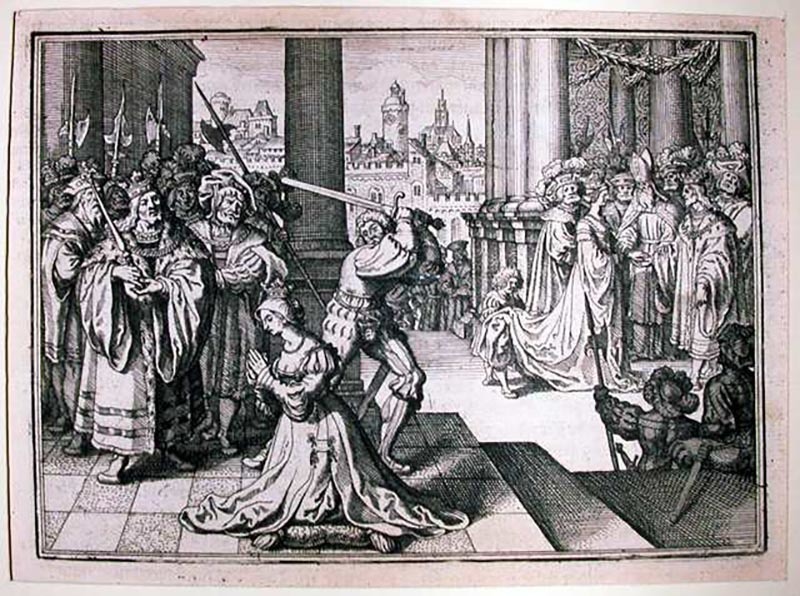
481 years ago today, a regally dressed woman, who truly needs no introduction, knelt before a crowd of her peers on London’s Tower Green, moments after beseeching of them their prayers for the prosperity of her Sovereign lord: that ‘goodly’ King of England, Henry VIII of whom she was now divorced – that possessor of the fatal hand who executed her death warrant. That accuser of witchcraft, adultery – and most horrifically, of incest.

Draped in a cape of ermine fur – a style formerly designated to reflect the status of her (once) most exalted station - the woman who would die a "Queen” to her allies – and a "concubine" to her enemies,[1] wavered momentarily during her cry of adulation for her single greatest foe – her one time lover and life partner who had so callously cast her aside for one of her very own ladies-in-waiting. Readily, Anne Boleyn steadied the quaver in her throat – perhaps distracted by delusions of an 11th hour reprieve - before succumbing to a trembling bout of nerves. Submitting to that all-too-late and momentary cold slap of reality, she darted a fearful glance over her shoulder at the finely dressed Frenchman from Calais, who stood just behind her. Perhaps the dethroned monarch expected to faint away fast at the sight of the glistening blade of a freshly sharpened sword steadily arching toward her "fair neck"[2] - saving her from the spectacle of being caught unawares, and from crying aloud and thereby dismantling before the several thousand spectators[3] who had gathered to witness the unusually restrained demeanor of the royally condemned. What Anne Boleyn saw instead was the unmasked face of her husband’s hired assassin. It was a kind face: one that bespoke of generous and thoughtful consideration for her untimely plight. He would strike, he warned the former queen, only after giving her fair warning. It would be just one of the many lies cast upon the former monarch in an effort to both placate her and assuage her fears.

It would also be the last.

As the regal woman, once formerly Queen of England began reciting a prayer for the Lord to receive her soul, the swift arc of the expertly yielded blade sliced though the neck of Anne Boleyn. So precise was the cut by the assassin from Calais, the very lips on the now severed royal head appeared to continue on reciting the condemned's solemn prayer.

A 19th century  German illustration depicting the execution of former
English Consort Queen Anne Boleyn, c. 1830. The doomed monarch was
beheaded 481 years ago today - exactly - May 19th, 1536, which just so
happened to also fall on a Friday.
The rise and fall of Anne Boleyn, consort and second wife to 16th century King of England Henry VIII is the stuff of legend. Her tragic fate has inspired countless poets, screenwriters, librettists and authors to convey her story (as they see it). Perhaps the most famous ‘retelling’ of the plight of the much maligned queen – where the arts are concerned, lay in Italian composer Gaetano Donizetti’s 1830 tragic opera “Anna Bolena,” a two-act composition so titled after it’s namesake.

But much of what we think we know of the Queen is part and parcel of that age-old adage that decrees that the truest version of history lay with the victor - and Anne certainly had her detractors. In fact, we aren’t really sure if the famous last words of the former Queen (in which Boleyn never once admits to any guilt for the offenses charged against her) - as retold by Edward Hall, an English member of Parliament and Under-Sheriff of London - were actually spoken by Boleyn, or were the half-manifested product of the Officer’s imagination – or worse – false recall, politically motivated or not.

The Tudor propaganda machine, historically, had been one of the most heavy-handed, stalwart mechanisms that often succeeded by churning out defamatory accusations against anyone who stood in the way of - or threatened - the royal crown (including consorts) often by means of torture, the threat of torture, or by exacting the ultimate form of punishment: the public execution. Thus, it is with great difficulty for historians of the era to discern with any fair degree of certainty the fact from the fiction – even concerning the smallest minutiae of the lives of their victims. That doesn’t make the lives of those living under the royal yoke of the renaissance any less interesting. Quite by contrast, it ignites a very constant, almost universal fascination with the attempt to uncover the truth.

Such an example of this fascination – where Anne Boleyn is concerned – occurred only recently, in 2015, when researchers brought to light a 16th century musical scrapbook containing the works of several highly prized Franco-Flemish composers, said to have been signed by – and possibly even owned and compiled by - the Queen herself: the most interesting scores in the lot being those pieces of anonymous authorship – one of which (“O Deathe rock me asleep”) may have been composed by Boleyn herself as she effectively sat on death row, awaiting her final exit from both her former realm and the worldly sphere.

Inscription from the music book bearing Queen Anne Boleyn's signature
The loosely binded (ravaged by the hands of time) 42-piece scrapbook, now preserved at The Royal College of Music, London, bears the inscription “Mistres ABolleyne nowe thus” followed by a portion of musical notation.

Scholars of the era have suggested the styling of “mistres[s]” as being indicative of the former consort’s time as concubine to a married Henry VIII, who was then famously wed to the unfortunate Spanish Queen Katherine of Aragon - “nowe thus,” they remind us, was the motto of father to Boleyn, Thomas Boleyn, 1st Earl of Wiltshire. They believe mistress Anne started the book during her time in France as maid of honor to Henry’s sister Mary, and later, to Mary’s stepdaughter, Queen Claude. It was in France that Boleyn is believed to have immersed herself in the courtly arts, chiefly, in the areas of manuscript illumination, literature, poetry, and music. Like her future daughter with King Henry, Elizabeth, Anne is said to have mastered playing – and possibly composing music for – the lute.

Therein lies the supposition that it was Anne who authored not only the lyrics – but possibly even the music for Deathe rock me asleep, which reads most languorous:

“O Deathe rock me asleep
Bringe me to quiet rest

Let pass my weary guiltless ghost...

For I must dye, there is no remedy.”


A beautifully notated selection from the scrapbook said to have belonged to Anne Boleyn

Upon it’s discovery, some 500 years after the scrapbook’s final entries were sewn into the fragile binding, Director of Music at Sidney Sussex College (Cambridge) and head of the Alamire choir (named after the 16th century royal composer and spy, Petrus Alamire of Bavaria) Dr. David Skinner selected 20 pieces of music from the tome – many of them by renowned artists of the era, possibly known to - or, as in the case of French composer Josquin Desprez, patronized by Boleyn herself – and recorded them for the pleasure of modern ears.

Included in those recordings – for which Skinner earned Best Vocal & Choral CD of 2015 for Australia’s Limelight Magazine and a nomination for the coveted Best Album award by BBC Music Magazine – is the mysterious and doleful lament…that just maybe among those so-called “known” final words - and thoughts - of Queen Anne Boleyn herself.

Listen to a recording of O Deathe Rock me Asleep below, followed by a delicious recording by a Boleyn favorite composer (and recipient of the Queen’s royal patronage), Josquin Desprez, in the 16th century composers’ setting of “Stabat Mater" (Dolorosa): *UPDATE / NOTE 12.26.17: Much of the Alamire/Skinner album unfortunately is no longer on YouTube, however listen below to the piece"O Deathe.." performed by Mezzo-Soprano Catherine King and the Rose Consort of Viols, and, in lieu of the now removed Dolarosa by Desprez, I am replacing the latter with the composer's "Praeter rerum seriem," which is included in Anne's Song Book and is recorded by the Alamire Choir under Skinner:


Footnotes:

[1] The harsh epithet was famously so lauded on the now decapitated Queen by the Catholic Imperial ambassador to Emperor Charles V, Eustace Chapuys, who messengered the following note to his employer (excerpt): “The execution of the concubine took place at nine o’clock this morning in the tower…"

[2] Boleyn famously referred to her “fair (little) neck” in an exchange with her jailor, Constable of the Tower Sir W. Kingston. True or fictitious as the account may be, it does lay small credence to the notion that the Queen approached her death in an ‘unusually calm' manner. From Kingston’s letter to Thomas Cromwell, dated the day of Boleyn’s execution, May 19, 1536:
“This morning she sent for me, that I might be with her at such time as she received the good Lord, to the intent I should hear her speak as touching her innocency alway to be clear. And in the writing of this she sent for me, and at my coming she said, "Mr. Kingston, I hear I shall not die afore noon, and I am very sorry therefore, for I thought to be dead by this time and past my pain ". I told her it should be no pain, it was so little. And then she said, "I heard say the executioner was very good, and I have a fair neck", and then put her hands about it, laughing heartily. I have seen many men and also women executed, and that they have been in great sorrow, and to my knowledge this lady has much joy in death. Sir, her almoner is continually with her, and had been since two o'clock after midnight.”

[3] Also from Chapuys' account to the Emperor Charles V "...the thing was not done secretly, for there were more than two thousand persons present.”

-Rose.

Sunday, 7 June 2020

A QUINCENTENNIAL REFLECTION ON A MAJESTIC ROYAL SUMMIT: THE 500TH ANNIVERSARY OF THE MEETING AT THE FIELD OF CLOTH OF GOLD

The Field of Cloth of Gold, British School, c. 1545 (probably commissioned by Henry VIII in remembrance of his glory days). Click on image to enlarge & view footnotes to learn more | Royal Collection Trust
It was on this seventh day of June, exactly 500 years ago today that two great kings met on neutral territory for an embrace - one which would mark the commencement of a lavish, 18-day celebration, giving birth to one of the most extravagant royal summits the Western world had yet seen. The Royal Embrace took place in a shallow valley in Balinghem (later called Val d'Or), an equidistant between Ardes in France and Guînes in the then-English controlled Pale of Calais.

A young King Henry VIII,
c. 1520, anon
The power players: a young King of England - Henry VIII - then only 28 with just 11 years on the throne, and the newcomer to the throne of France: 25 year-old François I, who had only become its monarch just five years prior.

The objective of the meeting of the sovereign minds was to put an end to the seemingly never-ending conflict between the two historically rivaling kingdoms, with the overall hopeful aim of creating peace between all Christian nations.

The summit was orchestrated by the legate of England, Henry's alter rex, Cardinal Thomas Wolsey. The King's Principal Councilor had shifted England to the forefront of those commendable nations skilled in diplomacy just two years earlier by drafting the Treaty of Universal Peace (otherwise known as the Treaty of London), a non-aggression pact co-signed by the representatives of the chief nations in Europe. A peaceful - and very public - meeting between the two Kings would go a long way toward reaffirming this newfound alliance.

A young François I, Roi de France, 
c. 1515, Jean Clouet
It would be an extravagant affair, with no expense spared by either boastful King. Each respective nation saw their royal coffers bursting at the seams, with France dishing out 400,000 livres (1/8 of the state's annual budget) on the 18 day event, and with Henry doling out a staggering £36,000 - more than 1/3 of England's annual income of £90,000.
 
The funds, in the eyes of the English and the French, were, at least for the moment, not spent in vain: although touted as a diplomatic affair, the summit provided a prime opportunity for both monarchs to display the wealth and power of each respective kingdom through a grand spectacle of pomp and circumstance. Indeed, the festivities and tournaments to be held at the Field of Cloth of Gold were, at their very core, a brazen display of ego, brawn, and one-upmanship.

English grandeur was majestically displayed through the erection of a temporary palace by Henry's reception. The brick-based, painted canvas structure sat on timber frames. Covered in gold and encrusted in colorful gemstones, the magnificent work of art was meticulously painted to mimic stone laid by the most skilled of masons. The structure was replete with panes made of real glass and with an oiled "slanted roof," which, if caught juste comme ça by the glint of the shimmering spring sun, gave spectators the illusion of finely laid slates.

The "palace" covered a massive area of some 12,000 square yards (10,000 mi²). Henry's display of luxury prompted one French spectator to label it "more precious than the amphitheatre of Caesar." 

Unquestionably the grandest of the structures at the Field of Cloth of Gold: Henry VIII's magnificent temporary 'palace.' Each side of the faux castle measured 100 m long. Expertly painted in trompe-l'œil style to give the illusion of finely laid masonry and tile, real glazed windows were installed to add an extra realistic touch. So numerous were these panes, the French dubbed the structure "The Crystal Palace." A large courtyard sat in the middle of the structure. Directly in front, at R, stands a massive fountain overflowing with beer and red wine. Both nations brought an excessive amount of libations to the festivities: the English alone provided the equivalent of 266,000 bottles of wine and 132,000 bottles of beer.
(Click on image to enlarge) | Royal Collection Trust
Included among Henry's massive retinue were gifts from the Ottoman Sultan Selim - two royal monkeys covered in gold leaf. 

For François' part, some 400 tents were erected, comprised of velvet and woven with thread of gold (giving rise to the coinage for the occasion, "The Field of Cloth of Gold"). The tents, which were considered by one eye-witness as being "more sumptuous than the pyramids of Egypt" were resplendent with decorative coats of arms and standards. François' tent - by far the largest and most grand of the lot - was "guarded" by a life-sized statue of the archangel Saint Michael.

Like his English counterpart, the French king traveled to the valley with a throng of high ranking noblemen, each of whom would display in a series of friendly tournaments against the opposing nation their skills in royal sport: as jousters, archers, and swordsmen - the two kings even partook in the recreations, famously challenging one another to a wrestle (which Henry lost).

Tapestry depicting wrestlers at The Field of Cloth
of Gold.  A bearded King François can be seen
observing the pair above R, directly beneath him
drapes an actual cloth made of gold. ca. 1520 
(Click on image to enlarge)
As beer and wine flowed from the spouts of massive fountains, cleansing the palates of those men and women gathered for the 18 days of festivities, music chanted, piped and strummed its way into the ears of the European elite, setting a jovial atmosphere among lavish banquets and friendly competitions.

Each occasion, attended by the accepting of a formal invitation - the English requesting the company of the French, and vice versa - was a scene of grandiose spectacle. Feasting was no exception: inside the lavishly decorated 'dining hall' stretched a lengthy table (which could seat 200) from which men and women of high rank drank heartily (from a five-spouted fountain which flowed for five consecutive hours with copious amounts of red wine, no less) and supped on repeated courses of royal-standard cuisine - sheep, swan and porpoise - freshly served up on plates made of gold. According to one nobleman in attendance, "the abundance of food and wine being so great the people choked themselves."

A rousing time was had by all - even the French King François, following the completion of what would have been a massive meal, took to the dance 'floor,' taking the hand of the lady Monpezat, the inamorata of a hostage gifted to the French King by the English (long touted as the most beautiful of the land) and began to dance in the "Italian manner" to the sound of French fifes and trombones, brought in by François for the special occasion.

 Tent of François I. The massive structure stood some 120ft tall, draped in cloth of gold and
adorned at its peak with a 6ft tall gilded statue of St. Michael, patron saint of France. Directly in
front, English and French retinues observe the royal embrace. Click to enlarge | Royal Collection Trust

The English Consort, Queen Katherine of Aragon, was also in attendance, as was a heavily pregnant Queen Claude,[1] both taking in the majestic and resounding din of English trumpets. Collectively, over the course of the lengthy summit, the privileged company enjoyed the euphonic sounds of the tabor, pipe, and viol.

Henry's musicians would be led by the multi-skilled Master of the Children of the Chapel Royal, William Cornysh, whilst the esteemed Jean Mouton led the French musical efforts (those also in attendance included Robert Fayrfax of England and a young Claudin de Sermisy of France), as each nation sought to outdo one another, not only in sport but also in song.
 

Fueling the competitive spirit which coursed through the festivities, a now infamous, musical "duel" was issued as a challenge between the two kingdoms. Musical representatives from both kingdoms performed a series of the most lavish motets, culminating on the 24th of June with the celebration of High Mass, with choirs and musicians from both England and France being heard, each in their own turn, pitting against one another the highly virtuosic vocal stylings beloved by the English against the wind-infused style of sacred music for which France was renown.

Inside a specially constructed wooden chapel covered in an exquisite tapestry of gold (and furnished inside and out with gold and jewel encrusted ceremonial objects of such magnificence that even the Pope himself would blush) "the singers of the Kings of France and England...loudly and sumptuously sung."

The English began by intoning the Terce and first Introit - the French choir responding with the second, in addition to the Kyrie. Choristers from both nations continued to sing, one after one another in this fashion until the completion of the Mass.


Above: A "re-creation" (playlist) of the High Mass (preceded by an anonymous English pavane) that may have been heard at the final Mass at the Field of Cloth of Gold. Compiled by Denis Raisin Dadre and performed by the Doulce Mémoire ensemble, these selections pit English settings of the mass against the French, and include a Kyrie by French composer Claudin de Sermisy, who attended the festivities (track no. 4 in the playlist) and a stunning Gloria by English composer Nicholas Ludford (track no. 6). Over the course of Henry's reign, the number of musicians employed by the royal court swelled to 58, and included members from Italy and the Low Countries. Unlike royal patrons of musicians past, Henry did not view those in his employ as mere serfs or simple commoners. The monarch, as a skilled composer and musician himself (and one who almost constantly wanted music performed around him) paid those in his service well, and even surprised them with gifts and holiday bonuses. The king's most esteemed musician, Robert Fayrfax, who had been made a Gentleman of the Chapel Royal under Henry's late father, king Henry VII, was treated especially well - Henry VIII granted the composer a £9 annuity (roughly £6,000) on a farm in Hampshire at the onset of his reign in 1509, and five years later granted him the title of a 'Poor Knight of Windsor' - a distinction which earned the composer a lifetime salary of 12 pennies per day (a not-insignificant sum for a musician earning a living in the 16th century). In one particularly generous gesture, the grateful king dished out £20 (equivalent to over £13,300 today) to Fayrfax in exchange for a "pricksong book" (a printed book of part-song or accompanied vocal music). The distribution of this largesse on behalf of the crown was in addition to the wages Fayrfax earned as a salaried member of the Chapel Royal.

As the Service drew to a close, the assembled crowd gazed towards the heavens, where high above the festivities, flew the final gift from Henry to François: a massive kite in the shape of a dragon, which soared across the sky, traveling from Ardres to Guînes. It was a glorious sight to behold: fully loaded with an arsenal of pyrotechnics, witnesses recount blazingly bright eyes on the makeshift creature, which audibly "hissed" from the mouth with each carefully timed firework detonation. The stretched canvas on wood flying art piece was an amalgamation of François’ salamander emblem and Henry’s Welsh Tudor dragon, thus uniting both symbols of majesty together, in a touching and symbolic gesture of peace.

Above: detail of the kite gifted from Henry to François (Click on image to enlarge) | Royal Collection Trust

The costly spectacle at what would become known as the Camp du Drap d'Or, in the long run, did little to secure any semblance of lasting peace as promised by the summit's message of an international camaraderie among Christian states, as exemplified by (what should have been) a newfound, and persisting alliance between England and France.

The historical rivals, who had come together on that balmy June evening in 1520, seeking to make amends for their most recent series of diplomatic disasters (the English invasion of France in 1513, and the co-signing of a peace treaty by the powerful Emperor Maximilian I and François following the latter's success at the Battle of Marignano) would find themselves back at each other's throats just one year following the now infamous summit at the Field of Cloth of Gold, when the two sides once more engaged in battle. 


With both kings still in the prime of their youths and both brooding with high ambitions of power, the friendly "warfare" that took place at Calais would again become all too real as blood once more began to spill across European sodded fields. What started with a warm embrace would thus find its end as little more than a footnote in the annals of international diplomacy: as a brief - and extremely costly - period of blissful détente among natural enemies.

N.B.,

Whilst much has been written about this momentous occasion and many contemporary accounts survive, little is known in regard to the specific music performed at the Camp du Drap d'Or. A brief reference to a "Perino" - an otherwise unknown composer - was referenced by the Mantuan ambassador at the court of France, although scholars reject this conclusion, relegating it to a mis-translation of the original tongue. Whether Wolsey, who is widely noted as having "said Mass" in fact sang during the service is likewise a matter of (modern) conjecture, although it is believed Robert Fayrfax did participate in the choir. Festive music would have included the then-fashionable French chanson and the English pavane, in addition to instrumental folk music, employed by the use of the pipe and tabor, as was common during celebratory occasions during both the medieval and renaissance eras.

Contemporary reports are extant - many of which can be found, in lavish detail, in the Calendar of State Papers and Manuscripts, Relating to English Affairs, vol. III, as seen, and bookmarked for the reader below:


Above: digitally archived copy of the third volume of the Calendar of state papers and manuscripts, relating to English affairs existing in the archives and collection of Venice, and in other libraries of northern Italy.  Click here to read directly on archive.org.

The reference to "Perino" occurs on page 75 proper (244 on the above archived digital copy). It reads thusly:
"The choristers of the two chapels of France and England sang this mass; the music by Perino, accompanied by an organ, with trombones and cornets" ("E la musica de Perino, tromboni e cornetti")

Footnotes:

[1]Included among the French consort's retinue was a ~19 year old Anne Boleyn, (b. ca. 1501 - 1507) who served as translator to Queen Claude. Anne had previously served as maid of honor to Henry VIII's sister Mary during the latter's marriage to Louis XII of France in October 1514, and later, through the same royal connection, she would repeat the privilege, serving as maid of honor to Mary's 15-year old stepdaughter, the aforementioned Queen Claude. The future English Queen would remain in the household of Queen Claude for some seven years. Anne would make her fateful journey from Calais into England just two and a half years following the summit at the Field of Cloth of Gold, where she would eventually wed Henry VIII, effectively becoming the second Queen of England under his rule in 1533. It was a role that would be tragically short-lived: Anne would be executed at London's infamous Tower Green just shy of three years into her reign in May of 1536.

*The painting seen at the top of this post, The Field of Cloth of Gold, was probably commissioned by Henry VIII in remembrance of his glory days. The stunning piece depicts multiple events which occurred over 18 days during the festival. Henry can be seen twice - in the lower left foreground on horseback, and in the central background, in front of the tent of the French king - commemorating his procession and the royal embrace at the Val d'Or, respectively.
- Rose.