Showing posts sorted by relevance for query Boleyn. Sort by date Show all posts

Friday, 19 May 2017

PAST MEETS PRESENT: 16TH CENTURY QUEEN ANNE BOLEYN BEHEADED ON THIS DAY AT TOWER GREEN; LONG FORGOTTEN ROYAL MUSIC BOOK UNEARTHED AND RECORDED TO THE DELIGHT OF 21ST CENTURY TUDOR ENTHUSIASTS

An assumed portrait of Anne Boleyn. The
so-called "Nidd Hall portrait," currently held
by the Bradford Art Galleries and Museums,
was linked to the former English monarch in
2015 after undergoing facial recognition by
state-of the-art equipment at the University
of California in Riverside. Portraits featuring
the likeness of the Queen were famously
rounded up and destroyed after her execution
in 1536 in a concerted effort to erase the
Queen from present and future history books.
To date, the only confirmed likeness of Boleyn
exists on the "Moost Happi" medal, pictured here.
481 years ago today, a regally dressed woman, who truly needs no introduction, knelt before a crowd of her peers on London’s Tower Green, moments after beseeching of them their prayers for the prosperity of her Sovereign lord: that ‘goodly’ King of England, Henry VIII of whom she was now divorced – that possessor of the fatal hand who executed her death warrant. That accuser of witchcraft, adultery – and most horrifically, of incest.

Draped in a cape of ermine fur – a style formerly designated to reflect the status of her (once) most exalted station - the woman who would die a "Queen” to her allies – and a "concubine" to her enemies,[1] wavered momentarily during her cry of adulation for her single greatest foe – her one time lover and life partner who had so callously cast her aside for one of her very own ladies-in-waiting. Readily, Anne Boleyn steadied the quaver in her throat – perhaps distracted by delusions of an 11th hour reprieve - before succumbing to a trembling bout of nerves. Submitting to that all-too-late and momentary cold slap of reality, she darted a fearful glance over her shoulder at the finely dressed Frenchman from Calais, who stood just behind her. Perhaps the dethroned monarch expected to faint away fast at the sight of the glistening blade of a freshly sharpened sword steadily arching toward her "fair neck"[2] - saving her from the spectacle of being caught unawares, and from crying aloud and thereby dismantling before the several thousand spectators[3] who had gathered to witness the unusually restrained demeanor of the royally condemned. What Anne Boleyn saw instead was the unmasked face of her husband’s hired assassin. It was a kind face: one that bespoke of generous and thoughtful consideration for her untimely plight. He would strike, he warned the former queen, only after giving her fair warning. It would be just one of the many lies cast upon the former monarch in an effort to both placate her and assuage her fears.

It would also be the last.

As the regal woman, once formerly Queen of England began reciting a prayer for the Lord to receive her soul, the swift arc of the expertly yielded blade sliced though the neck of Anne Boleyn. So precise was the cut by the assassin from Calais, the very lips on the now severed royal head appeared to continue on reciting the condemned's solemn prayer.
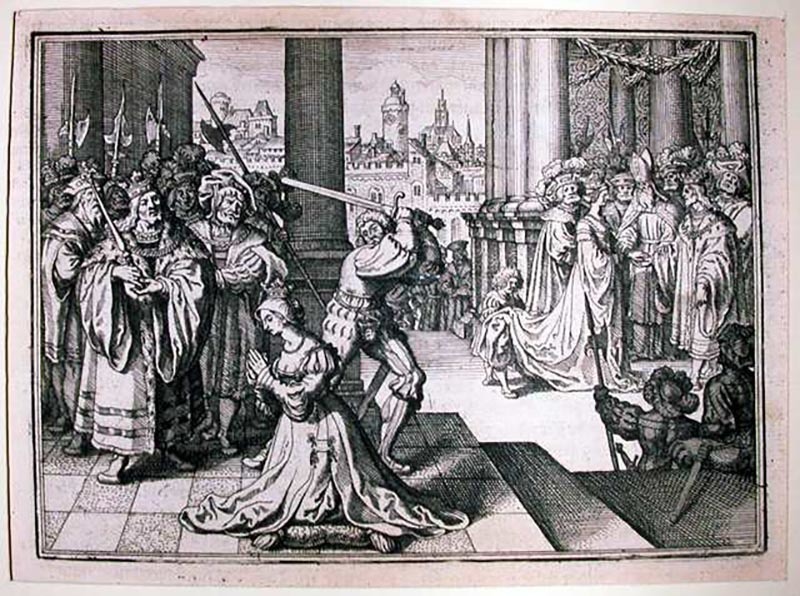
A 19th century  German illustration depicting the execution of former
English Consort Queen Anne Boleyn, c. 1830. The doomed monarch was
beheaded 481 years ago today - exactly - May 19th, 1536, which just so
happened to also fall on a Friday.
The rise and fall of Anne Boleyn, consort and second wife to 16th century King of England Henry VIII is the stuff of legend. Her tragic fate has inspired countless poets, screenwriters, librettists and authors to convey her story (as they see it). Perhaps the most famous ‘retelling’ of the plight of the much maligned queen – where the arts are concerned, lay in Italian composer Gaetano Donizetti’s 1830 tragic opera “Anna Bolena,” a two-act composition so titled after it’s namesake.

But much of what we think we know of the Queen is part and parcel of that age-old adage that decrees that the truest version of history lay with the victor - and Anne certainly had her detractors. In fact, we aren’t really sure if the famous last words of the former Queen (in which Boleyn never once admits to any guilt for the offenses charged against her) - as retold by Edward Hall, an English member of Parliament and Under-Sheriff of London - were actually spoken by Boleyn, or were the half-manifested product of the Officer’s imagination – or worse – false recall, politically motivated or not.

The Tudor propaganda machine, historically, had been one of the most heavy-handed, stalwart mechanisms that often succeeded by churning out defamatory accusations against anyone who stood in the way of - or threatened - the royal crown (including consorts) often by means of torture, the threat of torture, or by exacting the ultimate form of punishment: the public execution. Thus, it is with great difficulty for historians of the era to discern with any fair degree of certainty the fact from the fiction – even concerning the smallest minutiae of the lives of their victims. That doesn’t make the lives of those living under the royal yoke of the renaissance any less interesting. Quite by contrast, it ignites a very constant, almost universal fascination with the attempt to uncover the truth.

Such an example of this fascination – where Anne Boleyn is concerned – occurred only recently, in 2015, when researchers brought to light a 16th century musical scrapbook containing the works of several highly prized Franco-Flemish composers, said to have been signed by – and possibly even owned and compiled by - the Queen herself: the most interesting scores in the lot being those pieces of anonymous authorship – one of which (“O Deathe rock me asleep”) may have been composed by Boleyn herself as she effectively sat on death row, awaiting her final exit from both her former realm and the worldly sphere.

Inscription from the music book bearing Queen Anne Boleyn's signature
The loosely binded (ravaged by the hands of time) 42-piece scrapbook, now preserved at The Royal College of Music, London, bears the inscription “Mistres ABolleyne nowe thus” followed by a portion of musical notation.

Scholars of the era have suggested the styling of “mistres[s]” as being indicative of the former consort’s time as concubine to a married Henry VIII, who was then famously wed to the unfortunate Spanish Queen Katherine of Aragon - “nowe thus,” they remind us, was the motto of father to Boleyn, Thomas Boleyn, 1st Earl of Wiltshire. They believe mistress Anne started the book during her time in France as maid of honor to Henry’s sister Mary, and later, to Mary’s stepdaughter, Queen Claude. It was in France that Boleyn is believed to have immersed herself in the courtly arts, chiefly, in the areas of manuscript illumination, literature, poetry, and music. Like her future daughter with King Henry, Elizabeth, Anne is said to have mastered playing – and possibly composing music for – the lute.

Therein lies the supposition that it was Anne who authored not only the lyrics – but possibly even the music for Deathe rock me asleep, which reads most languorous:

“O Deathe rock me asleep
Bringe me to quiet rest

Let pass my weary guiltless ghost...

For I must dye, there is no remedy.”


A beautifully notated selection from the scrapbook said to have belonged to Anne Boleyn

Upon it’s discovery, some 500 years after the scrapbook’s final entries were sewn into the fragile binding, Director of Music at Sidney Sussex College (Cambridge) and head of the Alamire choir (named after the 16th century royal composer and spy, Petrus Alamire of Bavaria) Dr. David Skinner selected 20 pieces of music from the tome – many of them by renowned artists of the era, possibly known to - or, as in the case of French composer Josquin Desprez, patronized by Boleyn herself – and recorded them for the pleasure of modern ears.

Included in those recordings – for which Skinner earned Best Vocal & Choral CD of 2015 for Australia’s Limelight Magazine and a nomination for the coveted Best Album award by BBC Music Magazine – is the mysterious and doleful lament…that just maybe among those so-called “known” final words - and thoughts - of Queen Anne Boleyn herself.

Listen to a recording of O Deathe Rock me Asleep below, followed by a delicious recording by a Boleyn favorite composer (and recipient of the Queen’s royal patronage), Josquin Desprez, in the 16th century composers’ setting of “Stabat Mater" (Dolorosa): *UPDATE / NOTE 12.26.17: Much of the Alamire/Skinner album unfortunately is no longer on YouTube, however listen below to the piece"O Deathe.." performed by Mezzo-Soprano Catherine King and the Rose Consort of Viols, and, in lieu of the now removed Dolarosa by Desprez, I am replacing the latter with the composer's "Praeter rerum seriem," which is included in Anne's Song Book and is recorded by the Alamire Choir under Skinner:


Footnotes:

[1] The harsh epithet was famously so lauded on the now decapitated Queen by the Catholic Imperial ambassador to Emperor Charles V, Eustace Chapuys, who messengered the following note to his employer (excerpt): “The execution of the concubine took place at nine o’clock this morning in the tower…"

[2] Boleyn famously referred to her “fair (little) neck” in an exchange with her jailor, Constable of the Tower Sir W. Kingston. True or fictitious as the account may be, it does lay small credence to the notion that the Queen approached her death in an ‘unusually calm' manner. From Kingston’s letter to Thomas Cromwell, dated the day of Boleyn’s execution, May 19, 1536:
“This morning she sent for me, that I might be with her at such time as she received the good Lord, to the intent I should hear her speak as touching her innocency alway to be clear. And in the writing of this she sent for me, and at my coming she said, "Mr. Kingston, I hear I shall not die afore noon, and I am very sorry therefore, for I thought to be dead by this time and past my pain ". I told her it should be no pain, it was so little. And then she said, "I heard say the executioner was very good, and I have a fair neck", and then put her hands about it, laughing heartily. I have seen many men and also women executed, and that they have been in great sorrow, and to my knowledge this lady has much joy in death. Sir, her almoner is continually with her, and had been since two o'clock after midnight.”

[3] Also from Chapuys' account to the Emperor Charles V "...the thing was not done secretly, for there were more than two thousand persons present.”

-Rose.

Thursday, 11 February 2016

THE TUDOR DYNASTY & THE MUSIC OF THE CHAPEL ROYAL IN 16th CENTURY ENGLAND

The exquisite vaulted ceiling and one of the many frescoes of the Chapel Royal at Hampton Court Palace


In a followup to Tuesday's post on the historic Latin Vespers Service at the Chapel Royal at Hampton Court Palace, this post will discuss what the press who reported on the monumental occasion missed.

If you found yourself clicking on the external links provided, or simply perused other news articles in print or on the web, you may have noticed an not-altogether insignificant discrepancy in the dates provided in regards to the beginning of the reformation under Henry VIII (which, as stated in Tuesday's post here on unravelingmusicalmyths.blogspot.ca began in 1534) and the last Latin Service performed at the Palace's Chapel Royal,  documented by the press as "450 years ago... in the 1550's": 

 in regards to the Latin Mass ultimus, the reference is made to the King Henry VIII and the "mid-16th century"- but the reality is, the patriarch Tudor was already dead by 1547! According to the given timeframe of "450 years ago" (from today), the 'last Latin Service' would have been employed in the year 1566 - making Henry almost a full two decades into his grave - and three successive monarchs Tudor in.

So what exactly happened to music at the Chapel Royal, and to Cathedrals and Churches across England in the 32 year time span since Henry VIII initiated reformation proceedings with the issue of Act of Supremacy in November of 1534?

Read below to find out!


The boy-king Edward VI, the only
legitimate son of
Henry VIII and his third wife, Queen
Jane Seymour, who died in less than two weeks of
Edward's birth due to post-natal complications.
Half-brother to Mary I and Elizabeth I.
KING EDWARD VI (Reigned: 28 January 1547 – 6 July 1553):

Six months into the reign of the nine-year old newly crowned King of England, the incorrigible Edward VI, under the influence of Lord Edward Seymour, 1st Duke of Somerset and the Archbishop Thomas Cranmer (the same Archbishop who aided Henry VIII in his annulment from his Queen, Catherine of Aragon and his subsequent break from Rome), both Protestants like the boy-king, would orchestrate a series of ‘royal visitations’ at the countries’ major Cathedrals (including Winchester, York, Canterbury, and Windsor) with the explicit intent to ensure ‘Popish Rituals’ were abolished. Although the minutiae of details regarding who would be made allowed to participate in the act of singing the mass and by what frequency it would be permitted varied according to church, an edict issued by the Archbishop Cranmer at Lincoln Cathedral in 1548 made the changes to both language employed and the use of ornate polyphony within the music itself unmistakably transparent. In the demand, Cranmer (and effectively, the Monarch) decreed that “the choir shall henceforth sing or say no anthems of our Lady or other saints, but only of our Lord, and them not in Latin; but choosing out the best and most sounding to Christian Religion they shall turn the same into English, setting thereunto a plain and distinct note, for every syllable one: they shall sing them and none other.”

The Chapel Royal, the reigning Monarch’s personal Church (and establishment of musicians) at court, had already introduced the first English form of the compline (the evening service) three months prior. This is of interest to note, as it was one of the first precursors of what was to become of liturgical services across the nation. The Chapel Royal, under it’s Sovereign held the distinction of immunity from the actions of reformists. Nonetheless, the conversion from Latin to English at the Chapel set a precedent for the Church of England and all major Cathedrals across the nation.[1] Within five months of the first compline at the Chapel Royal in May of 1547, the Mass Ordinary was sung entirely in English at Westminster Abbey in London.

Two years later, the Act of Uniformity would declare the English-language “Book of Common Prayer” as the ‘dictation of God’ to be used in the Church in replacement of the Latin Service books. By the time the second edition was issued, revised under the hand of the Archbishop Cranmer, music itself in regard to liturgical services was reduced to a diminutive role, considered by the ‘church’ as an unnecessary distraction, and as a result, received scant mention. As the new King, the Archbishop and members of Edward's Regency Council began whitewashing Cathedrals, stripping them of ‘Popish iconography’ - including the organs used for music - so suffered the choirs, and their choir books, which were systematically sold, destroyed and burnt.


Queen Mary I, daughter of Henry VIII & the
annulled ex-Queen Catherine of Aragon; half-sister to
Edward VI & Elizabeth I.
QUEEN MARY I: “BLOODY MARY” (Reigned: July 1553 –17 November 1558)

Edward's whitewashing and dissolution of Services according to the Latin Rite would briefly change under his successor and half sister Mary I, whose stalwart dedication to Catholicism and her invasive measures to restore it as the religion of England and it's peoples earned her the moniker “Bloody Mary” as she systematically rooted out present and ex-conspirators, enemies of Catholicism, potential threats to the throne (this period included the sad tale of Lady Jane Grey, the sixteen year-old "Nine Day Queen” – a sobriquet earned upon her execution at the command of Mary in 1554) and protestants alike for public burnings-at-the-stake. Portions of the Acts of Uniformity were overturned, organs were restored to their Cathedrals and icons returned - and by 1557, around 13 Latin Service books, hoarded in secret by citizens during the Protestant reign of Edward VI - suddenly came to light under the ‘protection’ of the Catholic Queen Mary. 

For roughly five years, Latin Order was restored, and composers were encouraged to revert to the old style of elaborate and ornate polyphony. Such works of note to come from this period were indeed composed by - and for - members of the Chapel Royal, including "Videte Miraculum"[2] and "Gaude Gloriosa"[3] by Thomas Tallis (a staple at the Tudor court, and ‘non reformed Catholic’, who would serve four Tudor Monarchs – Henry VIII, Edward VI, Mary I and Elizabeth I, respectively) and the "Cantate Mass"[4] by composer John Sheppard.

In fact, it has been written that immediately upon a thrice-echoed proclamation of “God Save the Queen!” (shouted in earnest by awaiting crowds after the announcement of Mary’s ascension to the English throne was made - at Cheapside Cross by the Lord Pembroke in July of 1553) overjoyed civilians celebrated with a ringing of bells and festivities that lasted through the evening and into the following day. They also celebrated in song: as Pembroke and various Lords of the Council walked in state to St. Paul’s Cathedral, the building’s choir was already preparing to sing a Te Deum Laudamus in honor of the Queen. Formerly stowed organs were dusted off and rolled out to accompany the music: England had not heard it’s like for nearly six whitewashed years of Edward’s reign and imposed reformations.

Such (Latin) musical festivities appear to have been celebrated nation-wide: there are multiple documented accounts of public organ playing, bell ringing and singing well up until Mary’s procession. There is even evidence English composer William Mundy’s six voice Vox patris caelestis was penned for the Queen’s pre-coronation procession, or perhaps even for the coronation itself.

Learn about Mundy’s possible connection with Queen Mary at Oxford Academic.


Queen Elizabeth I, daughter of Henry VIII &
executed ex-Queen Anne Boleyn; half-sister to
Edward VI & Mary I.
QUEEN ELIZABETH I: “GLORIANA; THE VIRGIN QUEEN” (Reigned: 17 November 1558 – 24 March 1603)

The great neutralist Elizabeth I, half-sister to Edward VI and Mary I and daughter of Henry VIII and his second wife, ex-Queen Anne Boleyn (the seductive spark that fueled the reformation’s fire under the King) herself employed Latin Services at the Chapel Royal and in her own private Services at the beginning of her reign. Under the new Acts of Uniformity, issued by Elizabeth in 1559, reformist theology and tradition would also be included into the doctrine: lessons and readings from the gospel were to be in English, and some of the Latin Rites would be suppressed - including the Elevation of the Host - in an attempt to placate Protestant zealots. This combination of half-measures, of course, did not sit well with extremists: in Easter of 1559, reformist John Jewel, who had witnessed  Elizabeth attending a Latin Mass at the Chapel Royal rebuked the Queen, declaring the “masses and all the follies and abominations of Popery [were] everywhere sanctioned by the authority of the laws.”

Elizabeth’s seemingly relaxed and neutral stance on religion was not to be taken at face value. The so-called "Virgin Queen" was notorious for her fickle indecisiveness and famously maddening ability to ride the fence on almost all major decisions affecting the State. She would, over the course of her 45 year reign on the throne of England, execute more Catholics than the Protestants killed by her late half-sister Bloody Mary and the victims of the Spanish inquisition combined. 


Footnotes:
[1]This transition, however, did not happen overnight, but rather gradually. There is some evidence that suggests the composition of additional church music in the Latin tongue during this period, including the works of composer Christopher Tye (the Quaesumus Omnipotens and Domine Deus Coelestis, among others).

In fact, for the two year span between Edward’s coronation and the indoctrination of the first edition of the English Prayer Book in 1549, it is believed most of the attendees to church would have experienced worship according to the Latin rite, using recycled music as compositions in the official Roman tongue began to phase out.

It was, naturally, at the Chapel Royal under King Edward VI that experimentation with English liturgy first occurred, eventually branching out across English churches and cathedrals at St. Paul's and Westminster Abbey, both of which performed the mass ordinary entirely in the native English tongue in suit of the Kings establishment at the Chapel Royal.

A deeper look into the minutiae of the Act of Uniformity issued in 1549 reflects a gradual transition from Latin liturgy into English:

“it shall be lawful to any man that understandeth the Greek, Latin and Hebrew tongue, or other strange tongue, to say and have the said prayers heretofore specified, of Matins and Evensong in Latin, or any other such tongue, saying the same privately, as they do understand…though it be appointed in the afore-written preface that all things shall be read and sung in church in the English tongue…yet it is not meant but when men say Matins and Evensong privately, they may say the same in any language that they themselves do understand…”

MUSIC IN THE REIGN OF MARY I:

Latin works from the Composers Thomas Tallis: Videte Miraculum[2] & Gaude Gloriosa;[3] and John Sheppard: Missa Cantate[4]

 
         Thomas Tallis, Videte Miraculum             Thomas Tallis, Gaude Gloriosa                 John Sheppard, Missa Cantate

-Rose.

Wednesday, 26 April 2017

MAYHEM BEHIND THE MUSIC X: TRIVIA & HUMOR - (LITERALLY) 'DECONSTRUCTING' MOZART & OTHER SALACIOUS SCANDALS feat. Did You Know?

It’s time for another installment of TRIVIA & HUMOR!


Today’s much overdue feature combines a veritable cornucopia of mystery, scandal and intrigue as Unraveling Musical Myths meanders through the murky mire of the macabre, resting every now and then to regale the reader with tales of mercurial madness – a frequently occurring trait we have come to know and love in our beloved maestros of yore.


“LOWLY” MUSICIAN STATUS SAVES COMPOSER’S NECK


Alleged likeness of Taverner
We begin in the mid-16th century in Tudor England, just prior to the Reformation with the composer and organist John Taverner. Considered to be one of the most important musical figures of his era, Taverner would be appointed First Organist and Master of the Choristers at Cardinal College* (named after it’s ecclesiastical founder and then-Lord Chancellor to Henry VIII, Cardinal Thomas Wolsey).

Taverner, like many an Englishman living under the notoriously volatile monarch’s reign, would find himself in a heap of trouble for allegedly possessing ‘heretical’ manuscripts – books by German theologian Martin Luther - on his person (and possibly stashed in the ‘song school,’ with the intent of teaching them to his pupils in the choir) for which the musician was promptly holed up in the college’s fish cellar (which then served as a makeshift prison until which time further punishment would be executed – pun intended). The word “allegedly” is important here – this was, after all, the most tumultuous period of Henry’s reign, during which time the King sought to have his marriage to his first wife, the Spanish Katherine of Aragon annulled in order to place future consort Queen Anne Boleyn in her stead – a notoriously rocky road for the monarch that saw a highly contested battle of power between the determined English king and Pope Clement VII, and, failing permission by the Holy See to divorce, an eventual break with Rome.

Cardinal Wolsey being counseled by King Henry VIII
Alongside his abrupt shift in power over religious matters of the State, the autocratic ruler installed himself as the Supreme Head of the Church of England, setting forth a tidal wave of reformist activity across the nation.

Accusations of heresy ran wild – whether the party was in fact guilty or an innocent offender (labeling another as a heretic was a quick and convenient way to rid oneself of their enemies in an age where one was considered guilty until proven.. well, guilty).

As it turns out, Taverner himself was a
noted reformist. Perhaps armed with this knowledge, or simply having been all-too-aware of the further punishment that his appointee would have undoubtedly suffered if left to rot in the fish cellar, Wolsey neither confirmed nor denied the accusation lobbed on the imprisoned musician, and instead, appealed quite convincingly, to the jailors’ egos by diminishing Taverner’s influence over even the meekest of students, calling him “but a musician” (then equivalent to a servant). 

Apparently, it worked. Taverner would be promptly pardoned by the Cardinal.

Listen below to a gorgeous rendition of Taverner's Dum Tansisset Sabbatum (And When The Sabbath Was Past), Performed by Alamire choir under David Skinner:


*Note: now Christ Church College at Oxford


GUNPOWDER, FIRE…ATTEMPTED MURDER?


Talk about a premiere from hell: from the blazing inferno ravaging a large portion of a specially constructed structure funded out-of-pocket by the reigning British King (some £8000 - worth about 1 million in today’s money) and which claimed two lives, to the attempted murder of the Duke of Montagu by an enraged architect (and the latter’s unsurprising - yet highly mortifying - imprisonment), Composer of the Chapel Royal George Frederic Handel’s debut performance of his suite “Music for the Royal Fireworks” would go off with anything but a hitch. 

Friday, 22 January 2016

TODAY IN MUSIC: January 22, 1575 - TALLIS & BYRD GRANTED ONE OF ENGLAND’S PREMIER PRINTING & PUBLISHING PATENTS & A 21 YEAR MONOPOLY ON POLYPHONIC MUSIC

Thomas Tallis was a member of The Chapel Royal and would serve the Tudor
Dynasty as Organist and Composer over the course of four reigning Monarchs.
January 22 is a most significant day in music for England. It was on this day in 1575 that composers and organists to the court of Queen Elizabeth I, Thomas Tallis (a long-time musician to the court of England, having served three Tudor monarchs before Elizabeth: Henry VIII, his protestant son, King Edward VI, and half-sister to Elizabeth and Edward - Queen Mary I, respectively), and Tallis’ most beloved pupil, one William Byrd, would make English history with the exclusive rights to not only print and publish the polyphonic music of which they had just been granted a 21 year monopoly, but also the right to enforce the strict prohibition of sales of any “songs made and printed in any foreen countrie(s)” in a game-changing attempt at introducing to the world - and seeking dominance in it - the English repertoire among the masses, taking full advantage of the newly improved printing press.

Tallis and Byrd, both favorites of the Queen would be made able, thanks to the patent granted them by Elizabeth, to compose and print music to be used in the church in many of the popular tongues of the period, including English, Latin, French and Italian. Even further. the musical duo were the only composers permitted to use the paper on which music was printed!

William Byrd was once a star pupil of Tallis.
These grants came at an interesting time in British History. By the time Tallis and Byrd had received oligopoly over polyphonic music in 1575, England was already well into the throes of Religious Reform. Elizabeth had already sat some 17 years on a throne which had seen varied states of religious upheavals, revolts and reversals in her predecessors Tudor. Her notoriously fickle father Henry VIII had been the major catalyst behind the secular divide of Catholics and Protestants when he, following his infamous break from the church of Rome some two decades prior in order to legally divorce his wife and reigning Queen Catherine of Aragon and marry protestant Anne Boleyn in her stead), chose to set into motion the Act of Supremacy in 1534 in which he declared himself to be the ‘Supreme Head on earth of the Church of England’. With the advent of Martin Luther and his translated biblical texts into English, Europe - already on the brink of a series of religious civil wars across the continent - armed with this new, powerful public backing from an otherwise formerly neutral world leader, would find it’s citizens re-ignited by the already flickering spark of revolutionary spirit.
 
Protestants and Catholics alike would endure extremely violent, dogmatic reigns under the Tudor dynasty, reigns that would include instated Queen’s heads rolling off the chopping block, to executed ministers, archbishops and common reformists alike. Catholic churches would see themselves whitewashed and stripped of ornamentations in both ‘décor’ (icons) and in liturgical service (music; the ‘making of the cross’ on one’s chest) and replaced with the relatively conservative services of the Protestants, only to be violently undone and to have all ornamentations restored under the conditions of Catholicism during the reign of Mary I just prior to Elizabeth’s accession to the throne.

Music went through much change as the denominations of Christianity rapidly fluctuated, and, under Elizabeth, Tallis - who had been a constant at the Tudor court over the course of three monarchs and now on his fourth - would adjust the music of the Chapel Royal accordingly:

during the periods of Catholic flourishment, the highly ornamental and embellished polyphonic music consisted of rich and elaborate harmonies sung by multiple voices reminiscent of the music of the Renaissance era, while during the Protestant rise and wane, the rich and elaborate would be replaced by the softer, muter, more simple practices of singing with only ‘one syllable per note’ (as envisioned by one archbishop Cranmer), with emphasis placed less on aesthetic structure and more on the transparency of the texts that accompanied the compositions themselves (elaborate ornamentations being considered too 'Popish' for Protestant ears).

Elizabeth I as she would have appeared
in 1575, pictured here in the so-called
"Pelican Portrait" by painter
Nicholas Hilliard.
Elizabeth, having previously bore witness to the divide amongst the subjects of both herself and her predecessors, sought a more neutral approach in religion and it’s use of music, seeking to placate zealots on both sides of the religious divide by instituting her own Act of Uniformity in 1559, which included the 'Ornaments Rubric' clause: the ultimate royal show of religious compromise which would allow the Queen to retain for the Church of England traditional Catholic ceremonies, such as the ‘making of the cross’ at baptisms, and the adornment of the surplice and the cope amongst the clergy, while the doctrine of the Church itself would remain Protestant in nature. Accordingly, she would adjust, through her grant bestowed upon Tallis and Byrd in 1575, the rich polyphonic music of the old (Catholic) church with the new, more simple sound of the protestant choir, creating a uniquely English hybrid of vocal repertoire that, while initially facing public scorn via the religious fanatics of the ever-tumultuous period, would introduce into Europe a ‘Golden Age’ of Elizabethan music – one that continues to astound and astonish audiences around the globe to this day.

Listen below to two of the thirty-four motets composed by Thomas Tallis and William Byrd from the Cantiones quae ab argumento sacrae vocantur – a collection of compositions dedicated to Elizabeth's 17th year on the throne of England (accordingly, each composer contributed 17 pieces each to the mammoth work to represent each year of their beloved Queen's Reign), and in thanks for granting them the Printing Patent in 1575. This collection was the collective composer’s first work under the Monopoly.

#26, In Jejunio Et Fletu (in Fasting and Weeping) by Thomas Tallis:


#12, O Lux, Beata Trinitas (O Trinity of Blessed Light) by William Byrd:


- Rose.


Saturday, 17 November 2018

460TH ANNIVERSARY OF ELIZABETH I'S ACCESSION TO THE THRONE OF ENGLAND, AND A SHREWD QUEEN'S CUNNING USE OF 'MUSICKE' AS A POLITICAL TOOL

A recently discovered portrait of Elizabeth I,
c.1559, Unknown artist
Today marks the 460th anniversary of the Accession of Queen Elizabeth I to the throne of England following the death of Queen ("Bloody") Mary Tudor, Elizabeth's controversial half-sister on November 17, 1558.

The music of the Tudor court has been covered extensively on Unraveling Musical Myths, however in light of recent scientific and media attention toward the 16th century “Virgin Queen's” masterful manipulation of portraiture to influence heads of state, I wish to shift focus to "Gloriana's" use of music as a tool for spreading political propaganda.

This past June, BBC historian and art dealer Philip Mould discovered a hitherto unknown portrait of a diminutive Elizabeth on oak wood, (left) estimated to have been painted during the second year of her reign as Queen of England and Ireland in 1559 - potentially making it the earliest known portrait of the young queen as ruler of the British empire. 

The portrait depicts a youthful, softer side of the characteristically stern-jawed, resplendent likenesses of Hilliard, Segar and Gheeraerts that have become synonymous with the image of Elizabethan power and 16th century English dominance.

It would be followed by a series of likenesses of the Queen, both authentic and imagined, which would feature such feminine, girlish attributes: an increasingly expanding cherubic face, a direct forward facing gaze, a sly smile – demure characteristics Elizabeth would soon grow to detest. As such, authentic portraiture dating from the ruler's early reign – that is, portraiture for which Elizabeth actually sat – would increasingly fall into the category of rare commodities. The Queen is said to have destroyed in the fire portraiture she found unbefitting of the subliminal message of political prowess she sought to covey to her British subjects, and more importantly, to foreign heads of state.

*CLICK TO ENLARGE* Early portraits and likenesses of Elizabeth portrayed the young Queen in diminuitive form, much to the ruler's ire. The infamous "Rainbow portrait," seen on extreme right, bore all of the fruits of Tudor propaganda. Painted well into her rule, Elizabeth's wardrobe drips in symbolic excess - symbols are lifted from books of emblamatic morals: her cloak bears the eyes and ears of an all seeing, all knowing ruler, complimented by a serpent of wisdom which the Queen wears unabashedly on her sleeve, and there is the presence of a cestial armillary sphere, suggesting dominion in the heavens and on earth. This c. 1602 portrait attributed to Marcus Gheeraerts the Younger is the most heavily symbolic of Elizabeth's portraits.


Just as “Good Queen Bess” (just one of many nicknames attributed the Queen by her loyal subjects) would exert control over her image as she grew into her role as Ruler of England, becoming slimmer, grander, more symbolic (as seen in the famous Rainbow portrait by Marcus Gheeraerts the Younger above right) and even allegorical (see Elizabeth I and the Three Goddesses, attr. Hans Eworth below)  Elizabeth would extend her propagandizing efforts through music – through intimate and public settings to unconsciously bring detractors into the Elizabethan fold and into England's dominant Protestant Church.

This 1569 allegorical portrait of Elizabeth triumphing over the goddesses Venus, Juno and Minerva belonged to the Queen herself. The portrait is especially bold, as it re-fashions the mythological tale of the beauty contest 'The Judgment of Paris," in which it is Venus who triumphs over her rivals Juno and Minerva. In this painting, attributed to Flemish artist Hans Eworth, the mythological triumvirate enter the realm of the living, whereupon they are defeated by Beauty's ultimate victor, Queen Elizabeth I of England. Presently in the collection of the Royal Collection Trust, this masterful oil work sits inside a frame that bears the contemporary description:  `IVNO POTENS SCEPTRIS ET MENTIS ACVMINE PALLAS / ET ROSEO VENERIS FVLGET IN ORE DECVS / ADFVIT ELIZABETH IVNO PERCVLSA REFVGIT OBSVPVIT PALLAS ERVBVITQ VENVS'. T ('Pallas was keen of brain, Juno was queen of might, / The rosy face of Venus was in beauty shining bright, / Elizabeth then came, And, overwhelmed, Queen Juno took flight: / Pallas was silenced: Venus blushed for shame'.

The Queen of England was known to have held 'intimate' meetings with foreign dignitaries in which discussion of political affairs were accompanied by music - performed by Elizabeth herself. Scottish Ambassador Sir James Melville famously listened to her performing on her virginal in her private chamber, remarking that he had been unknowingly entranced: “I heard such melody as ravished me, that I was drawn in e'er I knew how,” whilst the Duke of Bracciano Don Virginio Orcino felt himself a paladin – a foremost warrior at the court of the illustrious Charlemagne, after the Queen sang, danced and played for him on the lute. 

Elizabeth's private performances with the French Ambassador, Charles de Gontaut (for whom she danced in her private apartments) and with Baron Rabenstein (Breuner, the Imperial Ambassador to Ferdinand I, the Holy Roman Emperor) were even more intimate: with marriage negotiations for the Queen to wed the Emperor's son, the Archduke Charles of Austria at a frustrating standstill (and perceived by the Baron as an exercise in futility), Elizabeth hatched a cunning plan to woo back into her graces the frustrated Ambassador (who was set to leave court empty handed) with a private boat side serenade on the river, where Breuner was instructed to sit in the mighty Treasurer's seat – a shrewd move that succeeded in regaining the Baron's faith in a potential victory for Ferdinand through the clever use of power placement seating and through the 'intimate privilege' of a one-on-one, private performance. The Ambassador would in turn report back to Ferdinand, tempering the Emperor's ire with words not of failure, but rather of praise and of optimistic hope, allowing Elizabeth to maintain a sense of détente between the two powerful rulers through creating the illusion of ongoing negotiations.

The ploy of using music as both a negotiating and propagandizing tactic was ingenious: by mixing her 'body politic' with her 'body natural,' Elizabeth invoked the powers of feminine eroticism with the learned graces of music - a gift promoted through the teachings of Aristotle as an invaluable political tool. Elizabeth effortlessly interweaved this intellectual, poised allure with that of the all-encompassing power of 16th century advertisement: through the illusion of intimacy, and through music, the Queen could begin to establish trust in the foreign diplomats who frequently visited her court, who would, in turn, return home to their respective kingdoms with ravishing reports of a learned, skilled, erudite ruler – reports that would spread rapidly across Europe like an untamed wildfire.

The Queen did not limit the influence of music to personal performances, however. Courtiers and noblemen were wont to both pen lyrics and compose music in her honor for fear of losing her good grace, whilst tunes of grandeur and English revelry would accompany her garrison as she held processional tours – a perfect highlight to the grand entrance of a powerful ruler.

Elizabeth I gets a 21st century animatronic treatment. Using
advanced digital scanning and 3D printing, artist Mat Collishaw draws
upon known portraiture and literature concerning the 'Virgin Queen' in an
attempt to reveal the true face behind the highly propagandized likenesses
of the 16th century Queen. Visit BBC.com to watch this fascinating video.

At home base, the frequently rivaling religious factions in England were still brewing – Catholic England had lost their chief supporter through the demise of Mary I, and whilst Elizabeth issued a compromise of sorts through her 1559 Religious Settlement, which re-established the Church of England's independence from Rome through the first of two acts, The Act of Supremacy of 1558 and the re-establishment of the Book of Common Prayer through the second (Act of Uniformity of 1559) which attempted to blend aspects of both religions under one faith, the English peoples remained nonplussed. The Protestants felt the full breadth of their faith unfulfilled, whilst the Catholics believed the issuing of the Settlement to be entirely heretical: their faith submerged under the crushing weight of the increasingly popular Protestant ilk which would eventually grow into such a dominating force it would result in the modern Anglican Church.

The industrious Queen Elizabeth, who strongly leaned Protestant, played a large hand in forming the Anglican Church as its denomination knows it today – and she did it through the power and influence of music, and through her trusted Archbishop, Matthew Parker.

In 1567, the Archbishop of Canterbury, appointed by Elizabeth in accordance with her late mother Anne Boleyn's wishes (to keep watch on her only child) was assigned by the Queen the task of translating into English from Latin select entries from the Book of Psalms. For his part, Parker chose Psalms 1, 68, 2, 95, 42, 5, 52, 67 in addition to a 9th century hymn known as Veni Creator (Come, Holy Ghost, Eternal God) and commissioned court composer Thomas Tallis to set the translations to music.

Imagined likeness of Thomas Tallis. Elizabeth would grant the long tenured
court composer and his most prized pupil, the composer William Byrd
exclusive rights to print and publish polyphonic music, granting them a
21-year monopoly which included the right to enforce strict prohibition of
sales of any “songs made and printed in any foreen countrie(s)” in a
game-changing attempt at introducing to the world - and seeking dominance
in it
-the English repertoire among the masses, taking full advantage of the
newly improved printing press. This was but just one example of Elizabeth's
savvy use of music as a tool for manipulating the status quo.

In doing so, Elizabeth was effectively challenging the liturgical practices of the Church as her subjects knew it, whilst influencing reform-minded Catholics to yield to the Protestant yolk. For 16th century English citizens, attendance at Church was mandatory – thus congregates who numbered themselves among the bodies lining fully manned pews were helpless but to both witness and partake in newfound tradition: the Nine Tunes for Parker's Psalter, as the Archbishop-Tallis collaboration would become known, would force the assembled congregation to sing – not simply orate – the poetic Psalms, and only in the English tongue.

It was this last stipulation that was of utmost importance to Protestant influencers, and Elizabeth was fully cognizant of this. By releasing the scripture from its formerly unintelligible tongue (most 16th century civilians could neither read, nor understand spoken Latin) and placing it under a visible spotlight where its words and meaning could be fully digested by all was an immensely clever way of attempting to establish a sole collective of congregates, who could find salvation through comprehension of the 'Word of God' - and, in effect, through the Protestant Church - effecting a potential victory by Elizabeth over the long held, acrimonious Wars of Religion that had for so long plagued the English State.


Listen below to the third of Nine Tunes for Parker's Psalter, “Why fum'th in sight” (Psalm 2) as performed by the Tallis Scholars. This piece would famously influence 20th century English composer Ralph Vaughan Williams to compose his much beloved Fantasia on a Theme of Thomas Tallis. It would also become known as the “third mode melody.”


- Rose.

Wednesday, 30 March 2016

MONTH OF MARCH HIGHLIGHT: CARLO GESUALDO "THE PRINCE OF DARKNESS" (Featured Post)*

This month Unraveling Musical Myths takes a look back at Italian Renaissance composer Carlo Gesualdo, born March 30, 1566. (*REPOST FROM: DECEMBER 2015 - see original article here)

Carlo Gesualdo, Prince of Venosa
October 16, 1590. The sun had set at the Palazzo San Severo in Naples, Italy - both below the horizon and in the private bedchamber of Donna Maria D’Avalos, first wife of Composer and Prince of Venosa Carlo Gesualdo.

Inside, the steamy quarters reeked with the stench of death. Amidst the blood-soaked enclosure, crumpled sheets and general disarray set-stage a scene of obvious whirlwind violence, leaving in it’s wake the grisly and horrific aftermath of plot, treason, and debauched primal furor. It was a hellish display of pre-determined destiny that would make the fate of Paolo and Francesca of Dante fame seem like a punishment fit for Paradise.


Deep within the caverns and alcoves of this magnificent castle, elicit and treasonous carnal exploits would meet their due restitution - at the end of a dagger and by the barrel of a still smoking gun.

The Prince of Venosa and Count of Conza was born into nobility. Born in late March c.1566 he was the nephew of a Pope (his mother was niece of Pope Pius IV) and nephew of Calo Borromeo, (later made Saint Charles Borromeo
.)

As the second surviving son of Fabrizio Gesualdo and Geronima Borromeo, the would-be Prince obtained carte-blanche status in Italy when he was crowned Prince of Venosa (a Principality handed down to Gesualdo through the paternal line via his grandfather, made First Prince of Venosa by the King of Spain) following the death of his elder brother, Luigi.

A dedicated Composer of madrigals and other sacred and secular works, accomplished lutenist and harpsichordist, Carlo Gesualdo would use his status as Prince to excess, obsessive in his display of dominion over music, his servants, his wife and her paramours, and later, toward his own person.

In 1586, Carlo would marry his first Cousin (a practice not uncommon among royal houses, dedicated to preserving the familial bloodline of future Princes and Kings), Donna Maria D’Avalos.

Donna Maria was a noted and celebrated beauty, and quickly caught the eye of a young Carlo. Unfortunately for Maria and for posterity, her charm and smouldering allure also grasped the attention of Gesualdo’s blood-uncle, Don Giulio.

Ever the provocateur, Giulio, after witnessing for himself Donna’s Maria’s comeliness, began a pursuit of unrequited romance in the form of trinkets, protestations and tears. They were all rebuffed. Giulio, however, fancying himself quite irresistible, persisted. It wasn’t long before Gesualdo's wife had had enough. Eventually, she put her foot firmly down, warning the wannabe Romeo that she would inform her husband, Prince Carlo Gesualdo, should he continue to pursue her.

This was enough to stop Giulio in his tracks - for the moment. What was to brew next inside of this bizzare love triangle was an episode so horrific, so full of brutality and betrayal that it shook Italy and the Gesualdo Principality to it’s core - creating shockwaves that still continue to permeate through the streets of Naples to this very day.

Donna Maria D'Avalos
Giulio would soon discover that Donna Maria, for her own transgressions, was also plagued by the elusive wandering eye and fickle heart. Already too deep into a passionate romance with the Duke of Andria, Don Fabrizio Carafa (himself a described “model of beauty”), Donna Maria would soon find herself, again, under the maleficent sombre wings of her Uncle-in-law.

And maleficent he was. Furious and feeling personally emasculated, Giulio set out to blackmail his niece in law - his idée fixe, now a whore in his eyes and her prettyboy lover had but two choices: either die steadfast and in the face of adulteries sin, or go out of this world in protest, kicking and screaming. Indeed, it wasn’t much of choice.

The jealous Uncle immediately informed Carlo of his wife’s indiscretion with the Duke, knowing full well ahead of time of Gesualdo’s penchant for possession and avarice. With this scandalous bit of information, both Uncle and Nephew would seal the fate of the adulterous traitors. The Gesualdo bloodline was wracked with inherited mental illness (perhaps as a result of incestuous marriages and the subsequent births resulting from their unions
.) This ‘mutation’ of the Gesualdo gene pool would be on full display at the Prince’s home in an intricate series of well planned traps and a nefarious use of psychological warfare.

October 16, 1590. The bait was set. Carlo, set to go on a hunting excursion that evening, leaving Donna Maria alone in La Palazzo San Severo, calmly “left” the premises he shared with his various servants and wife, allegedly off to bring home a fresh kill for a later feast. The Lady Maria hadn’t suspected anything was amiss, despite the fact that her villainous Uncle in law had told her lover the Duke of Andria that their extra-marital dalliance had been revealed to the Prince. Donna Maria, suspicious of her uncles protestations, probably imagined this to be a false claim under the cloak of blackmail, intended to be used as a underhanded tactic to resume courting her. Indeed, Carlo had said nothing of the matter to her, or to the Duke.


Carlo Gesualdo
It wouldn’t have mattered anyway. Carlo's' web was already spun. There was, in fact, no hunting excursion to be had that evening - at least, there was to be no hunting of wild game for sport or for sustenance. Instead, the fresh kill would be in the shape and form of his beloved Donna Maria and her paramour, Fabrizio Carafa, Duke of Andria.

Leaving all of the doors within the castle unlocked so as not to arouse suspicion of a coup d’état within the Gesualdo abode, wife Donna Maria and her handsome lover would find themselves succumbing to one another in her bedchamber. The two had already declared a pact between them, in the event her Uncle-in-law was telling the truth about revealing their relationship to Carlo.


In a dictated manifesto that read like a discourse on unyielding love, the two disgraced lovers vowed to die with and for one another. This was immediately preceded by a lamentation made by the Lady D’Avalos, who chastised the genial Duke as undeserving of a Knight and man, and therefore undeserving of her after he suggested they cool things off and let the dust settle. In an age where men were made Knights and Kings on the battlefield, this was an insult of castrating proportions.

Well into their conjugal tryst that autumn evening, Carlo, sneaking through the corridors of the Palazzo, burst into the bedchamber of Donna Maria D’Avalos, catching his wife and her lover in flagrante delicto. Overcome by her gall, and overpowered by rage, he stormed the chamber,
dagger (or possibly sword) in hand, accompanied by three of his trusted guards, and slit the throat of his philandering spouse, and repeatedly stabbed her for having the audacity to try to “make [him] a cuckold”.

In the end, it was difficult to tell who bore the greatest brunt of Carlos' and his henchmen’s brutality. Duke Don Fabrizio (described, oddly, as dressed in “only a woman’s nightdress with fringes at the bottom, with ruffs of black silk.”..this at a time where homosexuality and “sodomites” were considered agents of primal sin both blasphemous and injurious to Christianity, one can only imagine Carlos’ shock at espying his romantic nemesis in transgender garb) was himself repeatedly stabbed. His body was found “covered with blood and pierced with many wounds.”  


He had also been shot:

“..an arquebusade through his elbow and side, with two shots, and an arquebusade on the eye on the side of the temples, which went from one side to the other, and a bit of the brain had oozed out; and he also had wounds on his head, face, neck, chest, stomach, kidneys, arms, hands and shoulders - wounds made by sharp sword thrusts, quite deep, many of them passing through the body from one side to the other...*” 

when the Duke’s body was removed from the room, it was revealed he had been several times impaled through the torso and the floor underneath by a sword long enough to pass through the breadth of his chest and abdomen and leave tell-tale holes in the planks below his currently mangled corpse.

His now deceased inamorata also suffered a further abuse after her violent attack: Donna Maria, her throat already having been cut, had been stabbed in a count so numerous modern day detectives would label it overkill of a pre-meditated order. Carlo was seen leaving and then re-entering the domicile, his hands and clothes dripping blood, shouting  “Kill that scoundrel, along with this harlot! Shall a Gesualdo be made a cuckold?”  In all of his blind rage and inherited insanity, it seems he played his carte blanche privilege to it’s full reaches, unaware or unconcerned of any form of condemnation or punishment for his gruesome crime. After publicly shouting this murderous demand at his fellow executioners, Gesualdo himself took to Donna Maria, stabbing her already mutilated body another 28 times, declaring in a fit of insanity, “I do not believe they are dead!”

Of the contemporary accounts that survive, much is made of the additional crimes alleged to have been committed post-mortem. In those accounts, and, in current Neapolitan folklore, it has been suggested that Don Carlo ordered the corpses to be taken out of the Palazzo and splayed out in a crude fashion on the stairs leading up to the castle. (It has been regaled by contemporary local witnesses that the Lady D’Avalos was positioned spread eagle, and her corpse later violated by a passing Monk.)


Elizabeth I of England at her Coronation
Of course, these, and other similar claims could be the result of embellishment. On the other hand, however, 16th century Europe was far from immune to such ghastly displays of the flesh: over to the northwest in what is now part of the United Kingdom, a young Elizabeth Tudor, newly crowned, ruled over England, itself fresh from the public burnings-at-the-stake made popular by the previous, Catholic, Queen Mary I (“Bloody Mary.")

Although brutal punishments like hanging, drawing, and quartering were left behind by the predecessors Tudor and their antecedents, Elizabeth I of England would, throughout the course of her reign, execute more Catholics than all of the protestants executed by her sister Mary and in the Spanish Inquisition combined.  In then quite recent England, those convicted of treasonous offenses found their severed heads hacked off by a dull axe at the block, parboiled and left to rot on a spike over the River Thames, and their torso and limbs impaled and planted fermement in the ground as a warning at the borders of then-warring Scotland.

Also to the northwest in just under a mere two decades earlier, Catherine de Medici and her son, the future Henri IV, had orchestrated a devious coup to oust the Huguenots from the face of France by organizing a marital union between the Catholic house of Valois with the Protestant House of Bourbon through her only daughter, Margot, a Valois, and the King of Navarre, Henri III from the House of Bourbon. Scores of Protestants flooded Paris to witness the outdoor union at the Cathedral of Notre Dame. They were later slaughtered in the streets and pulled out of hostels as they slept and were made slain.

16th century Europe, for all of the wonders and social and political advancements of the Renaissance, was a very violent place to live. Church and State, for the most part still reigned supreme, with repeated uprisings and revolts across the continent (indeed, even after England’s Henry VIII broke from the Church of Rome in order to marry Anne Boleyn and establish the Church of England, the country would see the execution of Lady Jane Grey, the “Nine Day Queen," a Papal Bull and countless plots to overthrow Elizabeth in the Northern Uprisings and the notorious Babbington Plot that would leave Queen Mary of Scotland dead - her head hacked off by an executioner in the employ and command of her cousin Elizabeth I, no less
.)

In matters of high treason or offences against the Church, public displays of brutality in the form of executions and the display of corpses was Standard Operating Procedure. It served two benefits: first, it acted as a “deterrent” (in reality, the outcome of its efficacy was highly negligible: a public suffering and death was considered amongst religious zealots to be a gateway into the realm of martyrdom
.) Second, the mutilation of the flesh itself, it was believed, was a necessary evil to warn any would-be conspirators of a preordained refusal of the soul into afterlife..wherein the mutilated spirit, unaccepted by heaven and unwanted by hell, would be doomed to roam the earth, disassembled, for eternity.

Catherine de Medici's forced union between the Protestant Henri III
of Navarre and her Catholic daughter Margaret de Valois set off one
of the bloodiest massacres known to French history. The onslaught
would become known as the St. Bartholomew's Day Massacre.
If one considers the barbarous brutality that went into punishments such as hanging, drawing, and quartering, Carlo Gesualdo’s alleged treatment of his scorned cadavers seems, rather..commonplace in an era that was still ages away from the dawn of the period of Enlightenment. What can be argued as inordinate and especially cruel was that Gesulado’s actions were committed outside of the Church and based solely on primitive jealousy and an overabundant sense of vanity.

Gesualdo would soon flee Naples, perhaps consumed by guilt, where further atrocities would be reported, one in the case of an unidentified infant (believed to be either his own offspring, or the illegitimate son of Donna Maria and Duke Fabrizio Carafa of Andria) who he is said to have ordered murdered by swinging in a bassinette hung from a palace balcony while his servant-musicians sang madrigals of death - his own compositions - below until the child expired, for reasons that range from jealousy to preventing the child from inheriting his barbarity and familial insanity (depending on which contemporary account one chooses to believe
.)

He would also go on to physically abuse is second wife, a punishment likely as a result of her condemning his two female lovers as witches and ordering them to stand trial. It was said that Gesualdo became obsessed over one of his lady loves, and willingly participated in her explicit and disgusting (I will spare the reader the details) spells on him, so taken was he by her charms. That mock-trial ended in Gesualdo hosting the convicted ‘witches’ in his castle alongside his wife, both of whom were spared execution and given house arrest under his roof instead! Again, it would seem Carlo was untouchable. But, this sense of invincibility toward accountability would not last. Over the course of the last 15 years of his life, the troubled Prince of Venosa inflicted upon himself a seclusion that would last until his death.


A contemporary depiction of flagellents
Gesualdo rarely left his castle as his mental state rapidly began to deteriorate. He single-handedly cut down entire forests in a frenzied episode of schizophrenic-like paranoia around his castle by his own hand over the remainder of his life, afraid of unannounced villains who might be laying in wait outside of the fortress, plotting an attack; he procured a 3rd or 4th century BC ‘disk’, etched in hieroglyph-like carvings, and suffered upon himself a life long struggle with insomnia as he tried in vain night by mind-wracking night to decipher it’s mysterious code, even penning a letter to his alchemist, promising a large sum of money to enlist his services in cryptology (the disk exists today in a museum in Italy just on the outskirts of the scene of his horrific crime. It’s mysterious message remains unsolved.)

It is said the Composer-Prince became consumed by depression during this period, an impression made all the more palpable by a painting he had commissioned ("Perdono di Carlo Gesualdo" by Italian Mannerist Giovanni Balducci) of a pensive-looking Gesualdo, flanked by his uncle and gazing up to a pointing Redeemer -  an unidentified cherub-like infant hovering above his head just below Christ Himself. Could this baby be that of his son? Could Gesualdo, now a recluse, finally have found remorse while idling away in his castle? The Prince was also rumored to practice self-flagellation, a religious ‘practice’ condemned by the Catholic church that involved whipping one’s own back in a display of penance, in Gesualdo’s case with an alleged three-tailed whip. Could this accusation also be true?

It is difficult to say either way. The Prince of Venosa kept a close circle of trusted men in his employ, and never ventured beyond the reaches of the now deforested landscape surrounding his castle.

Even in spite of his madness, Carlo Gesualdo remained acutely aware of the spoils of his own nobility. It is said the Prince would order his male servants to cling to his back while he slept in an effort to keep him warm. He continued to enjoy the carnal pleasures of his convicted ‘witches’, and committed himself to the composition of music. If he was indeed depressed, Gesualdo certainly was productive about it.

In his remaining 15 years, Carlo Gesualdo would shift his focus in between his deforestation efforts, cryptology and music.
He would produce some of the most chromatic vocal compositions the world had yet seen or heard - and on a scale considered so progressive and musically significant, its influential match would arguably not be seen or heard of again until Classical music's Romantic Period in the late 19th century in the works of prolific composer Richard Wagner and later, in the 20th century, Igor Stravinsky.

German Composer Richard Wagner
Much like Wagner and especially in the case of Stravinsky, who would cause a riot in Paris at the Théâtre des Champs-Élysées some two centuries later with his and choreographer/ballet dancer Vaslav Nijinsky’s premier staging of “Le Sacre du Printemps”, Gesualdo’s style was equally controversial, widely panned by contemporaries and critics for their “ugliness” and unusual dissonances and peculiar harmonic tensions. Gesualdo penned works -  now considered virtuosic - in a style and manner 16th century melophiles had never before heard. Like any unchartered territory, what was ‘new’ was considered ‘strange’. Certainly, this ‘new sound’ was far removed from the exquisite and ingenious innovations of Monteverdi in his use of polyphony. Monteverdi’s was a purer technique - a more blended sound.

It is of interest to note that while largely critically panned in his era, Gesualdo’s frequent use of chords that seemed to contrast in tonality would later be declared to be predecessive of Wagner in his exquisitely ground breaking ‘Tristan Chord’ over two hundred and fifty years after Gesualdo’s death in 1613.

‘Wagnerites’ and later scholars would cite Gesualdo’s madrigal “Moro Lasso” as being highly influential for the infamous and celebrated chord employed by Wagner wherein there exists “little tonal interrelation”, “strange harmonic tension” and “chords far apart in tonality”. Wagner’s Tristan Chord would enter into the realms of infamy and go on to become one of the most influential and extensively analyzed innovations to modern classical music - nay, to music itself.

Stravinsky’s “Le Sacre du Printemps” would also find virtuosic roots in posterity. Stravinsky himself acknowledged Carlo’s premature stylistic genius and would go on to pay homage to Gesualdo in his lifetime by making pilgrimage to Naples and composing a work entitled “Gesualdo Monument," in honor of the late murderous Composer.

If anything positive can be drawn from the tragic life of the Prince of Venosa, it is this: that even drowning beneath the turbulent and undulating undercurrent of mental illness, it’s iron fisted grip on the fragile human psyche cannot undermine the hidden genius that exists in man... that in judging any given event in any given region in the annals of human history, one must consider the social, economical and political factors that surrounded the State in it’s epoch.

One simply must take into account the violent and dogmatic time in which men like Gesualdo lived in order to have for him or herself a concise picture in mind of the period in which the transgressor and victims met their fates. Abstract analysis favors neither the condoning nor excusing of actions.


Perdono di Carlo Gesualdo, 1609.
In the case of Carlo Gesualdo, certainly, one inevitably finds indisputable criminal brutality. This finding however, is foreshadowed by a class warfare, immature scientific discovery in the annals of medicine, and in a particularly archaic and misogynistic series of laws that seemed to favor the privileged man. Laws that may have left the critically insane like Carlo Gesualdo free to engage in unpunished criminal behavior. Indeed, it was custom in Italy at the time of the slaying of Donna Maria D’Avalos and the Duke of Andria, for the cheating wife of a man and her lover to be tried and sentenced to death for adultery. Had this not been the case, had the disastrous effects on the human psyche and products of incest been common knowledge, and had mental illness been recognized as an actual condition, instead of the protestations of an angry God, punishing mankind for it’s manifold sins, perhaps the crimes of the Prince of Venosa would have been taken more seriously, and perhaps - just perhaps - the biography of Carlo Gesualdo may have read differently.

But then, that is a lot to have expected from that distant period. Indeed, it is a lot to expect today, where, in various parts of the world, sin is still punished by death, and examples are still being made by exacting the ultimate punishment through a barrage of unbridled violence and brutality. Many of the tortures and punishments the world sees today are in fact nothing more than archaic methods, inherited by modern man that have continued to exist since some of humanities most primitive times..the bedchambers and boudoirs of yesteryear become today’s battlegrounds and bunkers. Mankind continues, and will continue for the foreseeable future, to live and die by their ‘honor,’ by their station in this world, and by God.


If you listen closely, it is said you can hear the anger, angst, passions - and perhaps even guilt - in the music of Carlo Gesualdo.


Carlo Gesualdo's Moro Lasso, Al Mio Duolo from book IV, Madrigali Libro Sesto.


Footnotes:
READ MORE OF MY POSTS ON THE "PRINCE OF DARKNESS" in the Gesualdo archives here.

-Rose.