Saturday, 17 November 2018

WOMEN IN MUSIC: THE ONE-YEAR ANNIVERSARY OF CECILIA BARTOLI'S HISTORIC RECORDING WITH THE SISTINE CHAPEL CHOIR

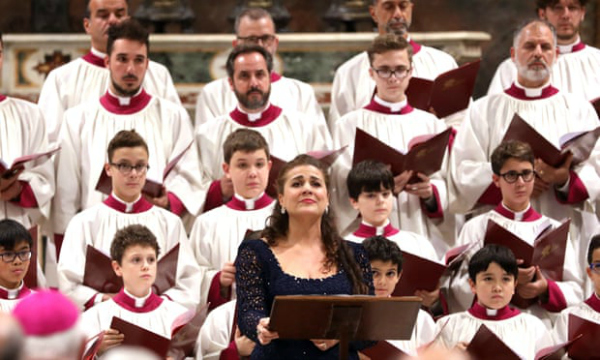
Cecilia Bartoli and the Cappella Musicale Pontifica "Sistina,"  Sistine Chapel, Vatican City, 2017 |  Franco Origlia


Saturday marks the one-year anniversary of Cecilia Bartoli's historic live recording of 13th century ars antiqua composer Pérotin's (Perotinus') breathtakingly exquisite conductus Beata Viscera Mariae Virginis from within the hallowed walls of the Sistine Chapel.

Last Friday, November 17, 2017 marked the first time in the history of the Church that a woman was accepted into the ranks of its infamous 50 member, male exclusive choir – the Sistine Chapel Choir, which is comprised of 20 men and 30 boys.

Bartoli – arguably one of the finest mezzo-sopranos to specialize in early music repertoire – appeared resplendent as she stood front and center before the dominating force of the choir, her nondescript Indigo dress offering mute testimony to the evenly paced, stunningly reverberate, ethereal voice that would escape from within her strong, feminine frame.

The unique and much revered acoustics offered by the Sistine Chapel (which had so infamously left 18th century Rome and a visiting young Wolfgang Amadé Mozart in awe) are adequately preserved on the pontifical choir’s 16-track Christmas CD Veni Domine: Advent and Christmas at the Sistine Chapel  (a previous, private session also recorded from within in the Church and released by Deutsche Grammophon in late October and December 2017.) That recording would pre-date the November 17 performance – making the DG release Bartoli's de-facto "first recording" in the Sistine Chapel with its resident choir.

In both album and in “live” video, Pérotin's hypnotically melismatic, recurrent refrain “O Mira Novitas” can be heard reverberating over onto itself as Bartoli and the collective choirs' voices echo tender cries of Marian praise and wonderment over the "purity" of the Christian Virgin Birth and the Holy Mother. 

Each poetic stanza (written by the theologian Philip the Chancellor) is likewise rendered every bit as awe-inspiring as the ever-expansive frescoes of Michelangelo which bore witness to the historic occasion from the vicinity of the holy church's ceiling (and which collectively point toward the direction of the heavens, leaving glorious music trailing mere steps behind.)

The live recording, described by the Archbishop Georg Gänswein (Prefect of the papal household) as a "[translation] into sound [of] the manuscripts present in the Sistine Chapel archive... a truly precious treasure...”) was scheduled to be performed before a Papal audience, however the presently residing Pontiff, Pope Francis was unable to attend.

The decision to highlight ancient works which formerly lay dormant among the Church's musical archives follows an edict set forth in 2010 during the reign of Pope Benedict XVI to reform the Cappella Musicale Pontifica "Sistina" through the restoration and performance of neglected works housed in the Vatican Apostolic Library. Pérotin's ethereal motet is but one of the manuscripts preserved in the archive, making Bartoli's efforts doubly significant: as the first female to perform alongside the Sistine Chapel Choir within the Church itself, and as the first ever to record Pérotin's Beata viscera Mariae Virginis.

When pressed for comment regarding her historic appearance, Cecilia described the once-in a lifetime experience as an exultant moment which projected her into a state of “seventh heaven.”

When listening to Bartoli's crisp, barley-there vibrato and tender – yet altogether powerful – timbre, its quite easy to join her there.

Listen below to the recording by Deutsche Grammophon, followed by a video excerpt (with interview.) Cecilia Bartoli and the Sistine Chapel Choir sing Beata viscera Mariae Virginis, led by Msgr. Massimo Palombella:


Footnote:
Pérotin (Latin Perotinus, also known as "Perotin the Great") was a 13th century European composer, believed to be of French descent, who composed for the Church of Notre Dame in both polyphonic and the ars antiqua style. He is one of the only composers of his era whose name can be authentically attributed to individual compositions, and has been cited as a "Magister," or Master - indicative of academic pedigree and of professorship. He pioneered the three and four-part polyphonic styles of organa (organum triplum and quadruplum), notable for being the earliest form of polyphonic European Church music.

External links:

- Rose.

Thursday, 15 November 2018

PREVIOUSLY UNKNOWN LETTER PENNED BY BRAHMS MARKS THE LATEST ACQUISITION AT THE BRAHMS INSTITUTE LÜBECK

Johannes Brahms as he would have appeared
in 1868. (Unknown, c. 1866)


A recent unknown, hitherto unpublished letter authored by the 19th century German composer Johannes Brahms has surfaced, the Brahms Institute at the Musikhochschule Lübeck (MHL) announced Tuesday.

The three-page, self-authored document, written in Kurrentschrift is dated 14 October, 1868 - it's recipient the renowned chanteuse Maria Schmidt of Zurich, whom Brahms addresses in cheeky salutation: "Dear Miss, (read: Madame)" - a reference to the singer's recent wedding to composer and pianist Theodor Kirchner, a confidante of Johannes.

MHL director, Prof. Wolfgang Sandberger highlighted the significance of the recent acquisition whilst speaking to the press in Lübeck:

"The letter fits perfectly into our collection, which includes [documents related to] Theodor Kirchner. The letter shows how virtuosically Brahms, who was repeatedly depicted as a lazy writer, really dominated the genre of letters...they show him as one of the great letter writers of the 19th century, as a master of irony, masking and obfuscation."

*CLICK TO ENLARGE* First of three pages:
Brahms letter to Maria Schmidt[1]
| Brahms-Institut Lübeck |

Indeed, Brahms follows his greeting to "Madame" Kirchner with the coy subtext "[the] metamorphosis indicated above is just [noted] between writing and reading" - a sly reference to the singer's sudden shift of status from Fräulein to Frau. Kirchner's union with Schmidt had come as a surprise to those within the pianists inner circle, including to Brahms himself, who had introduced the pair to one another. 

Theodor had infamously griped over the couple's engagement in a letter to the writer and muse of Richard Wagner, Mathilde Wesendonck in June 1868 that he had "no choice but to be released from an embarrassing situation." Nary three months later, the pair were walking down the aisle in the Neumünster Church in Zurich-Riesau.

Initially, Brahms' letter to Schmidt never reached its intended recipient - it would be returned to sender, whereupon the composer would add to the document, addressing not only Maria, but also greeting Theodor before once more sending the written exchange back to Zurich in February 1869.

Maria Schmidt | Brahms-Institut Lübeck |
The present letter, discovered in an American antiquarian bookshop, was acquired by the Brahms Institute through the support of the Association for the Promotion of the Brahms Institute Lübeck. It joins the so called 'Hofmann' collection at MHL - a veritable cornucopia of Kirchner regalia consisting of 36 music autographs, several hundred sketch sheets and designs, the extensive collection of first and early prints of his works as well as numerous documents and life documents acquired through the estate of Conrad Hanns, Kirchner's latest pupil. Hanns had been bequeathed a sizable share of memorabilia related to his former professor upon the latters' death.

The Brahms-Schmidt letter is now listed in the Brahms-Briefwechsel-Verzeichnis (BBV).[2] Its discovery completes the 'Hofmann' Collection, which may be viewed online in digital form at www.brahms-institut.de.


Brahms would score great success with the premiere performance (of the first six movements) of Ein deutsches Requiem (A German Requiem) in 1868, the same year in which the letter to Schmidt was written. The performance would be held, to much acclaim, at the Bremen Cathedral on the 10th of April, Good Friday, with Julius Stockhausen as baritone soloist, and with Brahms himself at the helm. Listen below to the gorgeous third movement (I) of the Requiem "Herr, lehre doch mich" (Lord, Teach Me) as performed by American baritone Thomas Hampson, the Wiener Symphoniker and Wiener Staatsopernchor under maestro Harnoncourt (Vienna, 1988):


Footnotes:
[1]Partial text (Deutsche Kurrentschrift):

"14. Oct. / Sehr geehrtes Fräulein (lies: gnädige Frau) d. 15 (author's note: "d. 15" is in reference to the date of the wedding that October of Kirchner to Schmidt, which was forthcoming. Translation: "Dear Miss (read: Madame))

Ihr liebes Schreiben kommt mir durch einen Zufall verspätet zu... oben angedeutete Metamorphose grade zwischen Schreiben [und] Lesen" (author's note: direct translation, paraphrase (omissions of unintelligible text indicated by ellipses) "Your dear letter comes to me late by accidental delay...[the] metamorphosis indicated above is just [noted] between writing and reading...")
[2]Inv.-Nr. 2018.070a; INCIPIT: "[Glückwunsch zur Hochzeit]"
External link:

- Rose.

Thursday, 8 November 2018

UNKNOWN DRAFT OF SCHUMANN'S “FANTASIESTÜCKE” (OP. 12) TO HIT LONDON AUCTION BLOCK TUESDAY 27 NOVEMBER

London auctioneer Bonhams has announced the inclusion of a hitherto unknown draft from 19th century German composer Robert Schumann's 1837 “Fantasiestücke,” the collective title of a set of eight pieces for piano in its November 27 Fine Books and Manuscripts sale.

Schumann drew inspiration for Fantasiestücke from the Fantasiestücke in Callots Manier of author E.T.A. Hoffmann - a collection of novellas, essays, treatises, letters and writings concerning music. Additionally, Schumann attributed the dual facets of his personality into each movement after Florestan (impetuous, passionate) and Eusebius (a sensitive dreamer) - characters assigned by the composer who dwell among the fictitious “Davidsbünd,” a band of Davidian artists who rejected the cultural Philistines of the era. As such, the eight pieces which make up Fantasiestücke vary in mood from sensitive and serene to playful and jovial. Schumann had previously explored this concept earlier the same year with his famous eighteen-piece Davidsbündlertänze, his sixth opus.

The 14-page manuscript, which is projected to sell between £200,000-300,000 (its current estimated value), is described by Bonhams as a “major discovery [which] provides a fascinating insight into Schumann’s working methods, and the creative decisions he took in completing the version of Fantasiestücke we are familiar with today...it contains six of the eight pieces from the final work and a ninth piece that was dropped at proof stage. Markings in Schumann’s characteristic red crayon also show how he experimented with the order in which the pieces should be played.”

*CLICK TO ENLARGE* Excerpt from the manuscript of
Robert Schumann's "Fantasiestücke"
The manuscript, completed in Schumann's own hand in July 1837, survived potential desecration during WWII thanks to a fortuitous exchange of hands that began with Schumann himself, who delivered it into the possession of the Jewish composer Gustav Schmidt in August of the same year, later to be acquired by Jewish-German jurist Dr. Moritz Sprinz, who would carry the work among his possessions during his flight from Germany in February 1939, mere months before the outbreak of the war.

Fantasiestücke is listed under Bonhams Fine Books and Manuscripts, Lot 31. The auction will begin at 13:00 GMT.

Listen below to all eight pieces of Schumann's Fantasiestücke. Martha Argerich performs.


External links:

- Rose.

A SNEAK PEEK AT KRZYSTOF PENDERECKI'S “FANFARE FOR THE INDEPENDENT POLAND,” SCHEDULED FOR A WORLD PREMIERE PERFORMANCE ON 11 NOVEMBER, 2018

A new composition written by the celebrated Polish composer Krzystof Penderecki, “Fanfara dla Niepodłegłej,” or, “Fanfare for the Independent Poland,” is slated for a multi-national premiere performance this Sunday, November 11 in Penderecki's native Poland (Kraków), and at eleven venues spread out across the globe: in London, Melbourne, New York, Chicago, Paris, Tokyo, Copenhagen, Milan, Frankfurt, Lviv (Ukraine) and Vienna as part of an international celebration of the Independence of Poland, which gained autonomy on 11 November, 1918, just one day following the culmination of WWI.

Each concert, which will feature music written in the past 100 years by Polish composers such as Henryk Mikołaj Górecki, Wojciech Kilar and Karol Szymanowski, will open with Penderecki's new fanfare. The concerts will wrap up once 100 Polish compositions have been played globally.

The collaborative domestic and foreign effort, coined “100 for 100 Musical Decades of Freedom" is the brainchild of PWM Edition, Poland's largest music publisher.

The Polish world premiere proper of Fanfare for the Independent Poland will be performed by the Kraków Philharmonic Orchestra under Tadeusz Strugała. It will immediately be performed at nine other venues across Poland following the world premiere at Kraków, including a performance conducted by Penderecki himself at the Teatr Wielki Opera Narodowa where he will be leading the Orkiestra Teatru Wielkiego Opery Narodowej. Fanfare's score calls for seven brass instruments, timpani and percussion.

Those unable to attend can preview Penderecki's roughly one-minute Fanfare by watching the video below:


External links:

-Rose.

Wednesday, 7 November 2018

RARELY STAGED OPERA BY GOUNOD, WITH NEVER BEFORE HEARD RECITATIVES BY SATIE TO HOLD ITS BOSTON PREMIERE FRIDAY: "LE MÉDECIN MALGRÉ LUI"

Charles Gounod
Lucky opera-goers residing in or traveling to Boston this week will have the rare opportunity to attend a production of Le médecin malgré lui (The Doctor in Spite of Himself), a 3-act opéra comique by the 19th century French composer Charles Gounod (with libretto by Jules Barbier and Michel Carré.)

Based on the 1666 play by the same name by famed playwright Molière, this comedic satire of 17th century French medicine follows the drunken exploits of an abusive wood-cutter (Sganarelle) and his vengeful wife (Martine), who hatches a plot with two brutish servants of a wealthy bourgeoisie (Géronte) to pummel the lout into accepting a new identity as a practising "physician” - forcing him in the process to work out the kinks of the unhappily betrothed daughter of Géronte (presently feigning a bout of hysteria to escape her fate), only to have their collective plans foibled when Sganarelle is offered a small fortune for the job at hand, becoming a rogue doctor 'in spite of himself.'

Gounod's opera would experience initial hesitation by the Comédie-Française (a major state theatre in France famous for hosting its own troupe of actors), who objected to the use of borrowed spoken dialogue and verse from troupe leader Molière's original play - notwithstanding the perceived slight of the memory of Molière himself, who both wrote and starred in his own production – and attempted to block all future performances of the opera.

 Le médecin malgré lui would be successfully revived in 1872 at the Opéra-Comique and would go on to travel far beyond the Parisian stage from where is first premiered (at the Théâtre Lyrique, on 15 January 1858), appearing before enthralled audiences in Hamburg, Stockholm and Warsaw.

Le médecin malgré lui, in spite of itself, would prove to be a smashing success – it would mark its 100th staging back in France from whence it was first revived - at the Opéra-Comique under maestro Sylvain Cambreling on November 25 1978. Both the opera and its composer would earn public and critical acclaim – with shouts of high praise from the likes of Igor Stravinsky, Richard Strauss and Hector Berlioz, who referenced a recent production of the opera as "Gounod is at his best!"

Russian impresario of Serge Diaghilev was so taken by Le médecin, he commissioned French composer Erik Satie to compose recitatives to replace the spoken dialogue, thereby transforming the work into an entirely sung opera in June 1923. Satie accepted the commission, and the reworked version of Gounod's opera would premiere seven months later, in Monte Carlo on January 5, 1924.

Le médecin, like so many great operas before them, would gradually fade into relative obscurity. It has rarely been performed on stage in recent years, however there have been infrequent, sporadic radio broadcasts of the opera which have been heard over the airwaves – notably by the BBC in the 1950's and on French radio in the 1970's.

The upcoming, fully-staged production by Odyssey Opera, set to premiere at Boston's Huntington Avenue Theatre this Friday, November 9th at 7:30 PM (with an encore performance being held on the 11th at 2:00 PM) promises to introduce to lucky attendees “never before heard” recitatives by Satie.

The production will feature baritone Stephen Salters (Sganarelle), mezzo-soprano Tascha Anderson (Jacqueline), tenor Piotr Buszewski (Leandre) who will be making his Boston debut, and a full orchestra and chorus conducted by Gil Rose, with stage direction by Daniel Pelzig.

Tickets can be purchased at Odysseyopera.org or by calling the number displayed at the end of the teaser shown below:


BONUS VIDEO:


Listen below to the charming sérénade “Est-on sage dans le bel âge,” from Gounod's Le médecin malgré lui, performed by tenor Michel Cadious and l'Orchestre de la RTBF, under Tony Aubin. Recorded at Brussels. 1959


- Rose.

FROM HUMBLE BEGINNINGS – (RE)INTRODUCING KASSIANI, THE FIRST KNOWN FEMALE BYZANTINE COMPOSER AND ONE OF THE EARLIEST COMPOSERS IN HISTORY WITH EXTANT SCORES

Bust of Terpsikhore, Greek goddess of choral song and dance


Today we are traveling back in time to ancient Greece, to discover the very roots of vocal Western Classical Music.

The date is 810 CE, the place, Constantinople – a bustling city located in the heart of the Byzantine Empire. In this year, a young girl would be born – her parents would name her Kassiani (or, “Kassia,” in short form) after the Latin Cassius – a strong, male, Roman name that would serve the child well into womanhood as she became to embody the attributes typically associated with her male counterparts. Having been fortunate enough to have been born into wealth and provided an education in Classical Greek studies, Kassiani would excel in musicianship and in composition, in literacy and philosophy and in razor-sharp repartée – learned skills often denied to young girls and women of lower classes.

In adulthood, the devout Kassiani would become abbess of her own nunnery (some 300 years prior to the famed Hildegard von Bingen) following a heated tête-à-tête with the future Roman Emperor Theophilos (the Iconoclast), who by all accounts, wished to wed the rumored beauty once laying eyes upon her at a “bride show” set up by his step-mother, the Empress Dowager Euphrosyne – that was, until the ever wise Kassiani out-witted the young Bachelor in his own attempt at debate.

Iconography of Kassiani (Kassia) holding her
eponymous Hymn of Kassiani.
Far from the subservient or demure sort, Kassia would famously thwart the advances of Theophilos as he approached the young woman from the assembled lineup of potential brides with the opening line:

 “Through a woman [came forth] the baser [things],"

referencing the suffering of man as a result of the sinful transgression of Eve in the Garden of Eden, a prideful Theophilus could hardly believe the insightful retort which would escape from the lips of the young woman who stood firmly before him: 

“And through a woman [came forth] the better [things]”

Kassia responded to a shocked audience and an outraged Theophilos - her reply a direct reference to the hope of salvation through the incarnation of Christ through the Holy Mother Mary. Surely, any decent young Greek lady ought to know her role in society, and stay in her place – such was the norm in ancient Greece. With these defiant, erudite few words, Kassiani flipped gender roles over onto themselves, eschewing any suggestion that she was less than capable of matching any nemesis – male or female, wit for wit.

Theophilos outright rejected the outspoken Kassiani in favor of the more demure Theodora, future patron saint. It was a matter of meager consequence to the young Kassiani, who would proceed to excel on her own, founding her own monastery abutting Constantinian walls at the tender age of 33 where she would begin to focus on composition. The abbess would pen many liturgical hymns – one of which – the eponymous Hymn of Kassiani, also known as the Hymn of the Fallen Woman, continues to be chanted in the present day during Holy Week.

Theophilos chooses Theodora as his wife 830 (Kassia at L)
Approximately fifty of Kassiani's hymns – much of them in didactic eastern chant – survive, 23 of which are included in the liturgical texts of the Orthodox Church. Kassiani was also a prolific producer of secular verse, among which many are counted as gnomic – that is, in epigram or aphorism form.

The abbess would also focus her finely honed crafts outside of the nunnery, working closely with the neighboring monastery of Stoudios (notable for re-editing Byzantine liturgical books, which would include much of Kassiani's work) through the 9th and 10th centuries.

Kassiani's contribution to Western Classical Music must not be oversimplified. From a retrospective lens, she exists as one first composers in history to have interpretable, surviving manuscripts – scores from the ancient era that reveal the humble beginnings of vocal music from the time of monophonic chant to the present era. Her hymns continue to be appear in the Byzantine liturgy to this day, and her status as a female polymath ranks her as one of the most influential women in history.

Kassiani would live out her final days composing poetry and setting them to music and penning both philosophical and literary works.

A small sample of her music can be heard in the video below. German early music ensemble VocaMe perform:


- Rose.

Tuesday, 6 November 2018

UN BREVE INTERMEZZO OF ART, OF CONSCIENCE AND OF "BEAUTY"

Erato, The Muse of Love Poetry, François Boucher
Here at Unraveling Musical Myths, art is synonymous with beauty.

Be it in the elegant prose of Dante or Goethe, or in the frescoes of Correggio, the Madonna of Filippo Lippi or the Virgine Degli Angeli of Giuseppe Verdi, I firmly believe that each medium is capable of revealing man's innermost desires, hopes, fears, triumphs and regrets, through a glorious tableaux of visual and acoustical masterpieces - exposing a universal collective conscience, a timeline of the past and of the future, and an autobiographical tome detailing both victory and fragile vulnerability.

Art and music have lived side by side for millennia: the ancient Greeks evoked the spirit of the gods through festive performances of both song and dance, inspired by the Bacchic god of festivity Dionysus. Theatrical Greek Tragedies incorporated music lessons into their plays, selecting from the general population amateur male musicians to both sing and perform on an instrument as a mandatory religious and civic duty. Oral tradition would be passed on from one generation to the next, and from city to countryside by reciters of poetry and by traveling musicians.

In 16th century Italy, a collective gathering of scientific and artistic intelligentsia calling themselves The Florentine Camerata would draw upon the practices of the early Greek theatre, influencing the progenitors of modern opera - composers who would eventually come to incorporate both spoken word and poetic prose with music, dance, song and theatrics (including both acting and elaborate stage design.)

An Allegory on the Four Seasons attr. Cornelis de Vos. Bacchus - or Dionysus - (seated, center) the noted mythological god of wine and debauchery, not only influenced the theatre of the ancient Greeks, but also past and present opera as well.
Tales of bacchic excess have been exploited by composers through the ages, from Claudio Monteverdi's L'Arianna, to Karol Szymanowski's more covert use of Bacchic influence in his Norman epic
Król Roger. He even makes an appearance in "To Anacreon in Heaven," the official drinking song for the Anacreaontic Society of London and source of the melody for the American National Anthem, The Star Spangled Banner. Bacchus is pictured here in triumphant pose alongside his immortal wife Ariadne, who exposes her naked breast to her beloved in a gesture of acceptance in taking him as her husband. Gathered around the couple are members of the Bacchic thiasos, or retinue.


Where early pioneers of modern opera held fast to the belief held by their Greek ancestors, that music should remain subservient to text and narrative – the classical era would usher in a new creed: 18th century Austrian composer Wolfgang "Amadé" Mozart famously wrote in a letter to his father, Leopold, that

“... in an opera the poetry must necessarily be the obedient daughter of the music,” [1]

thereby flipping the long-held Italian tradition on it's head.

By the romantic age, the total embodiment of art would be championed by the dominating force of German composer Richard Wagner. His "Gesamtkunstwerk," an all-encompassing, all-embracing art form that borrowed from all artistic mediums, looked to the Greek tragedies of Aeschylus and the perceived limitations of the Grand Opera as a starting point toward fashioning a complete synthesis of the arts - a fantastical vision that would culminate in his epic four-part music drama tour de force Der Ring des Nibelungen in 1876.

Wagner's vision proved so successful, “Gesamtkunstwerk” entered the English aesthetic lexicon.

In the present age, we have collaborators of the ilk of Italian art director and visual artist Rino Stefano Tagliafierro and composer Enrico Ascoli embracing the spirit of the great masters, in Tagliafierro's breathtakingly stunning magnum opus “Beauty,” an award-winning short art film, accompanied by a classical-synth hybrid of exquisite musical grandeur.

Ascoli, whose claim to fame lay in dance and electronic music, eases seamlessly into the classical element in Beauty, perfectly capturing the artistic vision of Tagliafierro, who draws upon the masterpieces of pre-Raphaelite, classicist, symbolist and renaissance maestri to tell the animated story of man from cradle to grave - and toward whatever may lay beyond.

The over nine and a half minute film is accompanied by a poignant – if succinct – text:

A path of sighs through the emotions of life.
A tribute to the art and her disarming beauty.

B E A U T Y is a short story of the most important emotions of life, from birth to death, love and sexuality through pain and fear.
It is a tribute to art, to life and their disarming beauty.

I couldn't have worded it better myself.


Turn down the lights, turn up the volume, and lay back and relax to Tagliafierro's Beauty: (2016 version. First released in 2014.)


Footnotes:
[1]extracted from Mozart's letter to his father, Leopold, dated 13 October, 1781, from Vienna: "...beÿ einer opera muß schlechterdings die Poesie der Musick gehorsame Tochter seÿn."
- Rose.

TORRID AFFAIR, SORDID SEX LIFE OF OSKAR KOKOSCHKA, ALMA MAHLER SET TO HIT THE BIG SCREEN

A rose by any other name: Alma Maria
Mahler Gropius Werfel (née Schindler). The
former composer would engage in numerous
extramarital affairs - Alma's relationship with
the writer Franz Werfel would overlap her
marriage to Walter Gropius, who himself
engaged in an affair with the wedded Mrs.
Mahler during her marriage with Gustav.
Alma would wed for the final time - to Werfel
in 1929, adopting his surname in the process.
News of an upcoming biopic on 20th century composer Alma Mahler - the wife of Gustav who would famously give up her career as a successful musician to placate her more famous husband's possessive demands - has recently been announced.

The forthcoming feature, Alma and Oskar, will not focus on the female composer's relationship with her one-time spouse, but will instead shine a spotlight on the femme fatale's bizarre and tumultuous relationship with the Austrian painter Oskar Kokoschka, of whom Alma first made acquaintance just one month shy of the one year anniversary of her late husband, Gustav Mahler's death.

As readers of Unraveling Musical Myths may already be aware, Mrs. Mahler (née Schindler) was considered a great beauty of her time. She would join the ranks of other so-called historical 'man eaters' of the likes of Irish dancer Lola Montez and the French singer  Emma Bardac, whose personal charm and stunning exteriors famously seduced men of both power and influence.

When Alma was Alma Schindler (up until the turn of the 20th century), she evolved from the composition pupil of the composer Alexander Zemlimsky to his spiritually emasculating lover (Alma was repulsed by her teacher's outward appearance, describing him, among many other cruel pejoratives as a "chinless, toothless, unwashed gnome"), breaking off the affair before its full consummation by wedding Gustav in 1902. Alma would not remain faithful to Gustav, either -  she would stray outside of her marriage with the German Architect Walter Gropius who she met whilst taking a mental health retreat at a spa shortly after the death of the Mahler couple's young daughter, Maria Anna, of scarlet fever and diphtheria in 1907.

The discovery of Alma's secret affair with Gropius would hit Gustav especially hard. Already stricken with the recent diagnosis of a congenital heart defect, the composer, laden with sorrow, would travel to Leiden in 1910 to meet with psychoanalyst Sigmund Freud.  The meeting could not have come soon enough for poor Gustav, who was presently shouldering a fair amount of guilt over halting his wife's creative ability (not to mention Alma's chastising of her husband for daring to test providence by composing his 1904 song cycle on the death of children, Kindertotenlieder, which she held responsible for Maria Anna's death.)

The less than epiphanous sessions with the good doctor (which were uncharacteristically held al fresco) did little in the way of mending Gustav's (literally) broken heart.

Mahler would return to his wife, olive branch extended. Curtailing back his own reservations over residing harmoniously within a dual-composer household, Gustav sat to edit and re-orchestrate Alma's lieder. Five of his wife's songs would be published via Mahler's own publisher in 1910, yet even this was not enough to save his already failed marriage to the stunning beauty. Mahler would perish just one year later - leaving the couple's issues unresolved - from an infection related to his heart defect. His passing left Alma, whose relationship with Gropius had begun a brief sabbatical (although the pair would later wed in 1915, bearing children from the union) free to explore her options.

It was during this brief romantic reprieve that Alma first laid eyes on Oskar Kokoschka. The pair would be introduced to one another over dinner, at the home of Alma's stepfather, the prominent art nouveau painter Carl Moll in April 1912.

Alma as 'La Gioconda," or The Mona
Lisa. Oskar Kokoschka, 1912
"Portrait of Alma Mahler,"
MOMAT
Over the course of three years, history would both repeat itself (Alma was less than enthused with her new lover) as well as take a bizarre turn - Kokoschka's adoration for his inamorata delved deep into the obsessive court. He would create some 450 artworks of the former composer, including one in which Alma evoked the spirit of the Mona Lisa

The most peculiar, however, of Kokoschka's artistic tributes to his ladylove lay in a life-sized, quasi sex-doll fashioned in the likeness of Alma, which the enamored painter commissioned in 1918 from the doll maker Hermine Moos, some three years after Alma jilted the devastated artist to wed Gropius whilst the former was off in combat, serving in the Austro-Hungarian Army during WWI.

Kokoschka, thrice inflicted - having been injured by bayonet in battle and declared by a military physician as "mentally unstable," did not take the news of the affair lightly when it first came to his attention following his return from the frontline. The manic painter would yield to the outstretched arms of full-throttled obsession, taking to his studio to design the perfect replacement for his forlorn Juliet - a sexed-up mannequin, with sinews and contours painstakingly measured to mimic the silhouette of the woman who existed now only as a mere shadow in the compulsive mind of a madman.

Detailed instructions to Moos survive - they read both pitiable and deeply concerning:

"Yesterday I sent a life-size drawing of my beloved and I ask you to copy this most carefully and to transform it into reality. Pay special attention to the dimensions of the head and neck, to the ribcage, the rump and the limbs. And take to heart the contours of body, e.g., the line of the neck to the back, the curve of the belly. Please permit my sense of touch to take pleasure in those places where layers of fat or muscle suddenly give way to a sinewy covering of skin. For the first layer (inside) please use fine, curly horsehair; you must buy an old sofa or something similar; have the horsehair disinfected. Then, over that, a layer of pouches stuffed with down, cottonwool for the seat and breasts. The point of all this for me is an experience which I must be able to embrace! Can the mouth be opened? Are there teeth and a tongue inside? I hope so!

... On my drawing I have broadly indicated the flat areas, the incipient hollows and wrinkles that are important to me, will the skin—I am really extremely impatient to find out what that will be like and how its texture will vary according to the nature of the part of the body it belongs to—make the whole thing richer, tenderer, more human? ... If you are able to carry out this task as I would wish, to deceive me with such magic that when I see it and touch it imagine that I have the woman of my dreams in front of me, then dear Fräulein Moos, I will be eternally indebted..."

In the six months it would take to complete the Alma Mahler doll, Kokoschka - who had apparently assigned the soul of Alma into the mannequin - would begin to grow impatient, writing to Ms. Moos in frantic verse:

"I would die of jealousy if some man were allowed to touch the artificial woman in her nakedness with his hands or glimpse her with his eyes! When shall I be able to hold all this in my hands?" 

Even his new lover, a masochistic chambermaid known only as Hulda, could not temper her Romeo's frenzied and lustful anticipations. It's not as though she didn't try - playing sexual subservient to her master, the naughty maid is said to have carved into her breast her lover's initials, and referred to the object of her affection with the ranking of none other than "Captain."

The Alma Mahler Doll, affectionately named "The Silent Woman."

Upon delivery of the Alma Mahler doll, it was Hulda who would aid in her lover's feverish demand to spread salacious gossip about the artificial pair - likely to stir up any form of emotion in the real Mrs. Mahler - now Mrs. Alma Mahler Gropius. Rumors of man-on-mannequin sightings and of infiltrated public sexual liaisons with the doll abounded.

The Alma Mahler doll was the artist's manifest idyll - his Eurydice to her Orpheus, as he would reference the fateful "reunion" with the "effigy" of his former paramour.

Together, Hulda and Kokoschka would name the doll "The Silent Woman." She would "pose" in varied paintings and sketches - including one reclined nude with legs spread eagle, which also served as the artist's self portrait, with Kokoschka himself depicted crudely pointing to the doll's genitalia.

This artistic depiction of unbridled yearning for absolute possession, combined with a personal unhinged lack of sexual and emotional control would eventually take its toll even on Kokoschka. The crazed painter's delusional affair would meet it's violent end late one evening following an "introduction" to Kokoschka's confidantes at a party organized by Oskar and Hulda especially for the occasion. There, she was dressed, for the last time in "beautiful clothing" by Hulda, where the doll (Alma) could be admired for all of her intoxicating allure, before succumbing to Kokoschka's dagger and a riotous splashing of red wine.

Kokoschka's crude outward display of possession is on stark display as he
cradles the outstretched legs of the Alma Mahler doll in this 1921 self-portait,
"Self portrait with Doll."
The mad man, now believing himself quite cured, wrote to Moos about the 'couple's' parting, and of his final release:

" ...When dawn broke - I was quite drunk, as was everyone else - I beheaded it out in the garden and broke a bottle-of red wine over its head."

Alma and Oskar is currently in production with Luxembourgish actress Vicky Krieps portraying Alma (the role of Kokoschka has yet to be cast.) The film is to be co-produced by Novotny & Novotny Filmproduktion with Amour FOU Luxembourg and Wüste Film.


A estimated date of release has yet to be announced.

*UPDATE 07 DECEMBER 2018: An exhibition dubbed "Oskar Kokoschka. A Retrospective," which will features the artists' work, including his depictions of Alma Mahler, is slated to be held at Switzerland's Kunsthaus Zurich, running from 14 December through to 10 March, 2019, after which it will relocate to the Leopold Museum in Vienna. Learn more about the impending exhibit by visiting the Wall Street Journal website.


Before resigning herself to mere 'wifely duties,' Mrs. Mahler had already begun to make a name for herself in the woefully undersaturated market of female composers. Following the discovery by Gustav of his wife's amorous indiscretion with Walter Gropius in 1910, Gustav made the decision to yield to his own reservations regarding his wife's yearning to compose by editing, and re-orchestrating Alma's music. Alma's Fünf Lieder (5 Songs) would be published through Gustav's own publisher one year later. The songs included in this series are, in numerical order:  1. Die stille Stadt   2. In meines Vaters Garten   3. Laue Sommernacht   4. Bei dir ist es traut  and  5. Ich wandle unter Blumen.

German contralto Wiebke Lehmkuhl and the WDR Symphony Orchestra perform Alma Mahler's Fünf Lieder below:


External link:


Recommended reading:

- Rose.

Friday, 2 November 2018

A RARE OPPORTUNITY TO VIEW FOR THE FIRST TIME ON AMERICAN SOIL THE ORIGINAL MANUSCRIPT OF DVOŘÁK'S CELLO CONCERTO IN B MINOR FOLLOWING ITS RECENT HISTORIC JOURNEY “HOME” TO NEW YORK CITY (feat. Did You Know?)

Antonín Dvořák
Visitors to the American cultural center in New York presently have the rare opportunity to view for the first time on American soil,* the celebrated Cello Concerto in B minor of 20th century Czech composer Antonín Dvořák, composed some 123 years ago from the iconic musician's U.S. home (since demolished) located in the heart of New York city at 327 East 17th Street - the very same house in which the temporary emigré composed his famous "From the New World" symphony.

Dvořák first arrived on U.S. soil on the 27th of  September 1892 following negotiations with the now defunct American National Conservatory of Music's founder and patroness Jeannette Thurber to take over the post of Director, which had begun one year earlier while the composer was still residing in Czechoslovakia.

He would begin his new position to the handsome salary of 15,000 USD (35,000 gulden) – thirty times the amount offered to him by the Conservatoire at Prague, and more than enough to ensure a lifetime of financial stability for the composer and his young family. Half of the salary was to be paid before Dvořák headed West, with the rest of the annual sum slated to be doled out in installments, with each installment scheduled to be paid and received by the composer one month in advance.

It would be toward the end of Dvořák's time in America that the now internationally celebrated composer would pen the cello concerto – moreover, it would be the last composition of the musician to have been completed in the country, and the last solo concerto he would compose.

Dvořák's 104th opus was written at the behest of the cellist Hanuš Wihan, who had repeatedly pressured Dvořák to compose a concerto for the instrument, requests that were consistently rejected. Dvořák had previously opposed the idea of a writing a solo concerto for the instrument, citing it's “nasal” high register and “mumbling bass:” (“it whinges up above, and grumbles down below.” )

Upon the completion of the work's first movement, the composer famously reflected upon his own bewilderment that he would have given in to Wihan, considering his distaste for the idea of composing such a piece for the instrument. In a letter to confidante Alois Gobl, Dvořák humorously quipped:

“I’ve just finished the first movement of a concerto for the cello!! Don’t be surprised; I was surprised myself, and I still wonder why I chose to embark upon something like this.”

It is quite likely that Dvořák had made the decision to relent following the successful run of the Cello concerto in E minor of fellow professor at the Conservatory, Victor Herbert, of which Dvořák had heard two satisfactory performances in 1894.

Hanuš Wihan would introduce
the idea of a cello concerto to

Dvořák - many of his attempts
were made in vain.
Much scandal world precipitate the premiere of Dvořák's Cello concerto in B minor prior to its debut in England on 19 March 1896. 

Antonín had wanted Wihan to perform the works' public debut as he had privately one year earlier in Lužany, however Francesco Berger, Secretary of the London Philharmonic Society, who had agreed to stage the world premiere in London, refused to postpone the concert to coincide with Wihan's downtime from touring with the Bohemian Quartet, of which the latter was contractually bound. The English cellist Leo Stern was to be hired in his stead.

A defiant Dvořák initially refused to attend the premiere, much to the
“great embarrassment” and frustration of Berger. By now, word of the Czech composer's success in the USA had spread to Europe, and the news of an impending world premiere staged on English soil had led to much public anticipation. Placards and advertisements promoting the upcoming event, and of Dvořák's presence in London were abundant.

It was only at the (once more) behest of Wihan that Dvořák (again) relented. The composer agreed to supervise rehearsals with Stern in Prague until such time as Antonín felt assured of a successful performance.

By early March, all was settled, and the scheduled premiere was given the green light by the composer. Dvořák himself would conduct at the works' debut from London's Queen's Hall.

Two months following the successful premiere, Dvořák would leave New York for good – returning to Bohemia on the 27th of April, 1895.[1]

The much valued original manuscript of Dvořák's Cello Concerto in B minor, presently housed at the Czech Center on New York's 321 E 73rd St., is a great boon to the city which the composer once called home. 

The preservation - or lack thereof - of historical artifacts related to the composer's tenure in the city has been a source of some conflict in the not too distant past.

A row between the Beth Israel Hospital and city's Landmarks Commission, backed by a coalition which included the President of Czechoslovakia Vaclav Havel, "Amadeus" director Miloš Forman, German conductor Kurt Masur and French-born Chinese-American cellist, Yo-Yo Ma famously ignited in the Big Apple in 1991 following the decision to redact the composers home on East 17th street from its Landmark status in order to build in its place a hospice for those suffering from AIDS.

The front facade of the since demolished
New York residence of
Antonín Dvořák,
who lived in the home from 1892-1895.
The decision to demolish the (albeit renovated) structure divided both the health and arts communities, many of whom belonging to the latter group felt themselves in a state of shock. For them, and for the Czech-American community, the home represented more than just a location in which a beloved icon composed his most celebrated works - to them, it also served as a symbol of resistance and a model of revolutionary spirit: just days after the silent attack on Pearl Harbor in December 1941, a solemn ceremony was held in the home in which domestic and foreign dignitaries, in addition to esteemed members of the musical arts community (including Bruno Walter, Fritz Kreisler and Arthur Judson) had gathered to voice an impassioned stance on progression in politics.

New York's residing mayor, Fiorello LaGuardia introduced the event, invoking the spirit of Dvořák:

“[he] produced much that will live forever, and his music will be played and his name will be honored when the names of Hitler, Mussolini, and the Mikado [sic] will be found only by referring to the criminal[s] ... of history.” 

These opening remarks were followed by a powerful testament by Jan Masaryk, Foreign Minister of the Czech Government-in-Exile and son of Czechoslovakia's first President, Tomáš Garrigue Masaryk:

“We Czechoslovakians and Americans of Czechoslovakian descent swear by the memory of Dvořák that we will do everything in our power to help the new world, because by so doing we will help to compose the real 'new world symphony' of free people."

Masaryk's presence at the ceremony was no small matter: it was his father, alongside American President Woodrow Wilson who succeeded in establishing Czechoslovakia as an independent nation following WWI. Dvořák's home, and his success in America was very much symbolic of these endeavors. 

Dvořák's very presence as Director of Thurber's National Conservatory of Music - an elite institution that dared to celebrate the music of both women and African Americans was (and remains today) justly considered revolutionary for its time. His success in New York helped place Czech music (and as a result, Czechoslovakia itself) on the musical world map, and his public championing for the inclusion of "negro music" in the West effectively changed the color palette of Western classical music, and opened doors for composers of color and for the initiation of progressive, race and sex-tolerant discussion.

For Czech-Americans and fans of Dvořák, the return of the Cello Concerto to ground zero may serve as a reminder of the composer's legacy, both at home and abroad.

The manuscript will be on display at the Czech Center Gallery until November 9. It serves as the focal point of the month-long celebration at the institution of the founding of Czechoslovakia as an independent nation in 1918.[2] 

*This will mark the first time in its history for the manuscipt to be viewed by the public. An early manuscript of the concerto made a quiet appearance in 2014 for a reserved audience of scholars and selected American cellists at the Czech Center.


Listen below to a breathtaking performance of Czech composer Antonín Dvořák's prized Cello Concerto in B minor, Op. 104, B. 191. Cellist Jacqueline du Pré performs under Barenboim:


Did You Know?

London's Queen's Hall, where Dvořák's Cello Concerto in B minor held it's world premiere in 1896 was a forerunner of the English capital's renowned Royal Albert Hall.

It was the original home of the famous Proms concerts, and served as home base for both the BBC Symphony Orchestra and the London Philharmonic. Celebrated as the "musical centre of the Empire," it housed performances of major movers and shakers of late 19th and 20th century western classical music, including performances by Debussy, Elgar, Ravel and Richard Strauss.

The concert hall was destroyed by an incendiary bomb during WWII by German forces in an offensive strike that has become known as the London Blitz. Despite public outcry for the hall to be rebuilt, the English government declined. The annual Proms celebration would henceforth be moved to the Royal Albert Hall, with the general concert season being held at the Royal Festival Hall.
Footnotes:
[1] A myriad of factors may have played a role in Dvořák's decision to leave the US. The composer is believed to have become homesick over his beloved Bohemia - greatly missing his children, who, with the exception of son Oskar who had traveled with Dvořák and his wife to New York, visited only on holidays.

Compounding Dvořák's already increasing anxiety was the unsettling news of the ill state of health that had befallen Josefina Kaunitzová – the composers sister-in-law and the former object of his romantic inclinations – who was in the final days of her life. Dvořák would honor the one time recipient of his courtship by inserting into the concerto a quotation from Kaunitzová's favorite song “Kéž duch můj sám” (Leave me Alone) from his Four Songs cycle (op. 82, no 1).

To make matters worse, America was bowing under the weight of its first major economic crisis to affect financial institutions (dubbed "The Panic of 1893"), the effects of which reached even the Conservatory board. As long term sponsors began to file out, so too did the remaining funds of Dvořáks salary.

In a series of letters written to confidante Emanuel Chvala in January 1895, Dvořák expressed his frustration over his situation and his yearning for more familiar ground:
“I will thank God when I am among my own people once more and perhaps sitting somewhere in the woods of Vysoka...In short, the best thing is to sit somewhere in Vysoka, it is the best place to recoup my energy, I’ll be able to rest and my happiness will be complete...We miss our children and we can’t wait to set sail again. Time goes slowly for us now, we go from day to day, counting how many of them we must strike off the calendar.”

[2] Czechoslovakia, formerly under the clutch of the Austro-Hungarian Empire, was officially proclaimed an independent entity in Prague on 28 October 1918 in the Smetana Hall of the Municipal House, to much patriotic sentiment.
 External links:

- Rose.