Rossini's Semiramide under Sir Mark Elder will
mark the first release under the new partnership.
Niche operatic record labelOpera Rara,praised for its persistent championing of rare and obscure works, has scored a vital boon with the major record label Warner Records (Classics division) as the world-famous institution recently inked a deal to take on worldwide distribution for all future Opera Rara recordings. The premiere release under the new partnership will be a recording of Gioachino Rossini’s 1823 tragic operaSemiramide, performed by the Orchestra of the Age of Enlightenment, under the baton of the artistic director of Opera Rara,Sir Mark Elder,on September 7, 2018. The recently discovered Donizetti opera, L’Ange de Nisida, which held it’s premiere at London’s Covent Garden yesterday, July 18, 2018, will be the next album to be released under the new partnership. Russian coloraturaAlbina Shagimuratovawill appear on the Semiramide release by Opera Rara. Listen below to the talented soprano sing the titular character’s stratospheric cavatina, Bel raggio lusinghier in a separate performance:
A posthumous portrait of Donizetti,
pictured as he may have appeared in the
late 1830’s, when L’Ange de Nisida is
believed to have been composed. The newly
discovered epic is a romantic display of the
ever-popular love triangle trope so
prevalent in opera – in this instance, the
unyielding love of a soldier who has
fallen besotted for the mistress of a king.
This summer, some lucky London and U.K.-bound melophiles will have the distinct pleasure of experiencing the world premiere of 19th century Italian composer Gaetano Donizetti’s formerly lost opera L’Ange de Nisida(The Angel of Nisida) at Covent Garden. The rare work, discovered by musicologistDr. Candida Manticasome eight years ago whilst she was studying as a PhD student at Southampton University, is believed to have been written by the composer sometime during the waning years of 1830 whilst residing in Paris[1]for the French capital’s Théâtre de la Renaissance prior to the company going bankrupt, thus prompting Donizetti to permanently shelve the opera. Dr. Mantica, who located fragments from the work’s score at Paris’sBibliothèque Nationale in 2010, spoke to reporters about the painstaking process of locating the additional leafs, which she says were scattered among 18 folders in no specific order, and which took her across the Atlantic and back to examine archives in both Europe and the United States to aid in the process of reconstruction:
“I was able to identify about 470 pages of autograph music [written by Donizetti, in his hand] thanks to a draft copy of the libretto, which allowed me to establish their original order.”
L’Ange de Nisida is set to premiere at Covent Garden July 18, with a repeat performance being held on the 21st. It will be a concert version only, with Joyce El-Khouryin the starring role and conducted bySir Mark Elder(Music Director of the Hallé / Artistic Director and publisher of obscure works atOpera Rara), who is quick to point out that although much of the music contained in this new work was later recycled by Donizetti in later works (includingLa Favoritein 1840),“over half”of the music in L’Ange has never before been heard. Tickets to the July 18th premiere and the July 21 encore are available now for purchase: ROH
Listen below to the tenor aria “Spirto gentil” from Donizetti’s La Favorite – a reworking of the previously shelved L’Ange de Nisida. Although Donizetti had new aria written for L’Ange, the fourth act is said to have been transferred over intact. Franco Corelli performs:
Footnotes:
[1]Donizetti had recently arrived in Paris after having fled Naples in the hopes of creating music under a less oppressive regime than found in Italy, which presently sought to “cleanse” opera of anti-religious/crown sentiment and/or parody, spectacular death, or any other distasteful subject matter that might incite public unrest. It was also meant to be a new beginning for the composer on the personal front: Gaetano had just lost both his parents, and his wife, Virginia (who died in childbirth) before packing his bags and journeying North. Interestingly, whilst Donizetti assigned Neapolitan roots to the cuckolded King in L’Ange de Nisidia, inthe reworked opera La Favorite, which would premiere in 1840 in Italy, the composer penned it’s king – under pressure from Italian censors – as a medieval king from Castile.
This is not the first Donizetti-related development to make the news in recent months: just this May the composer's rare Dante-inspired opera Pia de' Tolomeicaused quite a stir during its US debut in Charleston when stage producer Andrea Cigni's made the curious –and very controversial – decision to set the 13th century tale in Fascist Italy. The music scored a major success with critics, the updated, highly politicized setting, not so much.
An assumed portrait of Anne Boleyn. The
so-called "Nidd Hall portrait," currently held
by the Bradford Art Galleries and Museums,
was linked to the former English monarch in
2015 after undergoing facial recognition by
state-of the-art equipment at the University
of California in Riverside. Portraits featuring
the likeness of the Queen were famously
rounded up and destroyed after her execution
in 1536 in a concerted effort to erase the
Queen from present and future history books.
To date, the only confirmed likeness of Boleyn
exists on the "Moost Happi" medal, pictured here.
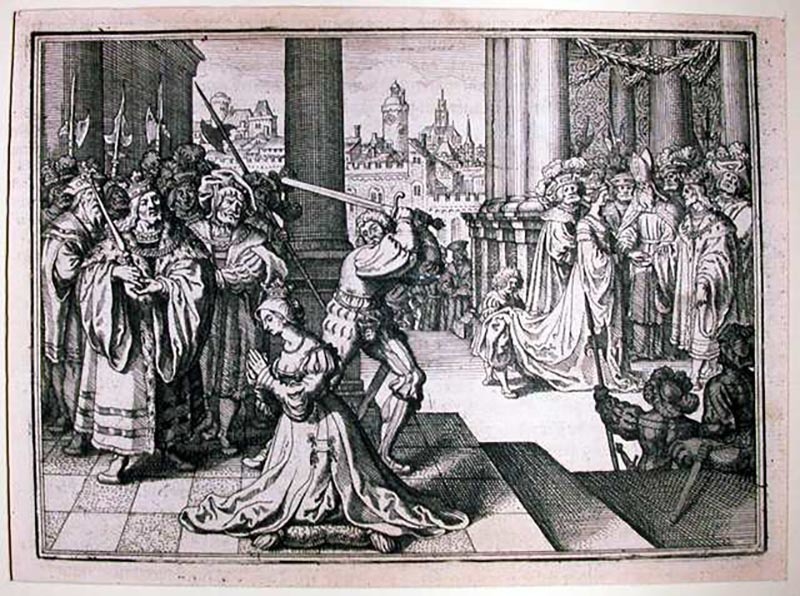
481 years ago today, a regally dressed woman, who truly needs no introduction, knelt before a crowd of her peers on London’sTower Green, moments after beseeching of them their prayers for the prosperity of her Sovereign lord: that ‘goodly’ King of England,Henry VIII of whom she was now divorced – that possessor of the fatal hand who executed her death warrant. That accuser of witchcraft,adultery – and most horrifically, of incest. Draped in a cape of ermine fur – a style formerly designated to reflect the status of her (once) most exalted station - the woman who would die a"Queen”to her allies – and a"concubine"to her enemies,[1]wavered momentarily during her cry of adulation for her single greatest foe – her one time lover and life partner who had so callously cast her aside for one of her very own ladies-in-waiting. Readily, Anne Boleyn steadied the quaver in her throat – perhaps distracted by delusions of an 11th hour reprieve - before succumbing to a trembling bout of nerves. Submitting to that all-too-late and momentary cold slap of reality, she darted a fearful glance over her shoulder at the finely dressed Frenchman from Calais, who stood just behind her. Perhaps the dethroned monarch expected to faint away fast at the sight of the glistening blade of a freshly sharpened sword steadily arching toward her"fair neck"[2]- saving her from the spectacle of being caught unawares, and from crying aloud and thereby dismantling before the several thousand spectators[3]who had gathered to witness the unusually restrained demeanor of the royally condemned. What Anne Boleyn saw instead was the unmasked face of her husband’s hired assassin. It was a kind face: one that bespoke of generous and thoughtful consideration for her untimely plight. He would strike, he warned the former queen, only after giving her fair warning. It would be just one of the many lies cast upon the former monarch in an effort to both placate her and assuage her fears.
It would also be the last.
As the regal woman, once formerlyQueen of Englandbegan reciting a prayer for the Lord to receive her soul, the swift arc of the expertly yielded blade sliced though the neck of Anne Boleyn. So precise was the cut by the assassin from Calais, the very lips on the now severed royal head appeared to continue on reciting the condemned's solemn prayer.
A 19th century German illustration depicting the execution of former
English Consort Queen Anne Boleyn, c. 1830. The doomed monarch was
beheaded 481 years ago today - exactly - May 19th, 1536, which just so
happened to also fall on a Friday.
The rise and fall of Anne Boleyn, consort and second wife to 16th century King of EnglandHenry VIIIis the stuff of legend. Her tragic fate has inspired countless poets, screenwriters, librettists and authors to convey her story (as they see it). Perhaps the most famous ‘retelling’ of the plight of the much maligned queen – where the arts are concerned, lay in Italian composer Gaetano Donizetti’s1830 tragic opera“Anna Bolena,”a two-act composition so titled after it’s namesake. But much of what we thinkwe know of the Queen is part and parcel of that age-old adage that decrees that the truest version of history lay with the victor - and Anne certainly had her detractors. In fact, we aren’t really sure if the famous last words of the former Queen (in which Boleyn never once admits to any guilt for the offenses charged against her) - as retold by Edward Hall,an English member of Parliament and Under-Sheriff of London - were actually spoken by Boleyn, or were the half-manifested product of the Officer’s imagination – or worse – false recall, politically motivated or not. The Tudor propaganda machine,historically, had been one of the most heavy-handed, stalwart mechanisms that often succeeded by churning out defamatory accusations against anyone who stood in the way of - or threatened - the royal crown (including consorts) often by means of torture, the threat of torture, or by exacting the ultimate form of punishment: the public execution. Thus, it is with great difficulty for historians of the era to discern with any fair degree of certainty the fact from the fiction – even concerning the smallest minutiae of the lives of their victims. That doesn’t make the lives of those living under the royal yoke of the renaissance any less interesting. Quite by contrast, it ignites a very constant, almost universal fascination with the attempt to uncover the truth. Such an example of this fascination – where Anne Boleyn is concerned – occurred only recently, in 2015, when researchers brought to light a 16th century musical scrapbook containing the works of several highly prized Franco-Flemish composers, said to have been signed by – and possibly even owned and compiled by - the Queen herself: the most interesting scores in the lot being those pieces of anonymous authorship – one of which(“O Deathe rock me asleep”)may have been composed by Boleyn herself as she effectively sat on death row, awaiting her final exit from both her former realm and the worldly sphere.
Inscription from the music book bearing Queen Anne Boleyn's signature
The loosely binded (ravaged by the hands of time) 42-piece scrapbook, now preserved at The Royal College of Music, London, bears the inscription“Mistres ABolleyne nowe thus”followed by a portion of musical notation. Scholars of the era have suggested the styling of “mistres[s]”as being indicative of the former consort’s time as concubine to a married Henry VIII, who was then famously wed to the unfortunate Spanish QueenKatherine of Aragon-“nowe thus,”they remind us, was the motto of father to Boleyn, Thomas Boleyn, 1st Earl of Wiltshire. They believe mistress Anne started the book during her time in France as maid of honor to Henry’s sisterMary,and later, to Mary’s stepdaughter,Queen Claude.It was in France that Boleyn is believed to have immersed herself in the courtly arts, chiefly, in the areas of manuscript illumination, literature, poetry, and music. Like her future daughter with King Henry, Elizabeth, Anne is said to have mastered playing – and possibly composing music for – the lute. Therein lies the supposition that it was Anne who authored not only the lyrics – but possibly even the music forDeathe rock me asleep,which reads most languorous:
“O Deathe rock me asleep
Bringe me to quiet rest
Let pass my weary guiltless ghost...
For I must dye, there is no remedy.”
A beautifully notated selection from the scrapbook said to have belonged to Anne Boleyn
Upon it’s discovery, some 500 years after the scrapbook’s final entries were sewn into the fragile binding, Director of Music at Sidney Sussex College (Cambridge) and head of theAlamire choir(named after the 16th century royal composer and spy, Petrus Alamire of Bavaria)Dr. David Skinnerselected 20 pieces of music from the tome – many of them by renowned artists of the era, possibly known to - or, as in the case of French composerJosquin Desprez,patronized by Boleyn herself – and recorded them for the pleasure of modern ears. Included in those recordings – for which Skinner earned Best Vocal & Choral CD of 2015forAustralia’s Limelight Magazineand a nomination for the covetedBest Album awardbyBBC Music Magazine– is the mysterious and doleful lament…that just maybe among those so-called “known” final words - and thoughts - of Queen Anne Boleyn herself.
Listen to a recording of O Deathe Rock me Asleep below, followed by a delicious recording by a Boleyn favorite composer (and recipient of the Queen’s royal patronage), Josquin Desprez, in the 16th century composers’ setting of “Stabat Mater" (Dolorosa): *UPDATE / NOTE 12.26.17: Much of the Alamire/Skinner album unfortunately is no longer on YouTube, however listen below to the piece"O Deathe.." performed by Mezzo-Soprano Catherine King and the Rose Consort of Viols, and, in lieu of the now removed Dolarosa by Desprez, I am replacing the latter with the composer's "Praeter rerum seriem," which is included in Anne's Song Book and is recorded by the Alamire Choir under Skinner:
Footnotes:
[1] The harsh epithet was famously so lauded on the now decapitated Queen by the Catholic Imperial ambassador to Emperor Charles V, Eustace Chapuys, who messengered the following note to his employer (excerpt): “The execution of the concubine took place at nine o’clock this morning in the tower…" [2] Boleyn famously referred to her “fair (little) neck” in an exchange with her jailor, Constable of the TowerSir W. Kingston. True or fictitious as the account may be, it does lay small credence to the notion that the Queen approached her death in an ‘unusually calm' manner. From Kingston’s letter to Thomas Cromwell, dated the day of Boleyn’s execution, May 19, 1536:
“This morning she sent for me, that I might be with her at such time as she received the good Lord, to the intent I should hear her speak as touching her innocency alway to be clear. And in the writing of this she sent for me, and at my coming she said, "Mr. Kingston, I hear I shall not die afore noon, and I am very sorry therefore, for I thought to be dead by this time and past my pain ". I told her it should be no pain, it was so little. And then she said, "I heard say the executioner was very good, and I have a fair neck", and then put her hands about it, laughing heartily. I have seen many men and also women executed, and that they have been in great sorrow, and to my knowledge this lady has much joy in death. Sir, her almoner is continually with her, and had been since two o'clock after midnight.”
[3] Also from Chapuys' account to the Emperor Charles V "...the thing was not done secretly, for there were more than two thousand persons present.”
“Hello Rose…if you were planning a romantic evening with a new (or old) friend, and could pick only one piece of music, who/what would you pick and why?...”
Unraveling Musical Myths answers your
questions! To submit via e-mail, use the
contact form provided in the sidebar (bottom R).
Thank you for your inquiry, Craig. I imagine you are preparing for Valentine’s Day, yes? If I could only choose one piece of music (what a difficult choice to make!) for the occasion, it would be Gaetano Donizetti’s“Una Furtiva Lagrima” (A Furtive Tear)from the composer's 1832 operaL’Elisir D’Amore (The Elixir of Love) performed by French/Mexican tenor Rolando Villazón. The aria is a classic romantic ballad – it’s back story delightfully charming: the peasantNemorino(Villazón), hopelessly in love withAdina – a wealthy landowner – downs what he believes is a specially concocted “love potion” (which he receives from the village quack, a 'healer' named Dulcamara - and which is in reality not a love potion at all but rather a cheap Bordeaux wine) in a desperate attempt to gain his beloved’s affections. Unaware he has recently inherited a sizable fortune (from his recently deceased Uncle), Nemorino, filled to the brim with confidence thanks to his magic ‘elixir,’ walks into a room containing his ladylove (who is surrounded with a band of women). He is immediately enveloped by a flock of otherwise fickle females – all of whom have eyes only for his newfound fortune. Moved by an overzealous sense of ego, and more than a soupçon of cockiness, Nemorino plays hard-to-get and ignores everyone in his immediate sight – including Adina, who swiftly exits the room in disappointment. It is at this moment Nemorino realizes that the much-covetedobject of his affection shares his feelings of love. Overcome with emotion, he can only sing of hisfortune:
“She loves me, that I see!...O God, I should die – I could not ask for more!”
Who among us hasn’t felt the anxiety of uncertainty, questioned the nature of our courtship, experienced the thrill of release? I would choose this aria for these reasons alone: its sentiment - as experienced and expressed through Nemorino - is a universal one.
Enjoy below Rolando Villazón’s incredibly moving rendition of this staple of romantic classical music (in a encore performance at Vienna’s Wiener Staatsoper):
Discover more (external link):
Read a translation into English (from the original Italian) at aria-database.com:
As Scotland recognizes the birth of it’s 16th century monarch, Queen Mary Stuart - born this December day in 1542 at the Heathered Isles’Linlithgow Palace, Unraveling Musical Myths takes a look back at the ill-fated rulers only true stronghold in the annals of British history: her impressive post-mortal foray into the world of symphonic muses. Queen Mary’s tragic life and all-too-brief “reign” (if one could even call it that in the era of ruling noble factions in Scotland) has been covered extensively on this blog. You may find background on this notorious femme fatale by perusing the archives. In brief: the young, hapless Queen, who attempted rule by matters of heart over matters of state was internationally reviled over the course of her blink-of-an-eye reign, save for the French King, Henri II and his sickly son, the dauphin François who Mary was all but forced into wedding after England’s tyrannical Henry VIIIset siege on Scotland (a violent period of British history known as"The Rough Wooing") in an effort to kidnap the young royal and force a betrothal to his only legitimate son, the future king of England Edward VI - which forced Marie de Guise(mother to the queen) to make a marriage pact for her daughter with François – and in effect with France – in exchange for exile and for a French military presence in Scotland to help the nation defend themselves against the troublesome English. Detested by the French Queen Regent and conspirateurCatherine de Medici, Mary would be swiftly ousted from Court following the unexpected premature death of King François by inner ear infection in 1560. No longer Queen Consort of France, Mary sought to regain control over her native Scotland and chose to retreat there. It would be a disaster right from the beginning. The Queen had just but set foot on terra firma after a stormy crossing at sea when the young Catholic ruler was met - rather rudely - by the Protestant leader John Knox, who loudly chastised the Queen and cursed her very arrival on Scotland. This was not the Catholic Scotland of her youth – this was a country in the midst of a Religious Reformation.
[1]Wedded bliss? A smug portrait of Lord Darnley, flanked by Mary.
Lord Darnley was born Henry Stuart - making the former Consort King
first cousin to Mary.
One disastrous marriage later to the consort kingLord Darnley[1]– a highly vainglorious, narcissistic lout sent to the Island by Mary’s cousin, Queen Elizabeth I of England - and the persistent ruler would find herself embroiled in a series of diabolical plots – both as victim and as alleged manipulatrice – that would prove to be her undoing. First, her close confidant and alleged lover, the luteist David Rizzo is executed in front of the Queen by her jealous husband after Mary shocks the nation by appointing him – a commoner -Secretary For Relations With France. It seemed Lord Darnley had political aspirations of the highest degree and would stoop to any level in order to overthrow his wife, disinherit her child (the future "Union King," James VI and I), and secure for himself the Scottish throne (including accusing Mary of a treasonous affair and alleging the child she presently carried in utero to be the illegitimate spawn of a humble musician – hardly fit to be a future King). Lord Darnley would pay dearly for his transgressions when Mary – and her very real lover – the Scottish LordJames Hepburn (the Earl of Bothwell),successfully launched an almost aborted coup d’état by first attempting to blow the king up as he slept, and, when that failed, by chasing him down and throttling him to death. As enraged nobles - all of whom carried their own political aspirations - sought to imprison and execute the Queen and Lord Bothwell for the heinous murder of Lord Darnley, Mary once more sought exile – this time sailing South, to England, where she rightfully possessed an heirship to the English Royal Throne via the female line of Tudors (Margaret, sister to Henry VIII was Mary’s grandmother through her marriage to the Scottish King James V – Mary’s grandfather).
Mary's only surviving son, James Stuart may have come
out the winner in an ages old battle for the British
Throne, yet his coronation would prove him to
be undoubtedly the son of the hapless Queen Mary
when it was announced that the newly-minted King
would receive his Coronation in the midst of a plague
that was busy decimating Europe. The "Union King"
as a result would receive none of the royal
festivities traditionally granted to Kings to mark the
historical occasion. It seemed the so called
"Stuart curse" (coined during his mothers reign) preceded him to the throne.
England itself was embroiled in a religious revolution, and those remaining Catholics who felt themselves thwarted by the Queen and punished for their worship were engaged in countless plots to overthrow the Protestant Elizabeth – a "usurper" of the English throne once declared by King Henry VIII himself (Elizabeth’s father and England’s former king) to have been abastard child- and place who they felt was the “rightful” Queen on the English throne: Mary Stuart. Mary herself famously became involved in several of these plots – how deeply involved remains hotly contested depending on which side of the United Kingdom one hails. In any event, the former Queen would be subjected to a show trial, promptly found guilty, and, after much hesitation, beheaded by an executioner in Elizabeth’s employ. In a cruel twist of irony (or as a matter of just desserts – which ever be your pleasure) Mary’s son,James,who had been raised English – and Protestant – would effortlessly accomplish what Henry VIII had sought to accomplish during his so-called "Rough Wooing" some sixty years earlier, and what Lord Henry Darnley sought to steal from Mary, and what Mary herself ultimately sacrificed her life for whilst trying to become:the heir presumptive of aUnited England. After Elizabeth died bearing no offspring in March of 1603, a middle-aged James automatically secured for himself the throne of both England and Scotland, simultaneously establishing the Stuart dynasty - and bringing together the two millenia-oldenemy nations under one Monarch, efectively setting the stage for what would eventually bceome The United Kingdom of Great Britain and Ireland, realized in 1801.**
Mary's only surviving child (she tragically miscarried twins whilst in prison) would reign gloriously over the British Empire asJames I of EnglandandJames VI of Scotland.
Mary’s fascinating life and tragic death have spawned countless biographies, plays, biopics – even a television series. Her many failed exploits are the stuff of legend. The classical music sphere knows her best as a scorned coquette in maestro Donizetti’sMaria Stuarda(click here to listen to “Mary’s” famous aria “Quando de Luce Rosea”) ...butDid You Know?
Queen Mary Stuart was also honored in the form of Lieder? Both megalithic composers Richard Wagner and Robert Schumann (who used the Queen’s own writings as his libretti) were just a few of the many famous and revered musicians to have set the fateful Queen’s life to music. Listen below to Herr Wagner’s“Les Adieux de Marie Staurt: Adieu, charmant pays de France" (The Farewell of Mary Stuart: Goodbye, my beloved country of France”) [left] followed by Schumann’s five-song collection “Gedichte der Königin Maria Stuart” (Poems of Queen Mary Stuart, or Mary Stuart Songs (colloquially)), for voice & piano (Op. 135) [right]:
Learn more about these lieder (external links):
“Les Adieux de Marie Staurt: Adieu, charmant pays de France"
**Whilst this Union, known as The Union of the Crowns, would unify the England and Scotland under one Monarch through James's ascension to the throne, both countries remained separate nations with separate parliaments. This crucial inheritance, however, must not be downplayed, as it set the stage for a Single Sovereign State under Queen Anne in 1707, herself ironically the last Monarch of the House of Stuart.
Thus, James' ascension was a pivotal step in the future creation of the United Kingdom, as the future Queen Anne's Acts of Union in 1707 effectively abolished the parliament of England and Scotland, uniting the nations to create a new, single parliament, henceforth known as Great Britain, which would be established in Westminster.
Throughout Anne's reign, she was also Monarch of the Kingdom of Ireland, however it continued to maintain its own parliament, whilst remaining subordinate to the parliament of Great Britain in London. As all of the Queens 11 heirs pre-deceased her, and with the clear directive established in the a document dubbed the Acts of Settlement created in 1701, which stipulated a ban on all remaining Catholic Stuarts for eligibility to the throne during the still contentious Reformation era, the third, final stage of the creation the United Kingdom of Great Britain and Ireland was established in 1801 under George III from the House of Hanover, which unified the Kingdom of Ireland into Great Britain, abolishing the former's parliament, thus joining England and Scotland under one Monarch.
The ties to the House of Stuart remained, not only through predecessors who set the stage for this monumental event, but also through bloodline, as George III was a direct descendant of the House of Stuart through his ancestor George I, the first son of Sofia of Hanover (George was therefore grandfather to James VI/I). Simply put, due to Queen Anne's lack of heirs, not to mention the caveat in the 1701 Act of Succession, which would have bypassed all remaining Catholic Suarts for eligibility to the throne during the contentious Reformation era, the house of Hanover never would have acceded to the throne were it not for the Stuart family lineage, and the implantation of James VI/I, son of Mary Queen of Scots, to the throne of England.
Today’sAUTHOR’S CHOICEentry is made in honor of 18th to early 19th century poet, playwright,historian and physician, Friedrich Schiller - arguably one of Germany’s greatest exports of political and philosophical minds, who also happens to hold the much coveted distinction of frequently sourced and internationally renowned contributors to art and authorship. Schiller, who died this day on the 9th of may, 1805 at the tender age of 45, was a pioneer of the famed Weimar Classicism movement - producing a litany of his most beloved stage-plays in the late 18th - early 19th centuries.
Much like Schiller’s contemporary and close companion, Johann Wolfgang von Goethe (who, alongside Schiller, became the most famous of the movement: Goethe would pen his famous Faust during this period), the German polymath would become one of Western Classical Music’s most favored authors on which to source material for constructing libretti (one could, in this instance, refer to Schiller as theGerman Shakespeare,although he operated at a far less output than the Bardand is thusly less sourced by comparison. It is highly probable Schiller would have continued writing, were it not for his untimely demise). I have selected for the reader four of my favorite Schiller-inspired arias from the world of Opera, all of which are based on the works of this most revered master ofGestalt:
I)ELLA GIAMMAI M'AMO – DON CARLOS – GIUSEPPE VERDI BASED ON:the play Don Carlos, Infant von Spanien (Don Carlos, Infante of Spain; produced 1787) as sung by German Bass René Pape:
Today’sQuote of the Day/ ‘Aria’ of the Month feature comes to us in the form of commemorative observance of the death of Italian belcantist composerGaetano Donizetti,who left this earthly sphere 168 years ago today on April 8, 1848 at Bergamo in Italy from the advanced stages of neurosyphilis. Today’s delicious quote was authored by a pubescent Donizetti, who, filled to the brim with of youthful optimism, would pen a poem at the tender age of 14 which would seem to accurately foreshadow his future successes in the realm of classical music and opera and certify him as an Icon of the artform:
"Ah, by Bacchus, with this aria I shall receive universal applause. People will say to me, “Bravo maestro!” I, in a very modest manner, shall walk about with bowed head; I’ll have rave reviews...I can become immortal... My mind is vast, my genius swift... And at composing, a thunderbolt am I!"
Donizetti’s ‘prediction’ was never so true as when applied to the infamous “Mad Scene”from his 1835 opera Lucia di Lammermoor (an opera based on the writings of Sir Walter Scott, who penned the novel “The Bride of Lammermoor” in 1819, itself influenced by actual events). Not only had Donizetti scored for his female lead a recitative and aria that would become something of a show-off piece (the fabulous“Il Dolce Suono”from said ‘Mad Scene’ that would become famous an an opportunist piece for those highly aesthetically gifted sopranos specializing in the bel canto style).
Playwright Salvadore Cammarano
would become Italy's most sought-after
librettist following the success of Lucia
di Lammermoor
The success of Lucia di Lammermoor wasn't just limited to high ticket sales or the blossoming reputation of it's composer: the dramma tragico certified Italian playwright Salvadore Cammarano as a most sought-after librettist, having been the fourth and most successful librettist to set Scott’s Lucia to music. Cammarano would go on to pen seven more operas with Donizetti during Lucia di Lammermoor's ten-year triumph over Italy as a “masterpiece” of the bel canto artform. He would later become librettist to one Giuseppe Verdi, penning the words to operasAlzira (1845), La battaglia di Legnano (1849) and Luisa Millerin (1849).
Following the rise of Wagnerism and the Romantic movement in Western classical music, both the bel canto artform and Donizetti’s most famous ‘scene’ fell out of vogue until the resurgence of the art of “beautiful singing” once more took hold of audiences in the late twentieth century, with the recitative and aria in question once more made famous (and, quite frankly, made exploited) by stratospherically talented belcantist sopranosJoan Sutherland, and a rather muted Maria Callas (who originally objected to the insertion of vocal abbellimenti as made popular by her contemporaries, preferring to sing the piece "come scritto" (as written). Even when sung under these 'normal conditions', Callas’ 1952 performance at Torino in Italy under the direction of conductor Oliviero di Fabritiis would showcase the both the demanding nature of the aria and of the divas stunningly agile vocal prowess, which, like a gloriously emboldened eagle taking flight, Callas' vocal flexibility would appear to soar to dizzying heights. As interest in the bel canto style continued to flourish well into the late 20th and present century, Donizetti’s ‘showpiece aria’ would continue to be performed by remarkably agile masters of the flashy coloratura vocal style, usually featuring highly embellished ornamentation.
Enjoy below April’s ‘Aria’ of the Month, the so-called “Mad Scene” from Gaetano Donizetti’s Lucia di Lammermoor, featuring the beautiful yet melancholic recitative “Il Dolce Suono” as sung by soprano Joan Sutherland (aka LA STUPENDA), in what became known as her ‘breakthrough’ role. Video below features a "recreation" of her debut as Lucia:
When studying the lives of the great innovators and composers of Opera and Classical music in times past, one trend seems to run so rampant amongst these prolific minds that it seems to jump off the page. I am speaking of the markèd appearance of mental derangement amongst many of the 16th to 20th century composers who lay at the forefront of Western Classical Music, each of whom shared, in varying degrees of severity, a cognitive degradation which would manifest itself over time, as a result of physical disease and aberrant psychological pathology.
Conductor Carlos Kleiber
As we have already seen in my posts on late sixteenth century Murderer-Prince and Secular Composer Carlo Gesualdo and in the lives of twentieth century conductors Erich and Carlos Kleiber - and not to mention the famous patrons of Wagner and his contemporaries - mental illness, in it’s vast and varied forms, ran the full gamut from depression and it’s resulting anxieties, to obsessive compulsions and megalomanics (I admit, as in the case of Wagner), all the way to the opposite end of the wellness spectrum with hyper-sexual pedophiles (as seen in one Aleksandr Scriabin), to murderers and proponents of suicide. We have also seen a rampant "supernatural cultism" (in the form of superstitions and their believers) emerge from followers of Verdi and Paganini, who considered the ‘cosmic reality’ found in the works of these virtuosos as being so ethereal, they believed the musicians themselves to be of a paranormal origin: in the case of Verdi, a deity on earth. In Paganini, il diavolo possessed (the former a school of thought we would see again in the life of - and indeed, after the death of - the late soprano Maria Callas.) Others would take 'occultism' one step further, as in the case of Gesualdo and Scriabin, both of the criminal sub-set of society. Whilst each were undoubtedly exceptionally erudite characters from a creative perspective, both composers considered themselves proponents and practitioners of the ‘art’ of 'witchcraft.' This is not to suggest that any form of mental illness is a requirement for genius, as is commonly believed. As we will see, particularly in the case of Anton Bruckner, (and as already noted in my post on Gesualdo), many of the ailments suffered by so many of our most beloved composers and members of the classical arts were, at least in part, very much a product of the times in which they lived. In most instances, medical advancements in the area of psychology still had much room to grow (one can successfully argue that this field remains in it’s infancy stage even today) and, in some cases, germ-theory was practically non existent, resulting in catastrophic degrees of disaster and repeated states of religious turmoil. We begin our descent into madness with a select group of composers, performers and musicians, each of whom were considered to be ‘touched’ (a highly derogatory term formally used to describe the mentally afflicted) not only by a prolific genius, but also by something considered far more sinister by their contemporaries:
GLENN GOULD
20th century pianist Glenn Gould.
This native of Toronto, Canada was afflicted with a case of OCD (Obsessive Compulsive Disorder) that presented itself with dips of incapacitating anxieties related to germs and general human interaction. The renowned pianist would leave the touring circuit at the height of his success and extricate himself from his own mother’s death bed (so afraid of the germs in hospitals was Gould.) A common recluse for most of his adult life, it is debatable whether this innovator of Bach’s Goldberg Variations lived in a state of severe depression due to his self-imposed lack of social interaction, or whether he found solace and comfort in isolation (much about OCD is highly misinterpreted and misunderstood - even amongst many of the professionals who diagnose it.)
The virtuoso once claimed to “love the night and darkness”, had dreamed about vacationing to the uninhabited polar regions of Canada (a dream and likeness I share!) and famously debased the touring circuit and it’s residual fame as unnecessary and gauche when he declared ‘audiences en masse’ to be “hideous...a force of evil.”
It is said that outside of a few romances (one of which carried with it children), Gould had almost no friends at all - likely as a result of his isolation. It is believed the reclusive pianist shifted his idle focus onto his own person in his later years of life, becoming one inch shy of turning into a full blown hypochondriac. The pianist allegedly kept a detailed log of any physical manifestations or imperfections he’d find whilst examining his body, and visited a series of doctors in order to create for himself a 'perfect cocktail' of drugs which he would take at his leisure as a result of the prescriptions he had obtained while ‘doctor shopping’. The infamously mysterious and eccentric pianist died alone, in October 1982 in his hometown of Toronto, Canada.
GUSTAV MAHLER & ARNOLD SCHOENBERG
Austrian Composer Arnold Schoenberg
Late 19th-early 20th century Viennese composers Gustav Mahler and Arnold Schoenberg, respectively, also suffered from depression-induced self-isolation and OCD-like symptoms (while not at the threshold of Gould, who used to soak his hands in water so hot, they glowed a bright hue of red.)
OCD is not relegated only to the musical
realm - one famous victim of the illness,
twentieth century tycoon and aviator Howard
Hughes suffered incapacitating symptoms
which were so ill managed by the end
of his life that the handsome entrepreneur who
seemed to have it all (much like our beloved
composers) was reportedly unrecognizable
at the time of death - a result of years of
malnutrition culminating from the time spent
performing cleansing rituals - and possible
alleged drug use (chronic pain often goes
hand in hand with OCD. The common school of
thought would seem to suggest an unconscious
desire for control over environment in lieu of
control over pain.)
Schoenberg famously brought the topic of Triskaidekaphobia (an intense fear of the number 13) to light, and tried to avoid the number at all costs through most of his adult life, compulsively seeking the ‘visions’ of astrologers. It is said the composer’s greatest fear was that he would meet his demise during any year that was a multiple of the number 13. He would spend many a birthday in a self-imposed seclusion, terrified at the thought of what might happen.
In 1939, Schoenberg had a friend consult an astrologer to get the final word on his limited mortality, so afraid was the composer of turning sixty five the following year (1940: 9+4 =13.) His birthday, of course, came and went without incident. That didn’t stop the obsessive Austrian from again consulting his band of astrologers, who, to Schoenberg’s horror, informed the composer of another 13 - this time hidden in his age at 1950: seventy-six (7 and 6, of course, equal 13.) The astrologer wrote in his correspondence to Schoenberg, not of a fatality per se - but rather of something of undetermined significance that would be occurring that year. Oddly enough, the year 1950 would be the ill-fated composer’s last. He died, twelve minutes before midnight - on Friday, the thirteenth day of July, 1951. He had just missed his 77th birthday by two months..which, bizarrely, would have been on September thirteenth, 1951.
Gustav Mahler is a special case: having survived the deaths of six of his young siblings (mostly from scarlet fever and diphtheria - two highly fatal infectious diseases that would not see a curb in mortalities until the ‘accidental’ discovery of penicillin by Sir Alexander Fleming in September of 1928) and having witnessed the suicide of another young brother, Otto, who shot himself to death in 1895 when Mahler was 35.
Austrian Composer Gustav Mahler
Gustav was especially close to Otto, and his death prompted the then-middle aged composer to famously declare "I am thrice homeless, as a native of Bohemia in Austria, as an Austrian among Germans, and as a Jew throughout the world. Everywhere an intruder, never welcomed" – an indication of destiny’s decree to thrust upon him a life tampered with forced periods of isolation and seclusion, remarkably affecting the composer’s outlook on life. Sadly, tragedy would strike again for down-trodden composer, when his own kin, daughter Maria Anna (his eldest by his wife and fellow composer Alma Mahler) died at the untimely age of four from a sinister culprit well known to Gustav: scarlet fever and diphtheria. Mahler’s only reaction to a life filled with such catastrophe was to immerse himself in music - themes of death were a regular occurrence in his compositions, most notably (and ironically) in his setting to music of the so-named “Kindertotenlieder” - a series of poems by famed German poet Friedrich Rückert, which deal with the psychological impact of the deaths of children, which he had commenced just six years prior to Maria Anna’s death.) Conversely, it can be seen later in life that Mahler seemed to resign himself to an intense desire to experience self-imposed isolation. He had confided in his wife that he wished nothing more than to “experience a life in isolation” with her, and, later, in a letter to his beloved, he mused on the spiritual aspects of such a life: “...when one spends longer periods on one’s own, one comes to a unity with nature...this is only normal. Isolation helps us to find ourselves, and from there it is but a small step to God...”
A disheveled portrait of Russian composer
Modest Mussorgsky as he appeared
just days before his death.
Obsessive Compulsives and complex phobias weren’t the only illnesses to manifest themselves in the lives of the Great Composers. The physical (and mental) effects of drug abuse and alcoholism would claim the lives of noted librettists Paul Marie Verlaine and Charles Baudelaire, whose toxin of choice was Absinthe (a alcoholic tonic later made famous by famed author Oscar Wilde), and in Baudelaire’s case, a toxic mixture of the drink, laudanum (an extract of an opiate similar to morphine) and opium (a drug famously used and propitiated by French Romantic composer Hector Berlioz, who famously composed La Symphonie Fantastique under it’s influence in 1830.) Much like the late Verlaine, composers Modest Mussorgsky and Johannes Brahms would suffer cirrhosis of the liver and it’s unsightly side effect of jaundice, and in Brahms case, a lifelong addiction to alcohol and an already diseased liver would later turn into cancer of the same organ. In both instances, drink would kill both megalithic composers.
Schizophrenia would rob from the stage a Russian (and indeed, a Parisian) icon in internationally celebrated ballet dancer Vaslav Nijinsky, who, after a period of forced sabbatical in Budapest during the first world war, would unsuccessfully try to initiate a tour of South America in 1917. Two years later, an underlying illness that had only formerly manifested itself as Obsessive-compulsive in nature would be diagnosed in the form of Schizophrenia when telltale symptoms of the illness began to rear their head following the dancer's arrest in Hungary and a failed tour. He would live the rest of his life (some thirty years) in and out of mental asylums, never once returning to the stage. A great many prolific composer were said to suffer from "Severe Depression" (now known as Major Depression):
Russian composer Pyotr Ilych Tchaikovsky
There is Sergei Rachmaninoff, who famously dedicated his Piano Concerto No. 2 in C minor to his psychiatrist, Hector Berlioz(also afflicted with OCD and who had once attempted a murder-suicide), Composer-Prince Carlo Gesualdo(alleged to have suffered a lifelong depression following his criminally culpable murder of his ex-wife, her lover and child in the 16th century) and Pyotr Ilych Tchaikovsky, who is believed to have committed suicide by intentionally drinking cholera-infected water following a lifelong struggle with homosexuality - and that's just to mention a scant few. As remains the case today, there existed those whose obsessions and/or depressions were so great they may have taken suicidal measures as an antidote:
Italian (and later French) composer Jean-Baptiste Lully
French composer and director of the Académie Royale de Musique,Jean Baptiste Lully was said to be so obsessed with, and so overcome by the shunning of King Louis XIV of France due to the former's homosexuality, that he initiated a frenzied performance of his setting of the Te Deum (which he had composed especially for the King) in 1687, violently pounding a largeconducting staff to the floor. In an overabundant display of emotion, the hapless conductor accidentally missed his mark and stabbed himself through the foot instead. 17th century Europe was far from the age of medical revolution. After a brief period of cupping, blood-letting and leech therapy, infection set in. The stalwart Lully could think only of the King, whom he had once taught to dance, and refused what likely would have been a life-saving amputation. The enamored musician was warned of the the consequences of failing to have the operation, but it was of no use - Baptiste would have none of it. He needed to dance with the King - and therefore the leg needed to stay.
Unfortunately for Lully, gangrene set in, traveling to and infecting his brain, killing the love-struck composer.
Erich Kleiber
Fellow conductors, this time of the 20th century,Erich and Carlos Kleiber (father and son, respectively), are both rumored to have committed suicide (although in both cases, this is speculative.) The patriarch Kleiber was found by a young Carlos, submerged in a tub, in a pool of his own blood inside of the family bathroom in January of 1956 following his rejection as music director of the Vienna State Opera. Erich was said to have mourned greatly for this oversight prior to his death. Some sixty years later, Erich’s consummate son Carlos, would himself be found dead under mysterious circumstances. Carlos was notorious for his need to self-isolate, rarely even finding himself on the podium (as compared to contemporaries.) He was considered to be a troubled genius of mammoth proportions, yet little is known about his private life. What we do know, from the interviews of his personal physician, is that Carlos was diagnosed late in life with a treatable form of Prostate Cancer. We know that the recently retired Carlos refused any form of treatment, and, following the death of his beloved wife Stanka, holed himself high up in the hills of Slovenia, just adjacent to the burial ground in which his wife lay. His body would later be found by his daughter on a visit to the home some six days post-mortem. Whether the enigmatic icon committed suicide (as it is alleged his father had sixty years prior), and by what method - or simply died as a result of the untreated cancer flowing through his veins - will likely never be known, and if there exists anyone who does know, it seems fitting that the legacy of the intensely private conductor live on in an lasting and enigmatic mystery. One thing about Carlos’ mental state at the time of his death can be said for certain: the conductor was quite bereaved at the loss of his beloved Stanka. Certainly, it is reasonable to infer from her passing and the circumstances surrounding his own demise a suggestion of prolonged suicide: Carlos had to have known, after all, that refusing any treatment for his cancer diagnosis would be an exercise of almost certain futility. Even if a ‘quick’ method of suicide were not a distinct possibility, the decision to let nature run it’s course certainly would have been a fatal one.
English conductor Sir Edward Downes
There is another conductor, this one who lived in more recent times, who also had a hand in his own death. Much like the understandably difficult physical and mental experiences of Beethoven and Bach, who had gone deaf and blind respectively (whilst still in their productive years), 20th century English conductor Sir Edward Downes would meet his end both visionless and anacusic.
The good conductor surely must have empathized with the tragic plight of Bach, who had the misfortune of undergoing a botched cataract surgery - performed by the 18th century's most nefarious ‘quack’, the Chevalier John Taylor - whose questionable methods had left him completely blind.
Like the baroque maestro, Sir Edward Downes knew of the mental anguish that accompanied the loss of such important senses (tragic for anyone - especially so for a conductor) that he, at age 85, alongside his wife, Lady Joan Downes took the modern (and what I believe to be the respectable) approach, when they applied for, and were granted, the services of physician-assisted suicide at the infamous Dignitas Clinic in Zürich, Switzerland on July 10th, 2009.
Both drank, under the supervision of a qualified pro-end-of-life physician, a lethal cocktail of antimetics and barbiturates, before succumbing peacefully into oblivion.
John Taylor was a known ‘oculist’ who would perform
surgeries in the public town square, and was said to leave
town ‘before the bandages came off’. His solution for his
disastrous surgery on Bach was remedied by the common
‘quack’ methods of the day: blood letting and cupping!
Within four short months, the composer would be dead.
Astonishingly, the Chevalier Taylor performed the same
procedure on Georg Friedrich Händel - who he also blinded.
The psychological effects of physical disease are not always secondary or psychosomatic in nature. Serious infections, if left untreated, can manifest themselves in a variety of aberrant and involuntary behaviors, often resulting in fatality. This was the case for the following slew of prolific composers, all of whom suffered from varying degrees of psychopathy as a direct result of a virulent strain of syphilis:
Franz Schubert -died in November 1828.
Although the official cause of death is listed as typhoid fever, later re-examinations into the death of Austrian composer and prolific pianist Franz Schubert has indicated a cause of death resulting from the use of mercury as a means of treatment for the tertiary (late) stages of Syphilis. Although there is scant literature available that dialogues the mental state of the late composer, there does exist a wealth of information in the form of reports concerning the physical symptoms that would seem to support the mercury theory. It is said the beloved pianist experienced a wide range of maladies: headaches and swollen joints, fevers and vomiting so severe Schubert is believed to have starved to death, unable to keep down any food.
Mikhail Glinka -died in February of 1857.
Although the composer is said to have died following a seasonal viral infection, Glinka’s own memoirs detail the psychological ramifications of syphilis:“thoughts [are] crowded my brain unasked” (a sign of a severe condition known as "General paresis of the insane" which strongly mimics the symptoms of schizophrenia, brought upon by late-stage syphilis). The composer also alluded to “musical hallucinations” prior to his death (typical of general paresis).
Hugo Wolf -died in an insane asylum in February of 1903, in a state of psychosis - the result of syphilis.
Wolf was only 43 when he died, and had only recently survived a failed suicide attempt.
Gaetano Donizetti - died in April of 1848 in a state of psychosis (believed to be bi-polar disorder) and paralysis brought upon by an untreated case of syphilis, which had later developed into the more serious, and fatal neurosyphilis (when the infection reaches, and spreads, throughout the brain and/or spinal cord of the victim.)
Robert Schumann -died in July of 1856.
Schumann is an interesting case. The German composer and pianist suffered from a lifelong case of mental illness, described by contemporary physicians as any and every psychopathy known to man, from ‘melancholic depression’ to ‘bi-polar disorder’ and ‘schizophrenia’ just to name a few.
He was also syphilitic.
One modern belief is that the hallucinations, suicidal tendencies (he survived a failed suicide attempt in 1854 after which he entered into an insane asylum in Endenich, near Bonn, entirely of his own volition) and the depressive nature experienced by the composer later in life were the result of the beginnings of neurosyphilis. Supporters of this ‘diagnosis’ believe the pianist first became infected as a youth, and the notoriously slow-moving virus would not reach the brain until relatively close in time to his death. They note the similarity in the aberrant psychopathy displayed in Schumann with that of neurosyphilis and the unfortunate results of mercury poisoning (the primary method of treatment at the time.)
Ludwig van Beethoven -died in March of 1827.
Doctors who performed the autopsy on Beethoven would cite the cause and manner of death to have been acute liver damage brought about by alcohol abuse. Since then, modern scholars of this period, medical professionals and scientists alike would re-examine those results. What really caused the death of Beethoven remains under hot debate, with causes ranging from alcoholic cirrhosis and infectious hepatitis, to lead poisoning and syphilis.
It seems the infamous range of moods exhibited by the composer in his final years may not have been the result of (only) his complete loss of hearing.
Bedřich Smetana - believed to have died as a result of advanced stages of syphilis, (in all likelihood neurosyphilis).
This Czech composer’s death in May 1884 was initially thought to have been the result of senile dementia. It was through the protestations of his family, and modern scientific analysis of biological material that a conclusion of syphilis (and it's resulting mental derangement) would be made. Alternative "diagnoses" abound regarding the true cause of the death of Smetana. An alternative theory, posited at the dawn of the present century by Czech facial surgeon Jirí Ramba (who examined the composer's skull as part of an anthropological research study) believes Smetana suffered from a chronic case of bone inflammation - the result of a horrific childhood accident involving the explosion of gunpowder to the face. According to the doctor, an 11-year old Smetana was engaged in a dangerous game with childhood friends which involved the burial of a glass bottle filled with gunpowder into a field. It initially failed to explode, prompting young Bedřich to investigate. The glass is said to have exploded in the boy's face, sending shards of glass and fertilized soil into his skin. Smetana is believed to have hastily washed his wounds in dirty water from a nearby pond, leading to what Ramba calls "a chronic [case of] inflammation."
Not all agree with Ramba's findings however - and the case for syphilis remains a distinct possibility as the the cause of death for the composer.
Unfortunately for our above described beloved composers, much like in the case of Gustav Mahler, the disease which robbed them of their livelihood and life existed in a free-for-all state until the advent of penicillin, which, in 99 percent of the cases mentioned, would not be discovered until the following century.
Germ theory itself would not begin to become realized until the late 18th century, when two Parisian ‘men of reason’, professor and physician Jean Noël Hallé, and his unwitting assistant unexpectedly stumbled upon a germ-infection-disease connection while attempting to figure out why ‘smells’ seemed to have a propensity to ‘kill’[1] in the midst of the French Revolution. Such a mammoth discovery, yet so infantile in contemporary perspective.
Europe, as we have seen in the above examples with our composers, still very much practiced the quack medicine from days of yore, when it was commonly believed that disease and pandemics (the bubonic plague of the 14th century being one) were result of mankind’s manifold sin and an angry God punishing them through the deployment of miasmas (foul, diseased air from the bowels of hell), to the ancient practice of Galenic medicine based on a dubious humoral theory. The cure-all was a mixture prayer for the former, and of natural tonics, penance, blood letting and a monitoring of the bodies four ‘humours’ and their corresponding 'temperaments' through naked-eye urine examination for the latter.
The 'Four Temperaments' as defined by their
respective four humors: phlegmatic, choleric, sanguine and melancholic.
See: external link: four humors wiki
It is quite easy, even after the scientific breakthroughs made in France at the height of the revolution, to imagine a skeptical populous. For so long they had relied upon faith and natural healing. The addition of mercury to the equation was no different: at the time of treatment of many of our above mentioned composers, mercury - although showcasing some dental and epidermal side effects - was not known to the afflicted patients or to their contemporaries as toxic, and certainly, not fatal.
The primary method of treatment at the time, mercury had taken precedence over the practice of boiling and inhaling the vapor of the sudorific wood Guaiacum, or Guayaco and its resin, derived from the Caribbean-native Guaiacum tree. It had long been professed that once inhaled (and the body immersed in hot compresses soaked in the solution), the so-called "holy wood" would begin to rebalance an infected patient's "humors" by inducing perspiration ("sweating out" the evil, and thereby, the disease itself.) This earlier method of treatment first appeared in medical recipe-related literature in the early 16th century. It was evident to sufferers however, that a stronger approach was needed: although the adverse effects experienced by syphilitics employing this method paled in contrast to those experienced by patients undergoing mercury treatment, it's efficacy in curing the disease proved as negligible. Unfortunately, for many musicians and citizens residing in the cities occupied by Napoleonic armies in the nineteenth century, the disease which ran rampant in the bordellos and whorehouses frequented by the troops quickly spread into the general population, wreaking havoc upon its residents and killing droves of otherwise robust men (and women) well before their time.
Anton Bruckner
I will close this post with none other than Austrian composer Anton Bruckner, whose curious psychopathy consisted of a mélange of disorder, including a possible case of non-sexual necrophilia.
This 19th century romantic composer suffered from numeromania (a symptom of OCD, consisting of a compulsive need to count items and perform repetitive behaviors in a order and count specific to that individual), crippling bouts of insecurity and a possible obsession with the composers Richard Wagner and Ludwig van Beethoven.
Of these many ailments, the most destructive and certainly the most peculiar of the bunch was Bruckner's alleged morbid, non-sexual curiosity with corpses.
The composer was known to frequent graveyards, often visiting burials unannounced (at the funerals of total strangers, no less), once even losing a lens from his pince-nez in the exhumed coffin of Beethoven, so curiously adamant was Anton to get a closer view of the rotting corpse. As in the case of almost all of the musicians mentioned in this post, the psychological ‘diagnoses’ of the times, and, even of more modern re-examinations, remain speculative and, in some instances, controversial.
In the case of Anton Bruckner, one also has to look at the social and political state of the country, and indeed, the era itself. As we have already seen in our syphilitic patients who partook in mercury treatment, a diagnosis of mental illness and the symptoms which accompany it can effectively disguise itself as psychosis instead of the residual result of poisoning.
Not to be outdone by 19th century
successors, the body snatchers' Burke,
Hare or Holmes, anatomist and
historically renowned 'father of modern
surgery' John Hunter not only
knowingly received stolen corpses,
he was also known to
solicit from resurrectionists cadavers by
means of bribery, notoriously purchasing
for himself the cadaver of
famed 18th century "freakshow"
carnival attraction Charles Byrne
in 1783 for 500 pounds (although
some reports suggest the figure paid to
have been even less)
In Brucker’s case, the public dissection of cadavers was all the rage in nineteenth century Europe. As anatomists welcomed the beck and call of the birth of modern surgery in the late 18th and well into the 19th century, an entire industry of body-snatchers was born (the most infamous being the two Williams - Scottish thieves-turned murderers Burke and Hare,and, across the Atlantic Ocean to the West, in the city of Chicago, one H.H. Holmes:former body-snatcher,[2] present architect, conman and killer), one that was notoriously supported on the sly by such prolific and innovative surgeons like John Hunter, now regarded by many as the ‘father’ of modern surgery. So widespread was the public display of cadavers during this period, body-snatchers even had a name: “Resurrectionists”. Following the passing of the Murder Act of 1752 in the United Kingdom, which allowed judges to transpose the post-mortem judicial sentences imposed upon executed killers from public display (a sentence designed to act as a deterrent for any would-be criminals, in which the executed corpse is left to publicly rot amongst the elements - usually by hanging in a suspended cage attached to a tree) to being used as medical cadavers for a public display of legal medical dissection.
Many a 'ressurectionist', having previously supplied to anatomists cadavers by entirely legal means would succumb to an overwhelming sense of greed and would, such as in the cases of Burke, Hare, and Holmes,[2] resort to a series of murderous rampages and grave-robbing (illegally exhuming corpses from graveyards, usually under the cover of night) in order to secure for themselves financial gain. Hunter himself was known to receive such victims, fully cognizant of their suspect origins. It is easy to imagine, in the course of his travels, Bruckner visiting one of these dissections made famous by anatomists of the stature of Hunter. It is highly possible that Bruckner, along with many 19th century contemporaries simply possessed a desensitization to the sight of lifeless flesh, along with a budding curiosity in a rapidly expanding medical sector and it's dark and seedy demi-monde that seemed to rule the popular press of the day, and that perhaps, just perhaps - he was simply curious to see his old idol and muse in Beethoven. It seems, in the area of medicine, almost anything - especially where mental health is concerned - is open to speculation.
Footnotes:
[1]The physician Jean Noël Hallé, and his unwitting assistant, one Mitarbeiter Boncerf, would become one of the early pioneers of Germ Theory quite by accident. Responding to the very vocal laments of the Parisian public regarding noxious odors permeating the residences surrounding the River Seine, Hallé and Boncerf set out on a mission to discover the etiology of the smells, and to map for the French citizens the most densely impacted areas which presented it’s inhabitants with a motley brew of olefactory nightmares and grievances. Setting up a 10 kilometer perimeter alongside the River Seine – a common latrine and waste ground for human and animal flesh – the good doctor and his cohort began in the west at the Pont au Change mud bank, ripe with freshly human waste fed by the open sewers of the Châtelet district, whose inhabitants, Hallé observed, had scarcely grown accustomed to the noxious odors provided by the detritus dumped by local slaughterhouses into the channel. So pungent was the East, as reported by locals, that Hallé set off M. Boncerf alone to document the causative agents of the foul aromas. It is said that within a half hour spent inside the eastern perimeter, Boncerf had already found himself assaulted with an ulcerative throat and swollen jaw. It would only be after Boncerf’s recovery from his most mysterious aliment that Hallé and his aide began to hypothesize on the idea of smell differentiation: those that merely assaulted the senses, and those that carried with it the prime ingredients required to brew up a motley concoction of harm. In retrospect, Hallé’s primitive yet revolutionary findings can arguably be considered an early foray into the idea of Germ theory at best - at the very least, it laid the foundation for it’s further analysis. It would be through the identification of both chemical and biological waste products brought about by the process of tanning that Hallé would first make his most notable connection between organic matter and disease. Hallé’s experiments alongside Monsieur Boncerf, which were geared toward proving the idea of germ- disease/infection - death (a largely underground theory in the time of the physician) and largely involving butcheries and the tanneries densely packed alongside the Île-de-France région in Paris during the period of French revolution would be instrumental in the ‘field’ of germ theory, which at the time of Hallé’s revolutionary discoveries, existed only as a fleeting hypotheses amongst a few yet densely numbered sects of physicians and scientists who often found themselves at odds with the humorists and theologians, whose theories largely relied on the belief of the existence of ‘miasmas’ - foul mists emerging from the bowels of hell which were sent to earth by an omnipotent and vengeful God who employed them as a means of combating what contemporary laymen referred to as "carnal sin." The byproduct of in/organic waste – in particular odors - caused by chemicals used in local factories and the excrement of animals were also widely regarded by contemporary laymen as a causative agent of illness and early mortalities. The odorous effects of the practice of tanning animal hides by means of treating animal carcasses, stripping it of it’s flesh, and immersing the hide in mixtures of lime and both human and animal urine and excrement in the Île-de-France région were believed to be the direct cause of a slew of deaths alongside the now buried river Bièvre in late 1700’s Paris. It would be through the staggering incidences of these early fatalities that Hallé found his curiosity emboldened, and he would use this newfound confidence alongside such statistical data as a means to facilitate the practice of experimentation based on the ideas held by fellow germ theorists.
Louis Pasteur
Whilst Hallé’s findings would cause a sensation amongst germ theorists – and would arguably be considered he beginning of true and widespread analyses supporting the idea (with dissenters taking a closer look at the fantastical idea), Germ Theory, in essence, would not be fully realized until later in the 19th century by fellow Frenchman and physician Louis Pasteur and the German physician Robert Koch, who, drawing on the extensive groundwork provided by theorists who shared the beliefs of Hallé, would go on to identify, through experimentation, the bacteria responsible for some of contemporary Europe’s most fatal diseases: the bacterium vibrio cholerae (Pasteur) (which was the causative agent of the water-borne illness cholera) and mycobacterium tuberculosis, which, at the time of discovery boasted a mortality rate of 1 in 4 infected patients across Europe and the United States. It would be Pasteur who would hog most of the spotlight through posterity. His groundbreaking discovery of an effective vaccination for anthrax on the use of cattle, goat and sheep at the Paris farm of Veterinarian and Germ-theory opponent Hippolyte Rosingnol in the late 19th century, considered the "first effective bacterial vaccine," would lay the foundation for the widespread acceptance of innoculation from disease - a method which continues to hold significant importance and yield grossly effective results to this very day.
It would be the physician's early experiments with the use of heat as a means to kill off yeast spores responsible for the deterioration of wine and other related tonics, and his use of the same premise to impede the pasteurization of milk that would lend to the food market Pasteur’s name: in drink we have the term “pasteurized milk” and in food, “pasteurized cheese.”
H.H. Holmes
[2]Holmes stole his victims not from graveyards, but rather from the morgue which he had direct access to during his tenure as a medical student at the University of Michigan in the late 19th century. He would proceed to disfigure, defile and defoul his cadavers before claiming the deceased to be victims of a 'terrible accident' in order to collect insurance monies courtesy of the policies he had taken out on his victims. It is believed Holmes chose to enroll at the University due to it's reputation as a hub for body-snatchers.
Analysis of / Image used in Title Card: The artistic embodiment of Syphilis, from Angolo Brozino's An Allegory with Venus and Cupid, c. 1545