Showing posts sorted by relevance for query meck. Sort by date Show all posts

Saturday, 7 May 2016

THE TIME TCHAIKOVSKY ATE HIS OWN WORDS (QUOTE OF THE DAY) | PIANO TRIO IN A MINOR

Pyotr Ilych Tchaikovsky
Today’s Quote of the Day comes to us from birthday composer Pyotr Ilych Tchaikovsky of Russia who was born 176 years ago today.

The following extract is from a letter dated 5th of November 1880, and is but one of the many pieces of private correspondence between Tchaikovsky and his wealthy benefactress and close companion Nadezhda von Meck.

The quote, from the hindsight offered by prosperity, is delightfully retrospective: in the quote re-printed below, Tchaikovsky expresses his frustration and intense disregard for the concept of composing a piano trio (which von Meck had requested of the 19th century romantic composer):

“You ask why I have never written a trio. Forgive me, dear friend, I would do anything to give you pleasure but this is beyond me! My acoustic apparatus is so ordered that I simply cannot endure the combination of pianoforte with violin or violoncello. To my mind the timbre of these instruments will not blend, and I assure you it is a torture to me to have to listen to a trio or sonata of any kind for piano and strings. I cannot explain this physiological peculiarity; I simply state it as a fact.”
-Pyotr Ilych Tchaikovsky, to Nadezhda von Meck, 5th November, 1880

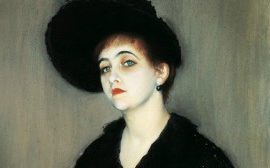
Nadezhda von Meck
Tchaikovsky, of course, would come to eat his own words when he sat down - only one year later - to begin sketching the outline for his breathtaking Piano trio in A minor, which would hold it’s public premiere just shy of two years following the composers' outright refusal to ever pen such a work at the Russian Musical Society at Moscow in October of 1882.

Further correspondence preserved by biographers and scholars of this most influential composer would showcase a gradual yielding to the formation of violin, cello and piano into a seamless whole – perhaps in an effort to appease his beloved Nadezhda, who would go on to support the composer in good times and bad – including during the fallout from Tchaikovsky’s disastrous marriage to his former pupil Antonina Miliukova in 1877, for a period of some thirteen years.

Certainly, Tchaikovsky owed much of his success to the musical savant von Meck, who had supplied the composer with an annual salary in the staggering amount of 6000 rubles - more than enough for Tchaikovsky to dedicate his attentions to composing music full-time.

Whatever Tchaikovsky’s motivation for constructing the work, the Piano Trio in A minor would prove to both speculative composer and admirer alike of the Russian musician's prowess in the arena.

Listen below to the highly emotive “Pezzo Elegiaco,” the 1st movement of Tchaikovsky’s 50th opus, his Piano Trio in A minor, in a powerful rendition of the piece by violinist Susanna Yoko Henkel, Monika Leskovar, cello; and Ian Fountain on piano (separated into two parts):


-Rose.

Sunday, 5 May 2019

TCHAIKOVSKY'S ENTIRE OEUVRE NOW AVAILABLE ONLINE AS COMPLETE WORKS ARE DIGITIZED feat. Did You Know?

Tchaikovsky's entire oeuvre has been digitized. Access the archive here.
Add the iconic Russian composer Pyotr Ilych Tchaikovsky to the growing list of composers who joined the digital age long after death.

Representatives of the Pyotr Tchaikovsky International Charitable Foundation and Muzyka Publishing House recently announced the digitization of the complete works of the 19th century romantic icon, which are presently available in the composers' native tongue on the Foundation's website - a version in English is set to follow later this year.

The virtual treasure trove of scores are derived from both scholar and composer submissions which had been entered into a 63 "fundamental edition" volumes published by the Muzyka Publishing House over some five decades, beginning in 1940 and concluding in 1990.

The digitization process was both a massive and laborious undertaking – over the span of “several years” experts scoured over each and every one of the 63 volumes of collected works for any errant inaccuracies, and, where necessary, restored and cited their corrections.

Speaking through the organization's press service, Foundation President and General Director of Muzyka publishing Mark Zilberkvit referred to the project as one which bears a “significance of which [it] is difficult to overestimate.” “It is important,” he continued, “that the complete works appear in the public domain. Now all professionals and amateurs can access the music."

The archive may be accessed here.

Listen below to the Münchner Philharmonie perform the gorgeous andante cantabile of Tchaikovsky's 5th Symphony (op. 64 in E minor) conducted by maestro Celibidache (movement 2 begins at 18:42):


Did You Know?


Pyotr's younger brother
Modest provided a source
of comfort for the often
melancholic composer to
air his grievances.
As undeniably stunning as Tchaikovsky's 5th is, the composer had not thought of commencing work on writing a new symphony until the spring of 1888, some ten years following a period of apathetic self-doubt following the disastrous 1878 premiere of his 4th symphony, which had been widely critically panned.

Pyotr first made mention of his intention in letters to his brother Modest and benefactress/confidante Nadezhda von Meck to spend the spring and summer months of 1888 composing at Frolovskoye, just outside of Kiln. A sense of personal vacillation during this process had not evaded him, and was clearly evident in his correspondence to Modest and Frau von Meck, in which the composer flip-flopped between perspectives, both pessimistic and optimistic.

On the 27th May 1888, he wrote to his younger brother:


“[it's now] mid/late May, [yet] I've still not yet made a start, because I've been working on various proofs. But I can honestly say that the urge to create has deserted me. What does this mean? Am I really written out? I've no ideas or inspiration whatsoever!"

This was followed three days later with a soupçon more hope: 


"Now I am gradually, and with some difficulty, squeezing a symphony out of my dulled brain." 

By the 22nd of June, Pyotr would lament in an exchange with the patroness von Meck that inspiration” had “deserted [him] completely."

After toiling for some three months, Tchaikovsky had at last found himself humbled by his work, telling the benefactress: 


“Now, as the symphony nears its end, I can view it objectively, and at the culmination of the work I must say that, thank God, it is no worse than my previous ones. This accomplishment means a great deal to me!!"  

Pyotr even went so far as to later proclaim 

“My symphony is ready, and I think that I have not miscalculated, that it has turned out well."

Critical feedback for Tchaikovsky's 5th was swift, and very much mixed: whilst praised by those in the composer's inner circle following the Moscow premiere in December 1888 (which the composer himself conducted – the first orchestral performance having been held in St. Petersburg one month prior) as possibly his “best work," the demand for the symphony was wholly underwhelming back in St. Petersburg and in Prague, where a mere three performances were held (twice in the Russian Imperial capital and only once in the Czech republic) prompting Tchaikovsky to lament his misfortune in a letter of characteristic self loathing to von Meck:


"With each day that passes I am increasingly certain that my last symphony is not a successful work, and the realisation that it is unsuccessful (or perhaps that my powers are declining) is very distressing to me. The symphony is too colourful, massive, insincere, drawn out and on the whole very unsympathetic... Am I indeed, as they say, written out?... If so, then this is terrible. Whether my misgivings are mistaken or not, regrettably I have concluded that the symphony written in 1888 is poorer than the one written in 1877."


It would take a successful performance in Hamburg in March of 1889 to sate Tchaikovsky's doubts as to his compositional ability (and of his reservations regarding beauty of the 5th itself.) He quietly raved over the concert in exchanges with both Modest and his trusted nephew, Vladimir Daydov:


"The musicians took to the music more and more each time the symphony was played. At rehearsals there was general enthusiasm, flourishes, etc. The concert also went excellently. As a result, I no longer have a bad opinion of the symphony, and like it once more... The Fifth Symphony was again performed magnificently, and I have started to love it again; my earlier judgement was undeservedly harsh..." 


Theodore Avé-Lallemant
Perhaps aiding in Tchaikovsky's change in perception lay in the encouragement of the works' dedicatee - Pyotr dedicated his 5th to Theodore Avé-Lallemant, then Chief Director of the Philharmonic Society, of whose acquaintance the composer first made shortly after his arrival in Hamburg in January 1888, where the composer was scheduled to conduct a concert of his own music at the Philharmonie (the program included his Serenade for String Orchestra, the Piano Concerto No. 1 and the Theme and Variations from Suite No. 3.) Herr Avé-Lallemant, who was known for his criticism of much of Tchaikovsky's oeuvre, was nevertheless so bowled over by Tchaikovsky's potential (as a potential future "German" composer), that he made arrangements for a private meeting with Pyotr two days following the performance, to be held in his home, where he surprised Tchaikovsky with a request that the composer emigrate to the country.

Writing in his memoirs, Tchaikovsky recalled the moment he received the unexpected request:


"First of all I should mention the chief director of the Philharmonic Society, the aged Herr Avé-Lallemant. This most venerable old man of over eighty paid me great attention and treated me with paternal affection. In spite of his age and frailness, as well as the long distance from his house, he attended my two rehearsals, the concert, and even Dr Bernuth's reception [after the concert]. In his extraordinary kindness he went so far as to request some photographs of me, which were to be taken by the best photographer in Hamburg. He even called on me to ask about this and arranged an appointment when I could pose for the photographer, as well as deciding on my behalf what size and format the photographs should be produced in. When I then visited this kindly old gentleman, who passionately loves music and who, as should be obvious to the reader, is quite free from that aversion which many old people have against everything that has been written in recent times, I had a very lengthy and interesting conversation with him.

Herr Avé-Lallemant openly confessed that there was a lot in those works of mine which had been performed in Hamburg that wasn't to his liking; that he could not stand my noisy instrumentation; that he hated some of the orchestral effects which I resorted to (especially with regard to the percussion), but that all the same he saw in me the makings of a good, truly German composer. Almost with tears in his eyes he exhorted me to leave Russia and to settle permanently in Germany, where the classical traditions and the general atmosphere of a higher culture would not fail to correct me and rid me of those deficiencies which he felt were easily accountable by the fact that I was born and grew up in a country which was still so unenlightened and backward when compared to Germany as regards progress.

Evidently, Herr Avé-Lallemant harbours a deep prejudice against Russia, and I tried as far as I could to mitigate his hostile feelings towards our country, which, incidentally, this venerable Russophobe did not actually express openly, but merely allowed to shine through in his words. We parted as great friends."

Unfortunately for Tchaikovsky, the warm reception awarded the composer following the performance at the Hamburg Philharmonie in March the following year (which the composer himself also conducted) went un-witnessed by the director, who had taken ill and was thus unable to attend the concert.

-Rose.

Tuesday, 31 May 2016

QUOTE OF THE DAY: MAY 31, 2016: TCHAIKOVSKY AND THE POWER OF MUSIC

Today's Quote of the Day comes from the preserved collection of private correspondence between 19th century Russian composer Pyotr Ilych Tchaikovsky and his patron and intimate confidante, the wealthy benefactress Nadezhda von Meck.

The following quote is just one of many exquisitely rendered exchanges between composer and patron, and is paraphrased from a modern translation of a biography on Tchaikovsky originally published at the dawn of the twentieth century, as penned by the musician's brother Modeste.*


"Your [music] is so wonderful, Peter Ilich, that it throws me as I hoped into a state of blissful madness; a condition in which one loses consciousness of all that is bitter and offensive in life.... Listening to such music, I seem to soar above all earthly thoughts, my temples throb, my heart beats wildly, a mist swims before my eyes and my ears drink in the enchantment of the music. I feel that all is well with me, and I do not want to be reawakened..."


The title "The Life and Letters of Peter Ilich Tchaikovsky" will be coming soon to unravelingmusicalmyths Book Reviews, alongside several other highly erudite and immensely enjoyable reads.

*Note: quote does not refer to the hymn below, but rather to a march by Tchaikovsky. I am featuring below the
composers' setting of Hymn of the Cherubim as today's feature sacred piece as it - at least to my taste - best
suits the sentiment von Meck so eloquently conveyed in her correspondence with the composer. Performed
by the USSR Ministry Of Culture Chamber Choir:


"Ah, God, how great is the man who has power to give others such moments of bliss!"
- Nadezhda von Meck.


-Rose.

Friday, 29 June 2018

RECENTLY REDISCOVERED DEBUSSY SCORE “HYMNIS” GIVEN SNEAK PREVIEW PERFORMANCE BY AUCTION HOUSE CHRISTIE’S IN PARIS

A young Claude Debussy, as he would have appeared around the
time he is believed to have scored Hymnis.
It was back in November 2017 that appraisers at the Livres rares at Manuscrits at Christie’s auction house in Paris were first presented with the treasure of a long lost, unpublished score by Claude Debussy, “Hymnis,” written sometime in 1881/82 for a play by the same name by the French symbolist poet Théodore de Banville.

The “astonished” staff, along with scores of fans of the late French romantic composer had all but given up hope on ever laying eyes on the manuscript again after it seemingly vanished following a sale at auction in 1926.

Speaking with Christie’s appraisers last month, Parisian specialist Andre Legendre reflected on the excited atmosphere experienced by the French department late last year:

“When we saw it and looked through the 28 pages, we were absolutely astonished..[it is] a piece of his youth, from which we already see the genius he will become.”
The new manuscript contains 15 pages of previously unknown music, and would mark the second time Debussy would collaborate on a play written by Banville (there was Florise in c1882, followed the same year by Hymnis, and Diane au Bois in 1883).

During the time frame Hymnis is believed to have been written, Debussy would score no less than 12 of Banville’s poems, each time dedicating the music to his lover, the amateur soprano Marie Vasnier. Hymnis is no exception – an indiscreet marginalia on the cover page of the manuscript reads "à Madame Vasnier.”

Debussy's inamorata, inspiration, and to whom the score of Hymnis
is dedicated, Marie-Blanche Vasnier.
The Debussy-Vasnier affair proved to be something of a tragic May-December romance: he, still in the flower of his youth – only 18 when he met his future amoureuse (he played pianist to her vocal lessons) – she, some 14 years his senior, and married, to boot. The contentious relationship would fizzle nearly a decade later, but while it lasted, the union was often fraught with jealousy: Debussy, over his ladylove’s avowed, and Mme. Vasnier over her young stud’s frequent travels with wealthy Russian benefactress and famed patroness of the arts, Nadezhda von Meck (the very same wealthy businesswoman who infamously provided Pyotr Ilych Tchaikovsky with written companionship and intimate friendship for some 13 years).

Leading Debussy scholars look to Hymnis as evidence of the torrid affair having been used as a source of inspiration for the music: the composer, for reasons unstated in his memoirs, opted to score only a portion of the comédie lyrique. Prior to this recent discovery, the only known musical setting of the work came from two sources

(from Christie’s:)

“...one for the Strophes of the first scene (‘Il dort encore, une main sur la lyre’ in the Martin Bodmer collection), the other from the beginning of scene 7, the Ode bachique (‘À toi Lyaeos’, formerly in the Toscanini Collection, sold at Sotheby's, 26 May 1983, lot 17, £14,000).
cover page with dedication to Mme. Vasnier.
High resolution available
at Christie's
The present manuscript, untraced since it was sold at auction on 1 June 1926, has never been described in any of the catalogues devoted to Debussy. It is meticulously notated in brown ink and comprises, with new variants, the Strophes of scene 1 and the Ode Bachique, whilst also including three previously unknown sections:

- The duo for Anacreon and Hymnis in scene 1 (‘Sous nos pas le ciel a mis’), pp. 7-8.
- The song of Anacreon in scene 2 (‘Quand par un jour de soleil’), pp. 9-11, lacking the end of the fourth stanza and the fifth stanza.
- The final trio of scene 7 (‘Ah! nous sommes bénis‘), pp. 23-31.”

excerpt. High resolution available at Christie's

The manuscript is a fair copy, believed to have been destined for the hands of Mme. Vasnier.
It is written in brown ink and appeared in the Christie’s catalogue under lot 13 and sold last month at auction for €112, 500, under it’s estimated hammer price of €120,00 -180, 000.

Just prior to the listing going live on the Christie’s website, the auction house arranged for a performance of the rediscovered work which it included (in truncated form) on a video uploaded to the site - no doubt geared toward highlighting for prospective buyers the exquisite beauty and historical significance of the recent find. It can be heard below (external link, opens in new window).

 Christie's
-Rose.

Sunday, 20 March 2016

QUOTE OF THE DAY

Pyotr Ilyich Tchaikovsky
“You ask me, my friend, if I have known love other than platonic. Yes and no. If the question had been differently put, if you had asked me whether I had ever found complete happiness in love, I should have replied no, and again, no. Besides, I think the answer to this question is to be heard in my music. If, however, you ask me whether I have felt the whole power and inexpressible stress of love, I must reply yes, yes, yes; for often and often have I striven to render in music all the anguish and the bliss of love. Whether I have been successful I do not know, or rather I leave others to judge. I do not in the least agree with you that music cannot interpret the universal nature of love. On the contrary, I think only music is capable of doing so. You say words are necessary. O no! This is just where words are not needed, and where they have no power; a more eloquent language comes in, which is music."
-Pyotr Ilyich Tchaikovsky, in a letter to his beloved patron and friend, Nadezhda von Meck; Florence, 1878 


-Rose.

Tuesday, 20 December 2016

TODAY IN CLASSICAL MUSIC HISTORY / NOTABLE LETTERS – MOZART’S DON GIOVANNI RECEIVES PREMIERE IN BERLIN, IS RIGHTEOUSLY PANNED BY THE CRITICAL PRESS, PREDICTED TO FADE INTO OBSCURITY

Portrait of Mozart (debated) c. 1790
It was on this December day in 1790 at Berlin’s Theater an der Wien that Mozart’s 19th opera, Don Giovanni made its premiere in the German capital (the opera’s world premiere having been held in Prague at the Teatro di Praga in October of 1787) to unanimously tepid reviews.  The Journal of Fashion called it “too artificial…overloaded with instruments” - a sentiment that seemed to make the rounds among the critical press: the Monthly Musical Journal expressed disbelief at the backlash Herr Mozart received for the performance – a very rare occurrence indeed for the composer - yet does nothing to repudiate it, simply claiming  

“until now I have not heard him considered by any thorough musician as a correct, less a perfect artist, and still less with regard to poetry, as a correct and fine composer…”

No review, however, was quite as scathing as the following critique, which not only lambasts Don Giovanni, but predicts a life spent in obscurity and a legacy ultimately left unrealized by its composer (extracted from a local newspaper in 1790 Berlin):

“If ever an opera was anxiously expected, if ever there was a work by Mozart raised to the skies before it’s performance, it was this ‘Don Juan.’ The composer must not speak to us by overloading the instruments, but with heart-feelings and passions; then he writes grandly, then his name will go down to future generations, and a perennial laurel will blossom for him in the Temple of Immortality…”

Strange commentary, indeed: Mozart’s Don Giovanni is today, far from an obscure work, proudly boasting a status as one of the top ten most frequently performed (and beloved) operas in theaters across the globe. It’s composer has long been considered one of - if not the - most influential and leading masters of Western Classical Music – an accolade that sees no hint of contest anytime in the foreseeable future.

From both a contemporary and industry standpoint, several major composers, from Franz Liszt and Frédéric Chopin to Herrs Beethoven and Offenbach - even Rossini - have borrowed music from the opera and/or made arrangements for it – Gounod called it a opera that "stands highest among all classic works;" Tchaikovsky famously praised both the opera and its composer in a privately written exchange with his confidante and benefactress Nadezhda von Meck in which he states


“I not only like Mozart, I worship him… I am quite incapable of describing to you what I felt on hearing Don Giovanni… nothing in opera has impressed me so deeply... I could cry out and weep from the overpowering strain on the emotions… I love the music of Don Giovanni so much that even as I write you, I could shed tears of agitation and emotion... Mozart is responsible for my having dedicated my life to music... how could I not want my dear, best, incomparable friend to worship the one I worship over all musicians? How could I not try to make you feel moved and carried away by that music which makes me tremble with indescribable bliss?”

Praise for Don Giovanni wasn’t limited only to Herr Mozart’s musical peers – many icons of literary intelligentsia would praise the opera, from the Danish philosopher Søren Kierkegaard, who writes (through a character in his novel Enten-Eller) that Don Giovanni is "a work without blemish, of uninterrupted perfection;" Gustave Flaubert called Don Giovanni one of the “finest things God has ever made” Whilst E.T.A Hoffman and George Bernard Shaw included scenes from the opera in their published works. Praise for the opera at it’s October 27 premiere in Prague in 1787 was swiftly lauded on the work and it’s composer, with one periodical claiming "Connoisseurs and musicians say that Prague has never heard the like…" - yet Don Giovanni’s disastrous premiere in Berlin and later in Milan (where it was received with a round of audience hissing) present an entirely different critical perspective. So what happened? What lessons, if any, are we to draw from such polar opposite viewpoints?

Contemporary poster for Mozart's Don Giovanni
I would posit that it was the challenging of classical music’s rigid rules in Berlin and in Italy by Herr Mozart that led to such criticism: the presentation of something new - setting sail upon formerly uncharted waters – combined with the composers' perceived placement on opera's royal throne – situated at the top of a finely gilded musical pedestal – that ultimately led to Don Giovanni's demise in the German capital.

A pack mentality – and Mozart’s own crushing celebrity combined with the over-saturation of the composer in local periodicals, I believe, played a large role in the attempt to dethrone the King of Opera. This destructive formula is nothing new. It persists even to this day, living on in full force in all genres of music and even stage. We recognize this trend most noticeably when a modern-day icon of music or screen dies – the previously ignored composer or actor is suddenly exalted to heroic status – his or her works and performances given new life - tagged with the sobriquet of perfectionism. We see it in the start-up soprano or tenor – whose physical appearance is given more importance than ever before required to help “sell” an opera’s romantic or tragic story – almost all of whom are roundly chastised by armchair critics, loathsome of the up-and-comer with the “full package”...beloved only when the popular perception of sex appeal is lost – when the artist ages, or puts on weight. Like Herr Mozart, they too are panned by their musical peers – in lieu of hopes for immortality, given a death sentence instead.

If we are to extract any lessons from the (now comical) crude “predictions” of the late 18th century Berlin press, it is this - draw your own conclusions. Listen to and enjoy thoroughly the music that moves you.

And, most importantly:

pay no attention to the critics. 


Enjoy below one of my favorite arias from Don Giovanni – Zerlina’s “Vedrai Carino” sung here by Slovak soprano Lucia Popp:


-Rose.